Details of Negotiations Not Disclosed...
"National Interest at Stake," Cautious Approach
Skilled Worker Visa Issue Also Discussed...
"Prompt Resolution Requested"
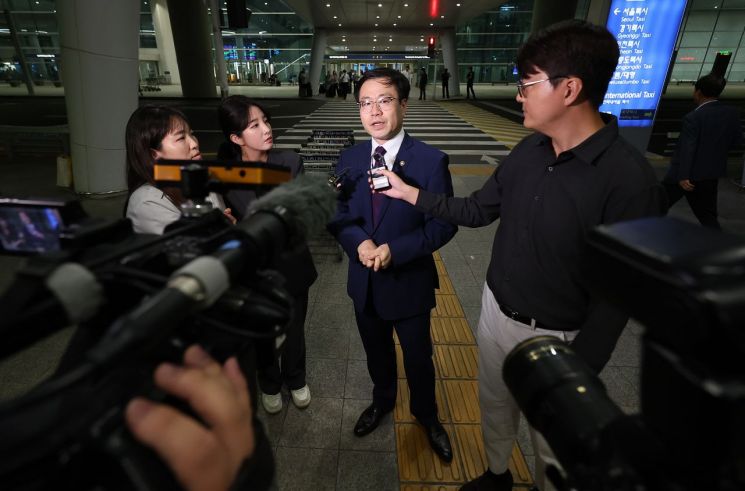
Yeo Han-koo, head of trade negotiations at the Ministry of Trade, Industry and Energy, returned to Korea in the early morning of September 19 after concluding discussions with the United States on tariffs and visa issues. Upon his arrival, he told reporters that he repeatedly emphasized the differences between Korea and Japan and conducted intensive negotiations with the U.S. side. He also indicated that, as Japan has already secured tariff reduction benefits first-resulting in a reversal of auto tariffs between the two countries-Korea will make every effort to secure the same level of benefits as soon as possible.
Previously, Yeo departed on September 15 and held a series of meetings in Washington with Jamieson Greer, a representative of the United States Trade Representative (USTR), as well as key members of Congress. This visit was arranged as a follow-up to coordinate measures to minimize the burden on Korean companies, after the U.S. proposed tariff reductions in exchange for participation in investments and guarantees worth 350 billion dollars.
In particular, the fact that Japan concluded negotiations and signed an agreement to lower tariffs to 15 percent-while Korea continues to face a 25 percent high tariff on major export items such as automobiles, batteries, and steel-has placed significant pressure on Korea.
Yeo stated, "Korea's industrial structure and trade circumstances are different from those of Japan," adding, "I made it clear that Korea should not be treated simply as the same model as Japan." He continued, "We are making every possible effort to ensure that Korea, too, can benefit from the 15 percent tariff as soon as possible."
Visa issues were also a key agenda item during these negotiations. Recently, restrictions on skilled worker visa issuance in Georgia, United States, have led to large-scale crackdowns involving Korean company employees, causing considerable disruption at industrial sites. Yeo said, "I strongly requested a prompt resolution, and confirmed that the U.S. side recognizes the seriousness of the issue."
The U.S. side reportedly stated it would review Korea's requests. However, as no concrete solutions or deadlines have been presented, it appears that negotiations between Korea and the U.S. will continue for the time being.
Yeo refrained from sharing details of the negotiation results. He explained, "As this is a matter directly related to national interests, it is difficult to disclose specifics," but added, "Negotiations are ongoing, and the government is responding closely at all levels." In fact, there is an assessment that these negotiations require a strategic approach, as they may expand beyond simple tariff adjustments to include future investment scale, technological cooperation, and supply chain linkages.
The automobile industry is most concerned about the widening gap with Japan. If Japanese vehicles face less tariff burden in the U.S. market, their price competitiveness will increase, while Korean vehicles, still subject to a 25 percent tariff, will inevitably face pressure on market share. An industry official said, "Japan already holds an advantage in local production and parts supply chains, and with the addition of tariff benefits, the gap could widen further. The government must conclude negotiations as quickly as possible."
The steel and battery industries are facing similar challenges. In particular, the battery sector, which is actively investing in the U.S., is experiencing a "double burden" as both tariff and visa issues have emerged simultaneously.
Some observers believe that these negotiations are more likely to develop into mid- to long-term discussions rather than reaching a quick conclusion. This is because the reciprocity-based tariff model set by the U.S. for its allies is not just about adjusting tariff rates, but requires a comprehensive "package deal" involving investment, employment, and technological cooperation. Yeo's emphasis on Korea's unique circumstances, rather than a simple comparison with Japan, is interpreted in this context.
© The Asia Business Daily(www.asiae.co.kr). All rights reserved.
![User Who Sold Erroneously Deposited Bitcoins to Repay Debt and Fund Entertainment... What Did the Supreme Court Decide in 2021? [Legal Issue Check]](https://cwcontent.asiae.co.kr/asiaresize/183/2026020910431234020_1770601391.png)















