U.S. Considers Strict Restrictions on Pharmaceutical Approvals and Trade
China Shortens Innovative Drug Approval Process to 30 Days
The power struggle between the United States and China over the pharmaceutical and biotech industries is intensifying in earnest. As the United States considers strengthening sanctions and regulations on Chinese pharmaceuticals, China has responded by drastically shortening the clinical approval process for innovative new drugs.
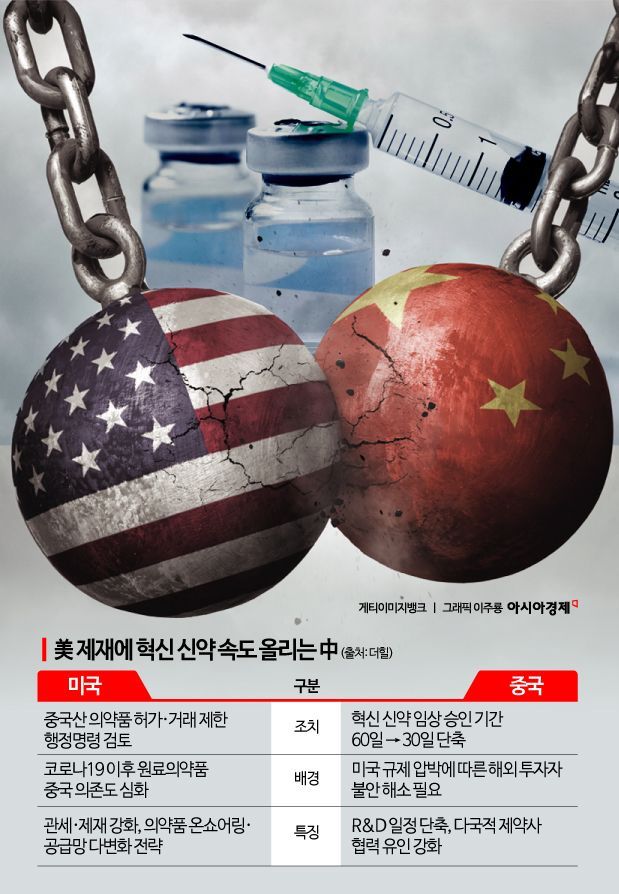
According to industry sources on September 19, the National Medical Products Administration (NMPA) of China recently announced that it will reduce the review and approval period for clinical trial applications of innovative pharmaceuticals from the current 60 days to 30 days. This "fast-track" policy will apply to Category 1 innovative new drugs, including chemical drugs, biological products, and traditional Chinese medicines. The Chinese government stated, "We will support the development of innovative pharmaceuticals by enhancing the quality and efficiency of clinical research."
This measure is not merely about streamlining administrative procedures. Given that new drug development typically follows the "10-10-10 rule"-an average of 10 years, 1 billion dollars (approximately 1.3885 trillion won), and a 10% success rate-speed is directly linked to corporate competitiveness in the pharmaceutical and biotech industries. The Bioeconomy Research Center at the Korea Biotechnology Industry Organization explained, "Faster regulatory review increases China's appeal in the global R&D network," adding, "It can promote early-stage multinational collaboration and strengthen bargaining power in licensing and funding negotiations."
This policy was introduced following a series of U.S. measures to curb China's pharmaceutical and biotech industries during the Donald Trump administration. Recently, the U.S. government has been considering executive orders to impose strict restrictions on the approval and trade of Chinese pharmaceuticals. In addition, the United States is pushing for the re-enactment of a biosecurity law in the Senate, primarily aimed at curbing Chinese biotech firms, and is seeking measures at the government level to effectively block technology transfers and investments in Chinese drug candidates. Amid these developments, Bristol Myers Squibb (BMS) of the United States sold its 60% stake in the joint venture "Sino-American Shanghai Squibb Pharmaceuticals" (SASS), which is headquartered in China, signaling a gradual decoupling of the pharmaceutical supply chains between the U.S. and China.
Despite U.S. restrictions, China continues to achieve results in innovative drug development. According to China Industrial Securities, as of the end of August this year, Chinese companies had signed a total of 83 out-licensing agreements, a 57% increase compared to the same period last year. The total transaction amount also surged by 185% to 84.5 billion dollars (approximately 117.3282 trillion won). While there are concerns that U.S. sanctions could weaken China's bargaining power, the shortened approval process serves as a means to mitigate such uncertainties and support the expansion of overseas partnerships.
An industry insider in the pharmaceutical and biotech sector commented, "The confrontation between the two countries will impact global new drug approvals and the overall supply chain," adding, "As uncertainties between China and the United States grow, there could be increased global demand for partnerships with Korean companies that possess technological capabilities and a reliable regulatory environment. At the same time, if the power struggle between the two countries intensifies, Korean companies may also be forced to make strategic choices."
© The Asia Business Daily(www.asiae.co.kr). All rights reserved.

![Clutching a Stolen Dior Bag, Saying "I Hate Being Poor but Real"... The Grotesque Con of a "Human Knockoff" [Slate]](https://cwcontent.asiae.co.kr/asiaresize/183/2026021902243444107_1771435474.jpg)















