A new on-device technology has been developed that allows users to check their heart condition at home simply by lying down fully clothed. On-device technology refers to the capability of performing artificial intelligence (AI) computations directly on the device itself. By integrating this with heart monitoring, it is expected that people will be able to routinely check their heart health at home through remote healthcare, as well as expand into various bio-healthcare fields such as sleep and stress analysis, ultimately contributing to disease prevention and diagnosis for patients.
KAIST announced on September 19 that the research team led by Professor Kim Cheol from the Department of Bio and Brain Engineering has developed a "bed-type heart monitoring on-device system."
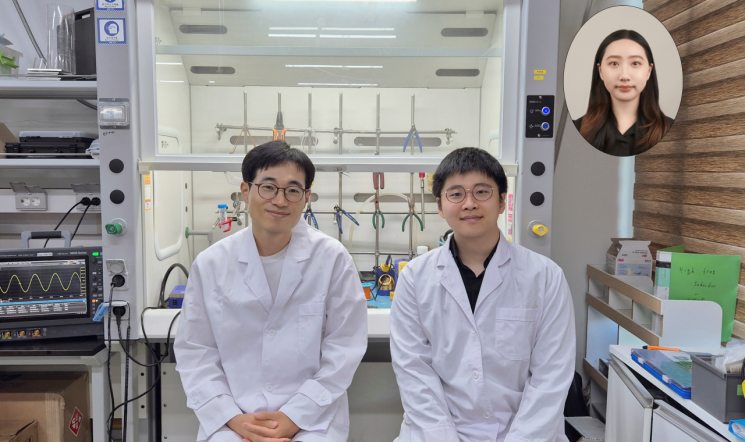 (From left) Professor Kim Cheol, PhD candidate Kim Minjae, Researcher Premlawit Thirawitchayangkun. Provided by KAIST
The research team fabricated a flexible substrate sensor that integrates electronic circuits and electrodes into a single unit to enhance precision. Through on-device signal processing, the system can perform real-time signal-to-noise separation, R-peak detection of heartbeats, and heart rate variability analysis, all within an integrated system.
This system addresses the inconvenience of traditional heart monitoring methods, which require patients to visit a hospital, lift or remove their clothing, and attach wet electrodes directly to the skin.
Most notably, the system enables long-term monitoring and everyday device use (such as checking electrocardiograms), while also overcoming the issue of external noise-a technical limitation common in contactless methods.
To achieve this, the research team incorporated a circuit (right leg drive circuit) into the bed-type heart monitoring on-device system, which actively shields against external noise and reliably captures subtle electrical changes in the human body.
Additionally, they implemented mathematical transformation techniques (wavelet transform) to extract only the most important parts of the heartbeat signal, and a peak detection algorithm to accurately identify the R-peak (the sharpest point in the electrocardiogram waveform), enabling precise, real-time signal analysis through on-device signal processing.
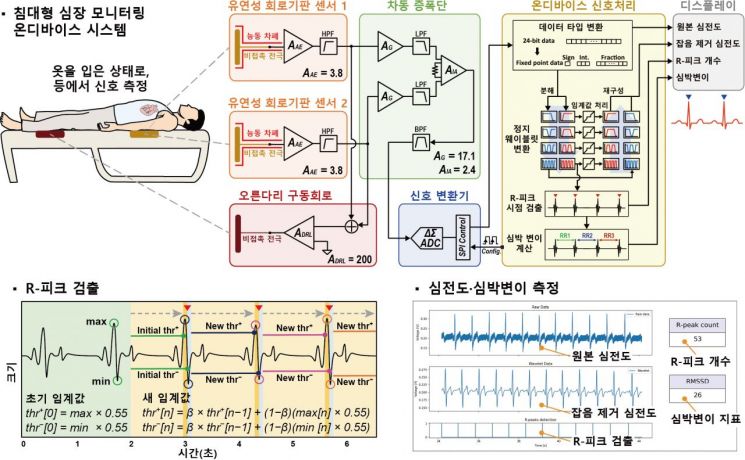 Overall architecture of the non-contact bed-type heart monitoring on-device system. Provided by KAIST
As a result, users can now obtain accurate electrocardiogram signal results simply by lying down on their back while fully clothed, according to the research team.
This research presents new possibilities for chronic cardiovascular disease management and elderly health support, as it can be easily used not only in hospitals but also at home.
Professor Kim stated, "The system developed by our team can extract real-time signals even in noisy environments, making it easy to monitor heart health in daily life. We expect that adding various biosignal measurement functions to this technology in the future will lay the foundation for comprehensive sleep health management."
This research was supported by the National Research Foundation of Korea's Basic Research Laboratory and Bio-Medical Technology Development Program, as well as the KAIST-Ceragem Future Healthcare Research Center.
PhD candidate Kim Minjae and researcher Premlawit Thirawitchayangkun participated as co-first authors in this study. The research results (paper) were recently published online in the international journal "Biosensors and Bioelectronics."
© The Asia Business Daily(www.asiae.co.kr). All rights reserved.


















