Ha Junkyung, Senior Secretary for Economic Growth, Gives First Media Interview
Excessive Private Debt to Be Addressed Through Productive Finance
On Rising Seoul Home Prices: "Measures for Han River Belt Are Ready"
Emphasizing 'No-Loophole' Real E
"We will redirect the flow of capital concentrated in real estate toward more productive uses, thereby alleviating economic imbalances and enhancing growth potential. Rather than allowing money to be funneled into rents, we aim to shift the flow toward more productive areas such as wages and profits."
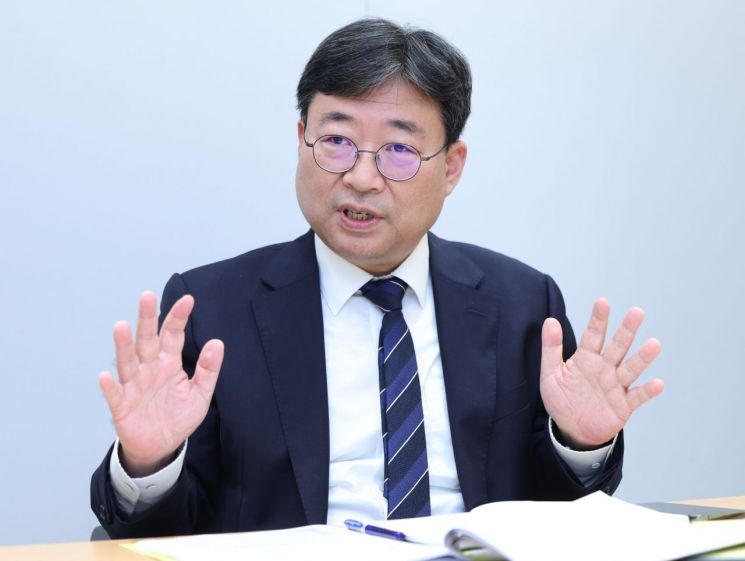 Ha Junkyung, Senior Secretary for Economic Growth at the Presidential Office, is giving an interview at the Presidential Office in Yongsan, Seoul, on the 18th. Photo by Presidential Office Press Corps
In an interview with Asia Economy at the Presidential Office in Yongsan on the 18th, Ha Junkyung, Senior Secretary for Economic Growth at the Presidential Office, stated that the administration will continue to introduce incentives to channel the excessive funds currently concentrated in real estate into high value-added, productive sectors. He believes that if capital moves into corporations and new growth industries, it will not only boost the potential growth rate but also increase jobs and help ease economic polarization. He further projected that, in the long run, this would naturally reduce the burden of private debt, which has risen to over 200% of GDP.
Regarding real estate measures, he explained that, in addition to the "June 27 Demand Measures" and "September 7 Supply Measures," all possible policies, including those utilizing the real estate tax system, have already been prepared. Ha emphasized that going forward, the administration will pay close attention to real estate finance and implement policies with no loopholes. Based on demand measures focused on real estate finance, the government plans to swiftly establish a "Real Estate Market Monitoring Organization" to root out market-disrupting activities, and also intends to introduce a "Regional Preferential Policy Package" to disperse the housing demand currently concentrated in the Seoul metropolitan area.
While this year's economic growth rate for Korea is expected to be around 0.9%, he projected that next year it will reach the mid-to-high 1% range. Regarding the ongoing follow-up negotiations on the Korea-US tariff agreement, which was reached on July 30, he refrained from making detailed comments, stating that all aspects-including foreign exchange market stability and side effects on the national economy-are being carefully considered. However, he did note that for companies suffering immediate losses due to excessive US tariffs, the government has prepared policy funding support, trade insurance (270 trillion won), specialized support for steel and aluminum derivatives (570 billion won), and export vouchers (420 billion won).
The following is a Q&A with Senior Secretary Ha.
Private debt stands at 207.4% of GDP (Bank of Korea, June 5). What are the causes of high private debt?
It is a structural issue. Since the 1997 foreign exchange crisis, polarization has intensified, and as the demand for corporate financing decreased due to the financial crisis, money flowed into real estate. At the same time, government policy has tended to avoid using fiscal resources-a kind of fiscal conservatism. If the government doesn't spend, the financial sector must, and since financial institutions prefer safe investments, they directed funds into real estate. It would have been better if the government had played a role in channeling funds productively and if there had been similar movements in the market, but significant imbalances have accumulated.
How will you manage this issue?
Solving this is the biggest challenge. Much has been said about productive finance, and these efforts are aimed at addressing the imbalance in debt. If more jobs are created and economic vitality is restored in productive sectors, polarization will also be alleviated. This could help mitigate the fundamental factors that have caused the imbalance. However, it is difficult for the government to manage the figures directly.
To what extent can the government handle national debt?
There is no theoretical limit. Comprehensive research shows that, compared to other countries, Korea still has fiscal capacity. The important thing is growth potential. We must not miss good opportunities simply because of a lack of funds. Currently, government spending can be effective. We cannot and do not intend to increase national debt without limit. The national debt ratio alone does not tell the whole story.
There is criticism that the June 27 real estate regulations have not curbed the rise in household loans over time.
There are concerns that things may become unstable again after a period of stability. Right now, the situation seems stable, with some minor fluctuations. In some areas, such as certain parts of the Han River Belt in Seoul, prices are rising. We are fully prepared with all necessary measures.
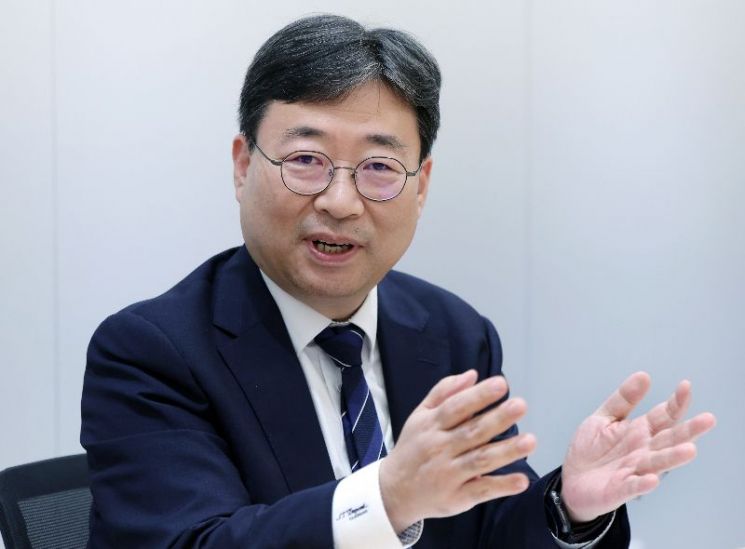 Ha Junkyung, Senior Secretary for Economic Growth at the Presidential Office, is giving an interview at the Presidential Office in Yongsan, Seoul, on the 18th. Photo by Presidential Office Photojournalists Team
How do this administration's real estate policies differ qualitatively from those of the past?
We will implement policies with no loopholes. In the past, household debt policies were approached from a financial perspective, and although they were managed, there were many gaps. For example, jeonse loans were excluded from regulations. This time, we are identifying all potential problem areas and addressing them thoroughly. Fundamentally, as long as housing demand in the Seoul metropolitan area continues to rise, there are limits to what can be done, so we are working to disperse this demand and are preparing a regional preferential policy package.
With jeonse prices rising, isn't reducing the jeonse refund loan limit to 100 million won likely to cause side effects?
Jeonse is essentially a form of private finance. I believe financial practices should align with market principles. Until now, loans have often been granted whenever requested, which was well-intentioned but has led to side effects, including abuse. When approaching household lending, it is best not to excessively distort the market. This adjustment should be seen as part of efforts to normalize the housing market and housing finance.
Given worsening investment indicators, do you think the Lee Jaemyung administration can achieve its promised growth target for this year?
The government currently expects 0.9%, and I think this is achievable if current trends continue. We are working to achieve even better results. Consumer sentiment is at its highest in seven to eight years. Although the construction industry is struggling, I believe it is in a recovery phase. Next year, growth is expected to exceed 1%.
Follow-up negotiations on Korea-US tariffs are at an impasse. Are there support measures for Korean companies that are suffering real losses?
We are increasing policy funding support and enabling companies to obtain low-interest loans. Trade insurance has been raised to a maximum of 270 trillion won. For steel and aluminum, there is specialized support of 570 billion won, and we have prepared 420 billion won in export vouchers. The details of support may change depending on how the negotiations proceed.
In the Korea-US tariff negotiations, are you leaving the door open for direct cash support? Are you considering other methods?
The agreement was reached on July 30. Since then, the foreign exchange market has shown different movements, suggesting that the negotiations are already affecting the market. Outbound investment to the US can be a source of instability for the foreign exchange market. It is difficult to say now how the negotiations will be fully concluded, but there is certainly potential for stress in the foreign exchange market. The US would not want instability in our foreign exchange market either.
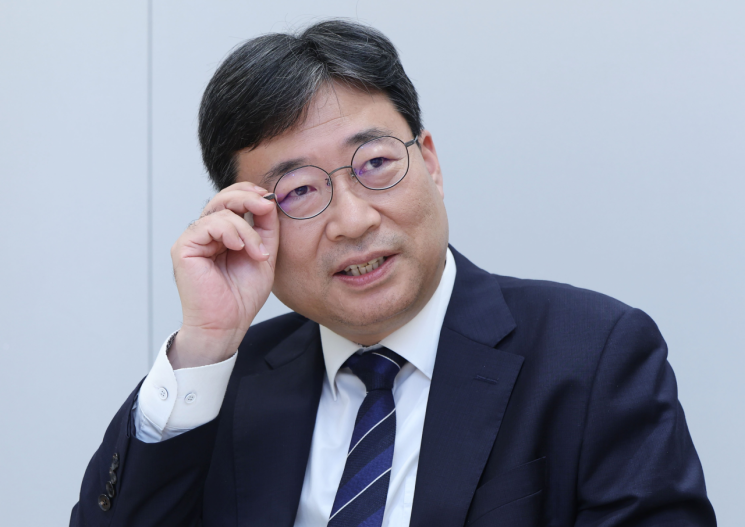 Ha Junkyung, Senior Secretary for Economic Growth at the Presidential Office, is giving an interview at the Presidential Office in Yongsan, Seoul, on the 18th. Photo by Presidential Office Press Corps
Please explain the launch timing and detailed operation of the 150 trillion won National Growth Fund, and how it differs from funds created by previous administrations.
The government will invest 75 trillion won, utilizing guaranteed bonds. The fund is scheduled to be launched on December 10. I expect full-scale investment to begin next year. We will identify investment projects and provide direct and indirect equity investments, infrastructure investment loans, and ultra-low interest loans. There are many projects that companies are unable to pursue due to risk, so the government will take the lead. For example, large-scale investments in artificial intelligence infrastructure are difficult for individual companies, so the government will spearhead these efforts. The key difference from previous funds is that this one is designed to provide stable and reasonable returns for the public.
Restructuring is underway in the petrochemical sector. Are there support measures to accelerate the process?
Industrial restructuring inherently involves conflicts of interest. In some cases, a "chicken game" occurs, which can be detrimental to all parties. Ultimately, everyone must make some concessions to survive together. The government can provide certain incentives during this process. Various discussions are ongoing. The industry is asking for solutions, and we have prepared support measures and have several tools at our disposal. However, it is not yet the right time to discuss the details.
President Lee Jaemyung has said, "It is desirable to write off overwhelming debt on humanitarian grounds." There are concerns about reverse discrimination against high-credit borrowers.
Finance is an industry licensed by the state, which is a significant privilege. There is a concern that such public resources should not be used for predatory lending. Policy finance develops because the government cannot provide welfare solely through fiscal means, so it is best to operate it in line with its intended purpose. Of course, the principle that those who faithfully repay their debts should be rewarded remains fundamental, and this is not about favoring those who deliberately default.
What do you think is the most pressing issue to solve?
Korea was once a model for growth, but as the country has shifted toward low growth, rent-seeking activities have increased. This includes real estate, middleman exploitation, illegal subcontracting, and other unfair practices. As growth slows, people are more tempted to bend the rules to make money. Many old systems, created during the era of rapid development, no longer fit current realities and now cause side effects. Sometimes, it is clear that these outdated systems are leading to undesirable outcomes.
© The Asia Business Daily(www.asiae.co.kr). All rights reserved.