Hosted by the Ministry of Health and Welfare: 2025 World Bio Summit
Closed Talent Structure Limits Growth
Need for Mega Fund Creation and Global Connectivity
There was a recommendation that, for Korea's bio clusters to grow to a global level, it is essential to secure talent and capital, as well as to pursue regulatory reform.
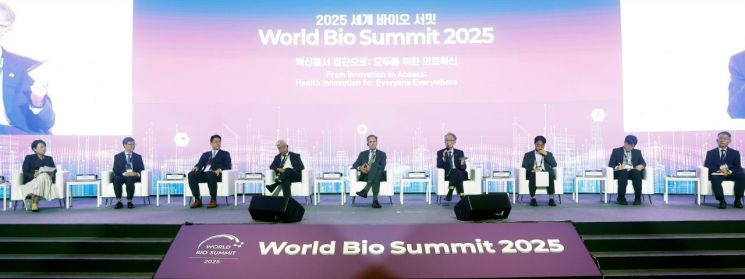 Panelists are engaged in a discussion on the theme of 'Regional Bio Clusters' during the third session of the 'World Bio Summit 2025,' jointly hosted by the Ministry of Health and Welfare and the World Health Organization (WHO) on the 17th at the Shilla Hotel in Jung-gu, Seoul. Ministry of Health and Welfare
The third session of the 'World Bio Summit 2025' (Bio Clusters: Innovation in Bio Ecosystems Beyond Regions and Borders), jointly hosted by the Ministry of Health and Welfare and the World Health Organization (WHO) on the 17th at the Shilla Hotel in Seoul, served as a venue to compare the cluster strategies of various countries and explore the direction Korea should take. Panelists unanimously emphasized the need to consolidate the dispersed capabilities of regional clusters and connect them to global networks.
"We Must Boldly Attract Foreign Talent"
The three key success strategies for bio clusters, commonly highlighted by the panelists, were: attracting talent without borders, securing capital to support growth, and pursuing regulatory innovation.
Steven Cho, former Executive Vice President of Novartis, pointed out, "The success of Western clusters lies in attracting the best researchers from around the world and integrating them into the ecosystem," adding, "It is difficult to find foreign researchers in Korea and Japan's bio clusters." He criticized the closed talent structure as a limitation to growth.
The secret to the success of Basel, Switzerland, was also in attracting talent. Paul Aeschmann, Head of International Market and Business at Basel Area Business & Innovation, cited the following as key factors in Basel's bio cluster success: a high quality of life that everyone wants, high wage levels, and an open, multicultural environment where more than one-third of the population speaks English. He stressed the importance of creating an 'attractive environment' that makes outstanding talent want to come and stay on their own.
Shin Kawamata, Professor at Kobe University, presented the Japanese case as a lesson. He said, "The government has invested huge budgets, but often failed to create 'self-sustaining effects,'" and emphasized, "To ensure sustainability, it is necessary to actively introduce private sector management, innovative manufacturing infrastructure, and technologies such as AI and automation." He also noted, "It is difficult to manage efficiently with only government officials," and suggested, "Private trading companies like Mitsui and Mitsubishi should open up global market connections, and Korea and Japan should establish a joint platform."
In Korea, there was growing concern about the concentration of talent in medical schools. Nam-Sik Han, Director of the AI Research Center at the Milner Therapeutics Institute, University of Cambridge, stressed, "We need to change the reality where excellent students are flocking only to medical schools," and added, "Success stories of star scientists and unicorn startups must accumulate so that the younger generation can venture into science and technology startups."
A National Bio Cluster Platform Is Needed
Experts widely agreed that attracting capital is also a key factor for the success of bio clusters. While Western clusters raise funds globally rather than being limited to domestic markets, it was diagnosed that Korea is still struggling to attract global investment. There was a suggestion that, beyond simple research and development support, the public and private sectors should collaborate to create 'mega funds' worth trillions of won and actively attract foreign investment.
Kim Juwon, Director of Talent Management at the Korea Institute of S&T Evaluation and Planning (KISTEP), stated, "World-class clusters like Boston and Basel were completed not just through government support, but by combining talent, capital, and international connections," diagnosing, "In Korea, 5,000 companies are scattered across 22 regional clusters in Osong, Daegu, Gyeonggi, and other areas, resulting in significant fragmentation and duplication."
He said, "The solution is differentiation through integration," and added, "We need integrated governance, private sector-led operations, and a national platform connecting domestic clusters." He continued, "Switzerland ranks first in global talent competitiveness, and Boston attracts the world's best graduates. Without investment in talent, the creation of mega funds, and global connections, Korea will also face limitations."
Cha Byungyeol, Director of the Biomedical Center at the Gimhae Biomedical Industry Promotion Agency, identified regulatory innovation as a key task for revitalizing regional clusters. He emphasized, "In 1977, when the Cambridge City Council in the United States approved recombinant DNA research, it laid the foundation for the growth of the Boston cluster," and added, "Bio is a regulated industry, so the 'gate' that opens up new research areas is regulation itself."
He continued, "In the case of Kobe, Japan, there was a model where regulatory research functions were established within the cluster, allowing for repeated and rapid institutional improvements," and suggested, "Korea should also introduce regulatory sandboxes in its areas of strength, such as CDMO (Contract Development and Manufacturing Organization), AI, and digital healthcare, to accelerate research and commercialization."
© The Asia Business Daily(www.asiae.co.kr). All rights reserved.












