Emphasizing National Interests in Korea-U.S. Tariff Negotiations
No Formal Agreement on Proposals Beyond Economic Capacity
Prime Minister Kim Minseok stated regarding tariff negotiations with the United States that "we are negotiating from the position that it is difficult to accept demands for unilateral sacrifices from Korea, in terms of our national interests."
On September 17, during a National Assembly session for government questioning in the economic sector, Prime Minister Kim responded to a question from Assemblyman Kwon Chilsung of the Democratic Party of Korea, who asked, "Is it true that the U.S. Secretary of Commerce is demanding that the United States decide on the investment destinations of a $350 billion fund (approximately 500 trillion won in Korean currency) created by Korea, that Korea bears the loss risk, and that 90% of the profits go to the U.S.?" Without confirming the specifics, Prime Minister Kim replied as above.
Regarding the response to U.S. demands, Prime Minister Kim said, "I understand that our negotiation team’s basic stance was to allocate $150 billion to the MASGA (Make American Shipbuilding Great Again) project, and $200 billion to sectors such as semiconductors and nuclear energy, which are strategic industries for us. While there are aspects that are burdensome for us in the short term, in the long run, it can be a win-win for both Korea and the United States and contribute to the long-term development of our economy, so it is difficult to evaluate the deal based solely on the amount."
He added, "If the investment is made through methods like currency swaps or bond issuance, the government’s actual burden can be significantly reduced. Furthermore, if it supports our companies entering the U.S. market, such concerns will be further alleviated."
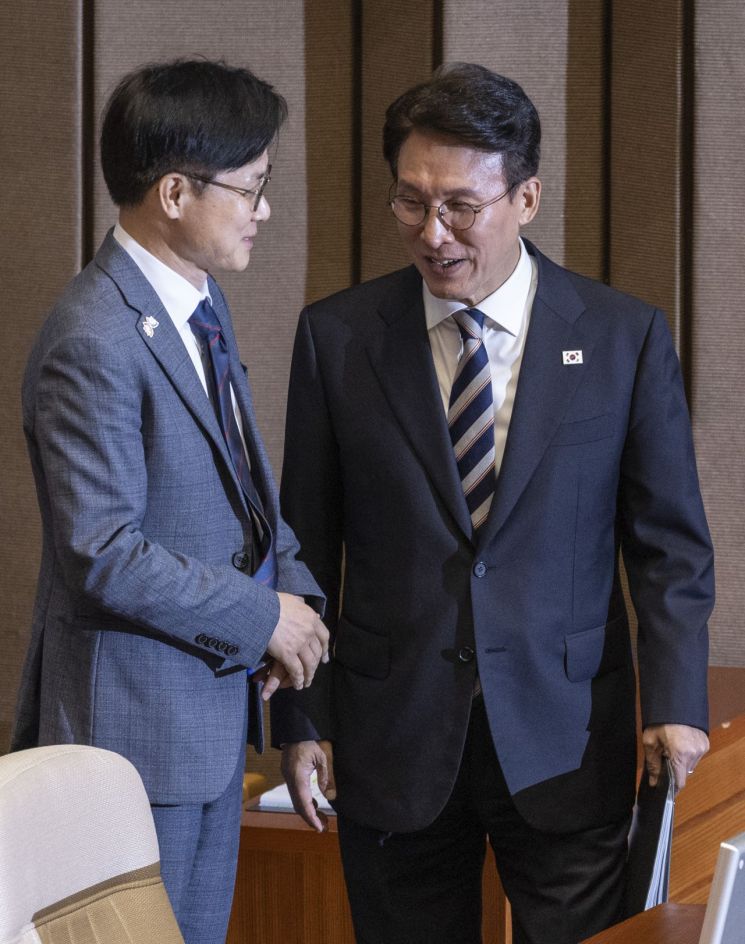
Regarding negotiation strategy, he said, "The fundamental premise is that we are not pressed for time. From the perspective of our economy’s capacity, we will not formalize in any form any aspects that we cannot handle. That is the basic principle."
On the disclosure of negotiation details with the United States, Prime Minister Kim said, "Even if a conclusion has not been reached, there may come a time when it is necessary to share and release information to the public, and I feel a sense of duty about this. However, at this stage, we are negotiating very detailed matters, so even if some information appears in the media, it is difficult to officially comment on it."
Lee Eonju: "U.S. Investment Should Transfer the Manufacturing Ecosystem"
Regarding the Korea-U.S. tariff negotiations, there was also a suggestion that Korea should emphasize its role in transferring technology and know-how to help rebuild the collapsed U.S. manufacturing ecosystem. Assemblywoman Lee Eonju of the Democratic Party explained, "Investment in the U.S. is not simply about corporate acquisitions through private equity funds or straightforward investments in the M&A market. In the United States, where the manufacturing base has collapsed, what we are doing is transplanting our manufacturing ecosystem, which is essentially transferring our technology and know-how." Minister of Trade, Industry and Energy Kim Jeonggwan commented, "U.S. Secretary of Commerce Howard Lutnick is gaining a deeper understanding of sectors such as shipbuilding and nuclear energy. Please be patient and watch the negotiation process unfold."
Meanwhile, Prime Minister Kim reiterated, as he did the previous day, that if the Korea-U.S. negotiations result in fiscal burdens, he could seek the consent of the National Assembly.
© The Asia Business Daily(www.asiae.co.kr). All rights reserved.
![Clutching a Stolen Dior Bag, Saying "I Hate Being Poor but Real"... The Grotesque Con of a "Human Knockoff" [Slate]](https://cwcontent.asiae.co.kr/asiaresize/183/2026021902243444107_1771435474.jpg)
















