Clear Evidence of Burning and Post-Mortem Smoking
Diverse Mummification Techniques Used Since Ancient Times
A new study has found that Asia preserved the dead as mummies thousands of years before Egypt did. This research is being recognized as evidence of the oldest mummies in human history. On September 15 (local time), an international research team from Australian National University, Peking University in China, and the University of Tokyo in Japan announced in the international academic journal Proceedings of the National Academy of Sciences (PNAS) that "in ancient Asia, as early as 14,000 years ago, bodies were mummified by removing moisture through exposure to smoke." The researchers emphasized the significance of discovering the oldest mummies in human history.
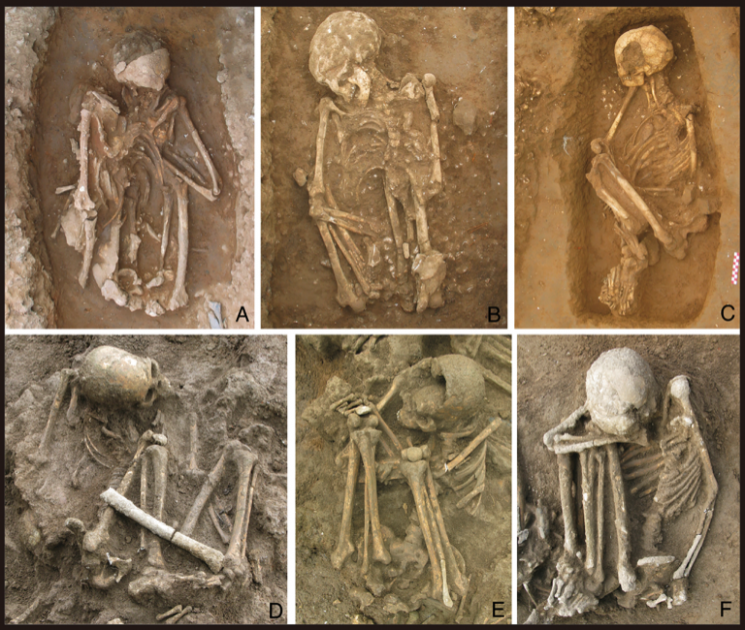 Professor Xiao Chunhong of Australian National University and the research team analyzed 54 skeletal remains discovered at 11 archaeological sites in southern China, northern Vietnam, and Sumatra Island in Indonesia from 2017 to 2025. All were in a seated position with legs bent and gathered together. Proceedings of the National Academy of Sciences (PNAS)
Professor Xiao Chunhong of Australian National University and his research team analyzed 54 skeletal remains discovered at 11 archaeological sites in southern China, northern Vietnam, and Sumatra Island in Indonesia from 2017 to 2025. All were found in a seated position with legs bent and gathered. Using specialized scientific equipment such as X-ray diffraction (XRD) and Fourier-transform infrared spectroscopy (FTIR), the team investigated the internal bone structure and chemical changes.
The analysis revealed that about 84% of the remains showed signs of being naturally dried and preserved after prolonged exposure to low heat. Some bones that had changed color were believed to have been smoked rather than burned directly by fire. Based on this evidence, the researchers explained that ancient Asians likely placed bodies in a crouched position over a fire and dried and preserved them for several months using low-temperature smoking, before finally placing them in pit houses or natural cave tombs.
Among the mummies discovered, the oldest remains were those of an adult male found in the Hang Muoi Cave in Hoa Binh Province, northern Vietnam. Radiocarbon dating indicated that he was buried between 14,027 and 13,798 years ago. This mummy had a skull shape similar to that of Australian-Papuan indigenous groups, and clear burn marks were observed on the right arm bone, indicating post-mortem treatment such as fumigation. A clavicle found at the same site was also confirmed to be about 14,000 years old.
Evidence of mummification by smoking bodies dating back 14,000 years
Humanity has long used various mummification techniques to prevent the decay of corpses by removing moisture, in many parts of the world. Common methods include heat, smoking, salt, freeze-drying, and embalming. Until now, the oldest known mummies were those of the Chinchorro culture in northern Chile, dating back about 7,000 years, and those of ancient Egypt, about 4,500 years ago.
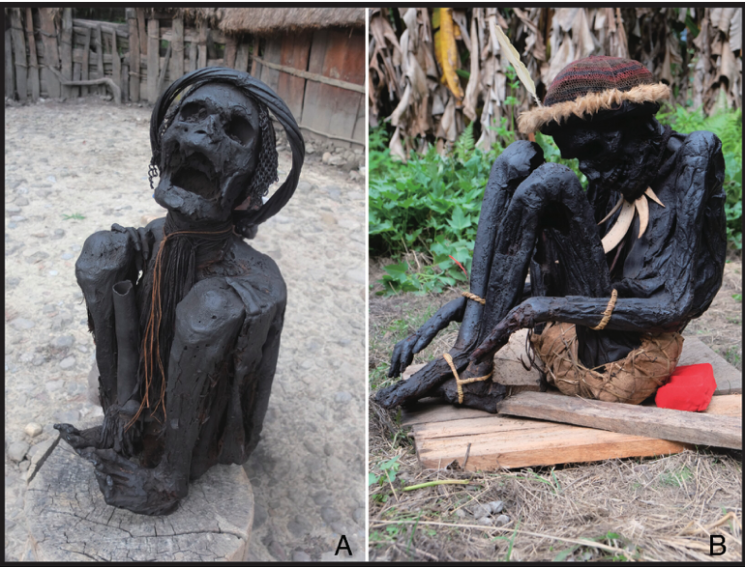 The funeral custom of creating mummies through smoking still exists today in Papua New Guinea. Researchers interpreted that drying the body with smoke to make mummies was likely the best option for preserving corpses in a humid environment. PNAS
This study demonstrates that funerary customs aimed at artificially preserving bodies have existed in both the East and West since ancient times. In particular, it is regarded as significant evidence of a mummification tradition that continued for over 10,000 years in Southeast Asia and southern China. Professor Hong, who led the research, stated, "This tradition reflects a deep human instinct that has persisted since ancient times," and added, "It shows the desire for families and loved ones to remain together forever, in some form."
The funerary custom of creating mummies through smoking is also found in Papua New Guinea. Dr. Hong said, "Surprisingly, this practice has continued across a vast region for an astonishing period, from the late Paleolithic era to the present day." The researchers interpreted that drying bodies with smoke to create mummies was likely the best option for preserving corpses in humid environments.
Emma Baysal, a professor at Bilkent University in Ankara, T?rkiye, commented, "This study is impressive in that it scientifically analyzed methods of body treatment, revealing funerary practices that are rarely seen today," adding, "It may also reflect the complex beliefs about the afterlife held at the time." The research team expects that further studies may uncover similar evidence of smoked mummification in other regions of Asia. These discoveries are likely to serve as important clues, showing that the funerary custom of preserving the dead has continued for thousands of years in human history.
© The Asia Business Daily(www.asiae.co.kr). All rights reserved.