Progress in U.S. Trade Talks with China and India
Besant: "Each Meeting Productive... China Also Sees Possibility of Agreement"
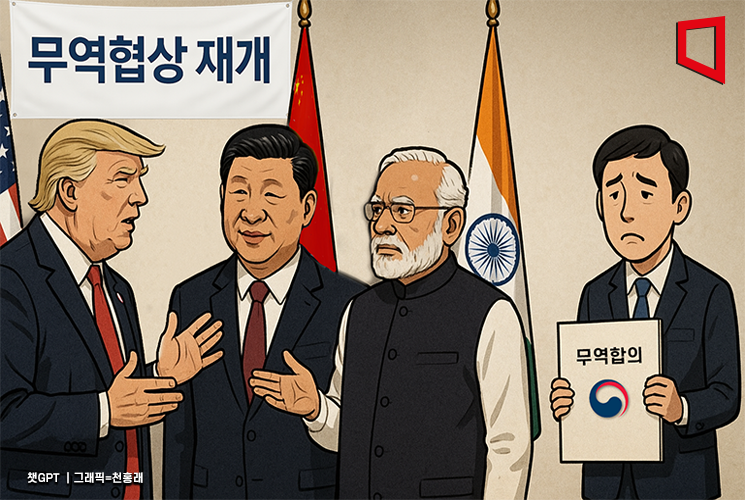
Trump Speaks with Prime Minister Modi as Trade Negotiations Resume
The administration of former U.S. President Donald Trump announced on September 16 (local time) that a trade agreement with China was imminent. After resuming trade negotiations with China just two months after imposing a super-high tariff of 50% on India, the pace of talks with China appears to be accelerating, coinciding with efforts to arrange a U.S.-China summit.
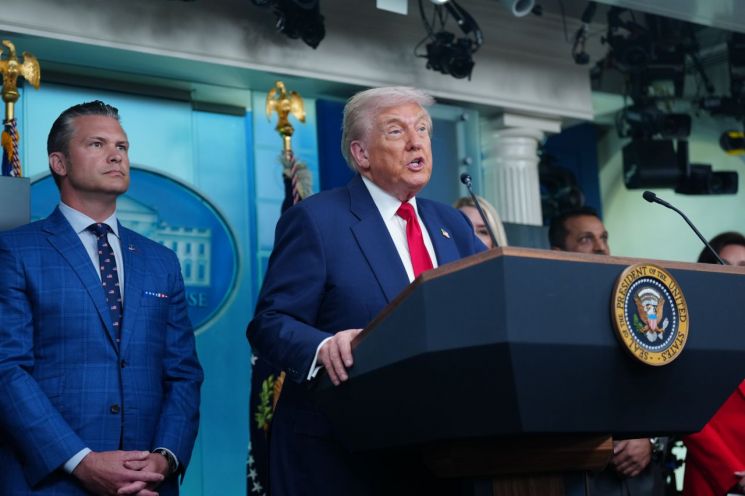
U.S. Treasury Secretary Scott Besant said in an interview with CNBC that "each round of talks is becoming increasingly productive, and it seems that China also believes a trade agreement is possible," adding, "We will meet again soon." He explained that additional negotiations would take place before the U.S.-China "tariff truce" expires in November.
The two countries reached a broad agreement on the sale of TikTok, a Chinese-owned video-sharing platform that had been a major sticking point, during the fourth round of high-level trade talks held in Madrid, Spain, on September 14-15. Secretary Besant also indicated that the two sides are not merely extending the tariff truce but are discussing actual tariff reductions. Previously, in April, the United States announced reciprocal tariffs on all its trading partners, imposing a combined super-high tariff of 145% on China-20% for fentanyl-related products and 125% in reciprocal tariffs. However, through subsequent high-level negotiations, the tariff rates were each reduced by 115 percentage points, and currently, the United States imposes a 30% tariff on Chinese goods, while China imposes a 10% tariff on U.S. goods.
Secretary Besant also mentioned that low-priced Chinese products are now entering countries other than the United States. He said, "Our trading partners are saying that Chinese products are flooding their markets, and they don't know how to respond," adding, "They are somewhat bewildered by this influx." This suggests that China is diverting its low-priced products to third countries to circumvent the high U.S. trade barriers.
He also explained that the U.S. trade deficit with China is shrinking. Secretary Besant stated, "U.S. Trade Representative Jamieson Greer expects the deficit to decrease by at least 30% this year and to fall even further in 2026," emphasizing, "The key is to achieve balance and fair trade." The U.S. trade deficit with China was $300 billion in 2024, but by July of this year, the cumulative deficit stood at $128 billion, indicating a significant annual decrease is expected.
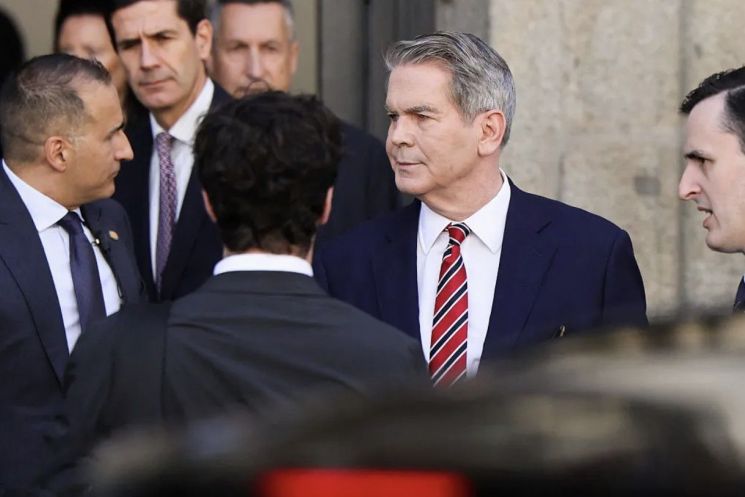
The United States and China held the fourth round of high-level trade talks in Madrid starting on September 14. The two sides reached a principled agreement on the sale of TikTok, and President Trump and Chinese President Xi Jinping are scheduled to hold a final agreement call on September 19. After the U.S. Congress passed the "TikTok Ban Act" in April last year, TikTok's parent company, ByteDance of China, faced the prospect of having to sell its U.S. business or face a service shutdown in the United States. While China had previously opposed the sale of TikTok, it is reported to have shifted its stance toward an agreement in order to facilitate President Trump's visit to China and a summit meeting. As a result, there is now a possibility that a trade agreement will be reached before a U.S.-China summit is held within the year. However, unresolved issues remain, such as the crackdown on the distribution of the opioid fentanyl and China's expansion of U.S. soybean imports, which could act as variables in the negotiations.
The United States has also entered a thaw in relations with India, with which it had been in conflict over tariffs. Currently, the United States imposes a total tariff of 50% on Indian imports-25% in reciprocal tariffs and an additional 25% on imports of Russian oil.
President Trump revealed on his own social networking service, Truth Social, that he had spoken with Indian Prime Minister Narendra Modi, stating, "I wished him a very happy birthday, and he is doing an incredible job," and "Thank you for your support for a ceasefire between Russia and Ukraine." As the U.S. and Indian delegations resumed trade talks in New Delhi on the same day and the two leaders also communicated, observers expect that the previously frozen relationship will thaw and that trade negotiations will accelerate further.
However, South Korea continues follow-up negotiations with the United States due to differences over specific issues, despite reaching a broad trade agreement at the end of July. At that time, South Korea secured an agreement to reduce reciprocal tariffs and tariffs on automobile items from 25% to 15% in exchange for a $350 billion investment in the United States. However, disagreements over the method of investment have prevented the tariff reduction on Korean automobiles from being implemented. The United States is demanding a direct increase in investment related to South Korea's U.S. investment fund. Meanwhile, as of today, tariffs on Japanese automobiles have been reduced from the previous 27.5% to 15%. With the price competitiveness of Korean automobiles in the U.S. market weakening, the South Korean government has been dispatching trade officials to the United States since last week in an all-out effort to break the deadlock in negotiations.
© The Asia Business Daily(www.asiae.co.kr). All rights reserved.














