Citizen Participation "Grassroots Dialogue" Reflected in Government Policy
Focus on Inclusive Involvement of Non-Regular Workers and Youth
Expansion of "Social Wages" Including Housing, Welfare, and Care
The "Sustainable Job Special Zone" policy, which Gwangsan District in Gwangju has focused on over the past three years, has been incorporated into the government's national policy agenda. As the "grassroots social dialogue" model, featuring direct citizen participation, has been selected as a case of job innovation to be considered for nationwide expansion, regionally-centered employment policies are now being firmly established within the central government's policy framework.
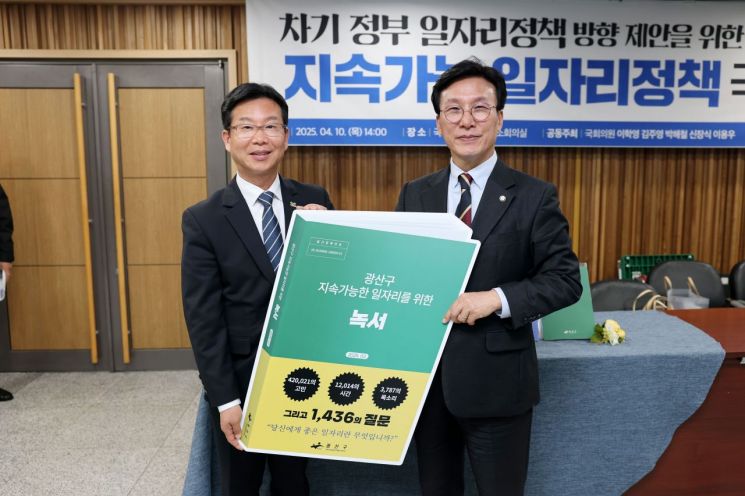 Park Byungkyu, mayor of Gwangsan District, handed over the "Sustainable Job Green Paper" to then-Assemblyman Kim Minseok (current Prime Minister) at a National Assembly policy forum held in April on the direction of job policies, and took a commemorative photo. Provided by Gwangsan District
On September 16, Gwangsan District announced that its citizen-participatory "grassroots social dialogue" has been included as an implementation task in the job sector of President Lee Jaemyung’s national policy agenda (Innovative Job Policy for Integration and Growth). The national agenda specifically calls for "expanding community-based social dialogue and governance to revitalize local employment," and the Gwangsan District case has been presented as a reference model.
The dialogue model in Gwangsan District has been highly regarded for involving groups previously excluded from employment discussions, such as non-regular workers, small and medium-sized enterprise employees, self-employed individuals, youth, and women. Additionally, it introduced a deliberative process that goes beyond simple discussion, progressing from the Green Paper (questions) to the White Paper (solutions) and then to the Blue Paper (action plans).
Furthermore, policies such as "creating quality jobs led by the local community" and expanding "social wages"-including support for housing, welfare, health, and care-are in line with the direction Gwangsan District has pursued. The eighth popularly elected administration of Gwangsan District has focused on regionally-centered, sustainable job creation, viewing the central government and large corporation-centered employment structure as deepening inequality and accelerating regional decline.
On this day, President Lee Jaemyung, presiding over a Cabinet meeting at the Sejong Government Complex, stated, "We will use the management plan for the 123 major national policy tasks as our compass to change people’s lives and lead the world." The Gwangsan District policy had already attracted attention from experts and lawmakers as an alternative for job innovation at a National Assembly policy forum in April.
In March, Gwangsan District published the Green Paper containing citizens’ questions and is currently conducting a second phase of dialogue to produce the White Paper with solutions. The district plans to prepare the Blue Paper, which will outline the action plan, and launch pilot projects starting in January next year.
Mayor Park Byungkyu stated, "The inclusion of our initiatives in government pledges and the national policy agenda is the result of three years of on-site discussions and persuasion by citizens, public officials, and experts." He added, "We will do our utmost to ensure that Gwangsan District’s sustainable job model spreads nationwide and opens a better future for Korea."
© The Asia Business Daily(www.asiae.co.kr). All rights reserved.












