"This is the first time we've experienced such a prolonged deadlock in negotiations with a particular country; it is proving to be very challenging"
"In the end, this issue is directly linked to corporate interests"
Following Minister Kim Jungkwan,
As detailed negotiations continue regarding the $350 billion U.S. investment fund that resulted from the Korea-U.S. customs negotiations, the Presidential Office has reiterated its position that it cannot sign any agreement that would harm the national interest due to time pressure. This response comes amid growing concerns that the negotiations over the U.S. investment fund have reached an impasse and may be prolonged.
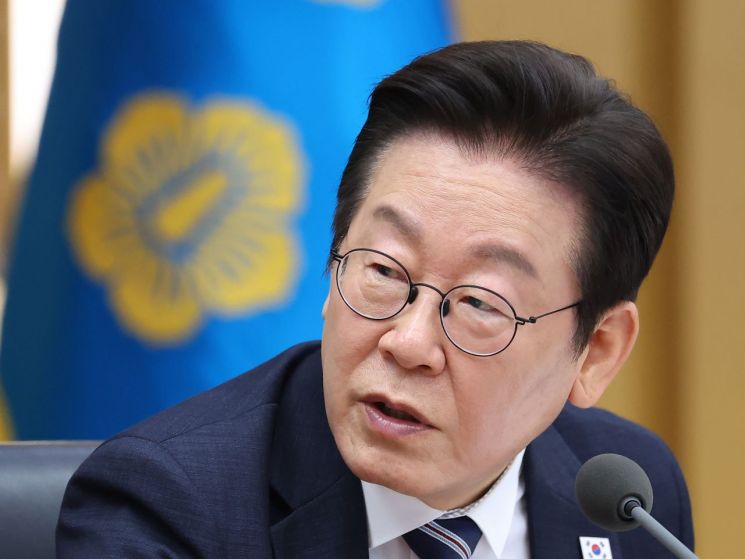
A senior official from the Presidential Office told reporters at the Yongsan Presidential Office on the 16th, "This is the first time we have experienced such a prolonged deadlock in negotiations with a particular country, and it is proving to be extremely challenging." The official added, "However, we cannot sign an agreement that could result in significant losses for our companies simply because we are pressed for time."
The official further explained, "While we often use the term 'national interest' in an abstract sense, ultimately, this issue is directly tied to the interests of our companies. Although our goal is to reach an agreement quickly, we cannot allow time pressure to cause serious harm to our national interest."
The official went on to say that President Lee Jaemyung's resolve is clear, stating, "(President Lee) cannot simply comply with everything the United States wants. He is determined not to force losses upon our companies." The official also explained, "If you look at where President Lee usually focuses his energy, the economy and people's livelihoods are his top priorities, followed by Korea-U.S. negotiations."
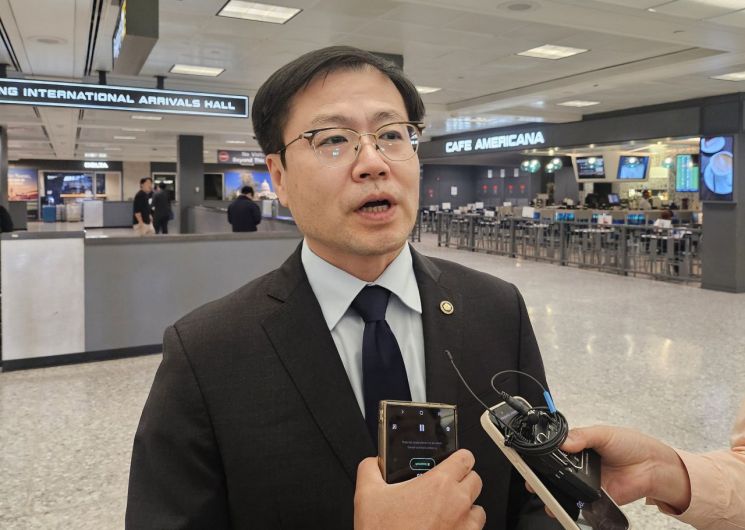
With the Korea-U.S. customs negotiations entering a stalemate, the government has urgently dispatched its top trade official to the United States once again. As soon as Minister of Trade, Industry and Energy Kim Jungkwan returned to Korea early on the 14th, Yeo Han-koo, head of the Ministry's Office of Trade Negotiations, departed for the United States the following day (the 15th).
Previously, Minister Kim held negotiations with U.S. Secretary of Commerce Howard Lutnick in New York on the 11th and 12th, but returned without resolving the key issues. Both inside and outside the industry, the outcome was described as a "return empty-handed." It is reported that the two sides have failed to narrow their differences regarding the structure of the $350 billion (about 480 trillion won) U.S. investment plan and the distribution of profits, which the United States is demanding from Korea.
In particular, the United States wants Korea to inject cash directly or to establish a special purpose company (SPC) to raise the investment funds. In contrast, Korea’s position is to minimize its burden through indirect means such as guarantees or loans. Regarding profit distribution, the United States is demanding a Japanese-style model, which involves differential profit allocation before and after the initial investment is recovered, while the Korean government is rejecting this approach as "unreasonable."
Industry observers interpret the latest developments as signaling that the negotiations have entered a "long-term battle" that will be difficult to conclude in the short term. Yeo Han-koo is a seasoned expert who has overseen key trade issues, including free trade agreement (FTA) negotiations and responses to World Trade Organization (WTO) disputes. Unlike the minister, who was responsible for political messaging and symbolism, this round is expected to focus on detailed negotiations-a "second round of working-level talks."
Upon arriving at Dulles International Airport near Washington, D.C., Yeo Han-koo told correspondents, "The devil is in the details," and emphasized, "We are negotiating intensely over the details. I will do my utmost to ensure our national interest is reflected, including by meeting with the United States Trade Representative (USTR) and engaging on all fronts."
© The Asia Business Daily(www.asiae.co.kr). All rights reserved.













