Reflecting National Interests on All Fronts, Including Meeting with USTR Representatives
"Negotiating Fiercely Over the Details"
Strongly Raising the Issue of the Georgia Detention Incident
Yeo Han-koo, the Trade Minister of the Ministry of Trade, Industry and Energy, who visited Washington, D.C. on September 15 (local time) for Korea-U.S. trade negotiations, stated, "The devil is in the details," and added, "We are negotiating fiercely over the details." As Korea and the United States continue negotiations over investment methods in the U.S., Minister Yeo visited the U.S. following Minister Kim Jeong-gwan.
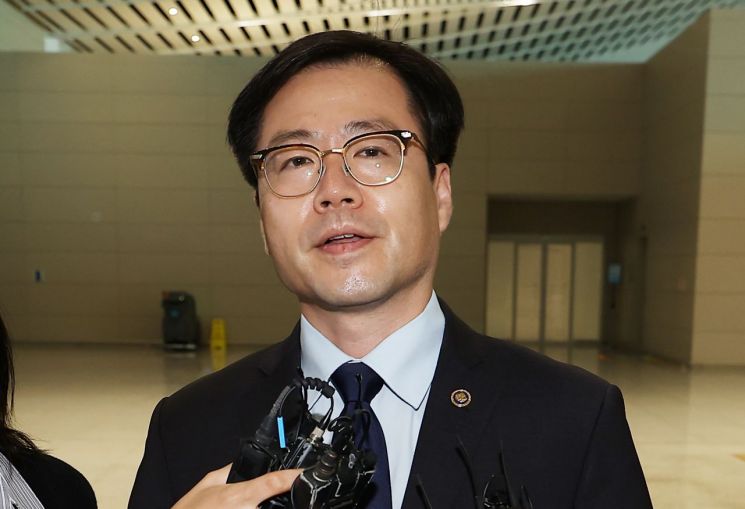
After arriving at Dulles International Airport near Washington, D.C. on this day, Minister Yeo met with correspondents and said, "I will do my best to reflect our national interests on all fronts, including by meeting with representatives from the U.S. Trade Representative (USTR)," reiterating his commitment.
On July 30, the two countries agreed during trade negotiations to lower the U.S. reciprocal tariff rate on Korean goods from 25% to 15%, and for Korea to pursue a total of $350 billion (approximately 486 trillion won) in investments in the U.S. However, as detailed discussions remain, an official signing to enact the agreement has not yet taken place.
The two countries' trade authorities held working-level talks in Washington, D.C. on September 8, and a ministerial meeting in New York on September 12, but it has been reported that they have yet to narrow their differences over investment methods.
When asked whether the follow-up negotiations are facing difficulties, Minister Yeo responded, "Please look at the whole picture and understand," and emphasized, "The most important task is to achieve a rational negotiation outcome that best serves our national interests."
Regarding whether the detention of about 300 Korean workers in Georgia could affect the negotiations, he said, "That is an issue we must strongly raise," and added, "It seems the U.S. side also feels that their actions may have been excessive. We will do our utmost to reflect the interests of our companies."
On Japan lowering its tariff on automobile exports to the U.S. to 15% starting September 16, he commented, "We are also working to ensure that the 15% rate can be applied as soon as possible," and added, "I will not be swayed by every turn in the negotiation process."
In accordance with the July 30 agreement, Korea decided to lower its tariff on automobile exports to the U.S. from 25% to 15%, but a final agreement has not yet been reached. In contrast, Japan has already reached a final agreement and the 15% tariff is being applied, resulting in a 10 percentage point difference in the U.S. automobile tariff rates between Korea and Japan.
When asked how the two countries would bridge their differences over the method of the $350 billion investment in the U.S., Minister Yeo replied, "We are analyzing all opinions," and emphasized, "What matters most is which option can bring us the best outcome."
Regarding the possibility of introducing an "unlimited Korea-U.S. currency swap" as a safeguard against sharp exchange rate fluctuations if direct investment is increased as requested by the U.S., he said, "It is difficult to comment on each specific detail," avoiding a direct answer. A currency swap refers to an arrangement in which one country deposits its currency with another and borrows the other country's currency at a predetermined exchange rate.
Previously, it was reported that the Korean government requested an unlimited currency swap as a condition for establishing a $350 billion (approximately 485 trillion won) investment fund in the U.S.
© The Asia Business Daily(www.asiae.co.kr). All rights reserved.

![Clutching a Stolen Dior Bag, Saying "I Hate Being Poor but Real"... The Grotesque Con of a "Human Knockoff" [Slate]](https://cwcontent.asiae.co.kr/asiaresize/183/2026021902243444107_1771435474.jpg)















