Japanese Cars to Face 15% U.S. Tariff Starting Tomorrow
Korean Tariff Cut Also Agreed,
But 25% Still in Place Due to Delays
Toyota RAV4 at $37,778
Kia Sportage at $37,863
The reduction of U.S. tariffs on Japanese automobiles from 27.5% to 15%, effective September 16 (local time), has immediately impacted Hyundai Motor Group's competitiveness in the U.S. market. Although the United States agreed with South Korea in July to lower tariffs on Korean automobiles from 25% to 15%, the 25% tariff is still being applied due to administrative delays. A reversal in vehicle pricing is now imminent.
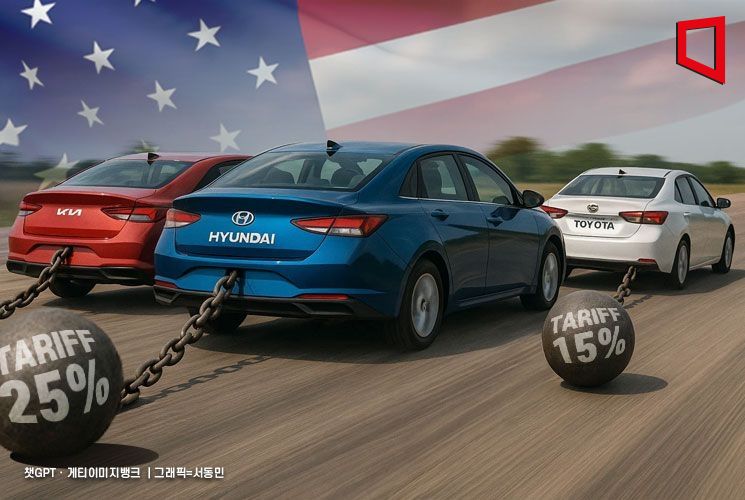
While increasing local production is a realistic solution, the situation has become even more challenging due to the recent detention of workers at the LG Energy Solution joint battery plant in Georgia. This incident has disrupted the production of not only electric vehicles but also hybrid vehicles. Minister of Trade, Industry and Energy Kim Jungkwan met with U.S. Secretary of Commerce Howard Lutnick, but it is reported that there has been little progress.
According to industry sources on September 15, if the tariff rates for South Korea and Japan diverge to 25% and 15%, respectively, a price reversal is expected for major export models. Currently, the Kia Sportage Hybrid sells for $30,290 in the U.S., while the Toyota RAV4 Hybrid is priced at $32,850. With the tariff changes applied, the Sportage would rise to $37,863, making it more expensive than the RAV4 at $37,778.
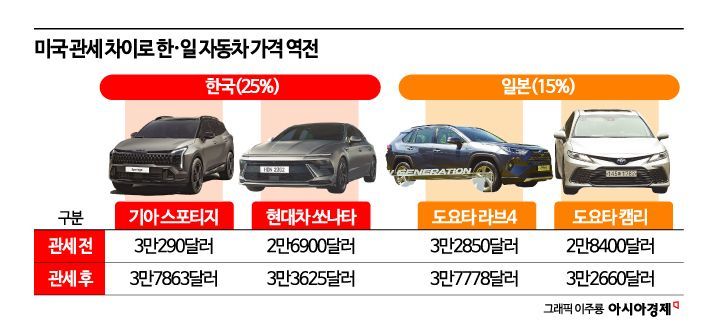
The base trim price of the Sonata in the U.S. is $26,900, which is more than 5% cheaper than the Toyota Camry at $28,400. However, if the tariff impact is reflected in the sales price, this price competitiveness will disappear.
The Genesis brand, which has seen a surge in popularity in the U.S. market recently, is also likely to be affected. Since all Genesis vehicles are produced and exported from South Korea, they will inevitably be at a disadvantage in sales competition with Japanese luxury models such as the Toyota Lexus.
After the U.S. imposed tariffs in April, Hyundai Motor and Kia chose not to raise prices in the U.S. market, absorbing the additional costs themselves to defend their market share. In the second quarter, Hyundai Motor's operating profit decreased by 828.2 billion won due to the U.S. tariff impact, while Kia bore 786 billion won in tariff costs, resulting in a decline in operating profit. There are concerns that the decrease in operating profit will become more pronounced from the third quarter, when the tariff impact will be fully reflected.
Industry estimates suggest that if the 25% tariff remains in place through the third quarter, Hyundai Motor's operating profit could decrease by as much as 1.2 trillion won. This amounts to 33% of last year's third-quarter operating profit of 3.5809 trillion won. SK Securities projected that due to the U.S. tariffs, Hyundai Motor's operating profit in the third and fourth quarters of this year could decrease by about 1 trillion won and 827.2 billion won, respectively, while Kia could see declines of 763.4 billion won and 615.6 billion won over the same period.
The expected decline in demand for electric vehicles in the near term is another source of concern. An industry insider said, "Once the electric vehicle tax credit ends soon, market demand will likely shift from electric vehicles to hybrids. Since Hyundai Motor and Kia have a high proportion of hybrid electric vehicle exports from South Korea, they will be directly affected by the tariffs," adding, "There are concerns that the dual challenges of weak electric vehicle demand and tariffs could undermine their competitiveness."

The outlook for the second half of the year is even more uncertain, as it remains unclear when the 15% tariff will be applied. Following Minister Kim Jungkwan, Trade Negotiations Head Yeo Hankoo is continuing high-level contacts, but South Korea and the United States have yet to narrow their differences on the details following the trade agreement.
Hyundai Motor is converting part of the production line at its dedicated electric vehicle plant, Meta Plant America (HMGMA), in Georgia to hybrid vehicle production. By increasing hybrid vehicle output instead of electric vehicles, the company aims to respond flexibly to local demand. Plans are also being considered to raise the proportion of hybrid vehicle production to as much as 50% in the future.
Over the past few years, Hyundai Motor and Kia's hybrid vehicles have shown steady growth in the U.S. market. In 2021, annual hybrid vehicle sales in the U.S. reached 90,614 units, about three times higher than the previous year, and last year they continued to grow, reaching 222,486 units. From January to August this year, sales increased by 47.9% compared to the same period last year, totaling 198,807 units.
However, with the recent large-scale detention of Korean workers due to visa issues, there are concerns that hybrid vehicle supply could also be disrupted in the short term. Hyundai Motor President Jose Munoz predicted that the battery joint plant construction would be delayed by at least two to three months due to the recent immigration enforcement action. In response to the battery plant production delay, Hyundai Motor has prepared contingency plans to source batteries from facilities such as the SK On plant in Commerce, Georgia.
© The Asia Business Daily(www.asiae.co.kr). All rights reserved.
![Clutching a Stolen Dior Bag, Saying "I Hate Being Poor but Real"... The Grotesque Con of a "Human Knockoff" [Slate]](https://cwcontent.asiae.co.kr/asiaresize/183/2026021902243444107_1771435474.jpg)












