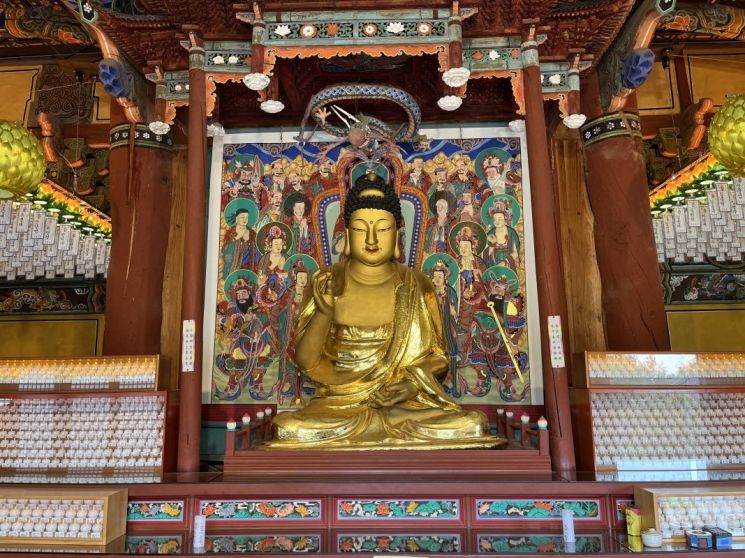
 Enshrinement of the Amitabha Buddha Seated Statue in Wood at Geungnakbojeon Hall, Biamsa Temple, Jeonui-myeon, Sejong Special Self-Governing City. /Photo by Cultural Heritage Division
The "Amitabha Buddha Seated Statue in Woodcarving at Biamsa Temple," which demonstrates the transmission of the form and techniques of Buddhist statues from the early Joseon Dynasty, is set to be designated as a nationally recognized cultural heritage.
According to the city of Sejong, the Amitabha Buddha Seated Statue in Woodcarving at Biamsa Temple, located in Jeonui-myeon, has been preliminarily listed for designation as a national treasure as of September 14. After a 30-day notice period, it will be officially designated as a national treasure following a review by the Cultural Heritage Committee of the National Heritage Administration. Although there is no surviving inscription detailing its creation, making it difficult to determine the exact production date or the sculptor, the stylistic features-such as the depiction of the face, facial features, and body proportions-suggest that the statue was produced in the early Joseon Dynasty (16th century).
The estimated production period, based on stylistic analysis, aligns with the results of radiocarbon dating, which indicate it was made between 1508 and 1520.
The "Amitabha Buddha Seated Statue in Woodcarving at Biamsa Temple" stands 194.2 cm tall with a knee width of 132 cm. It is characterized by a technique in which the outline is first formed in wood, and then details are completed with a small amount of clay. This differs from the more common method of constructing a rough wooden frame and then forming most of the statue with clay. Since the production technique is clearly identified, the statue is regarded as an important resource for future research on early Joseon Buddhist art.
As one of the very few surviving Buddhist statues from the 16th century, its rarity and the distinct individuality of the sculptor expressed in its features give it significant art historical value.
An official from the city stated, "The statue is in good condition and holds academic significance for understanding the form and techniques of early Joseon Buddhist statues," adding, "We will continue to make efforts to ensure systematic preservation and to widely promote its value."
© The Asia Business Daily(www.asiae.co.kr). All rights reserved.












