Protests Erupt After Government Blocks Social Media, Leading to Clashes With Police
President Announces Dissolution of Parliament and General Elections Scheduled for March Next Year
A shocking video has emerged from Nepal, where intense anti-government protests continue, showing the finance minister being dragged through the streets in underwear by protesters.
On September 13, foreign media outlets reported that a video titled "Nepalese Finance Minister" is rapidly spreading on social networking services (SNS) such as Instagram. In the footage, an individual in underwear is being carried by protesters, with their arms and legs held aloft.
 An individual presumed to be the Nepalese finance minister being dragged on the street in underwear. Instagram capture.
According to foreign media, the person in the video is believed to be a senior official in the Nepalese government, specifically the finance minister, which has further intensified the controversy. This scene is being regarded as a symbolic example of public anger against the government reaching its peak.
The current protests began on September 5, when the Nepalese government blocked access to 26 SNS platforms, including YouTube, Facebook, Instagram, and X (formerly Twitter), sparking unrest centered in the capital, Kathmandu. The government claimed this was to prevent the spread of fake news, but young people strongly objected, arguing that it was an attempt to suppress online movements exposing corruption.
As the protests spread beyond Kathmandu to the entire country, police responded with tear gas, water cannons, and rubber bullets, leading to a harsh crackdown. So far, at least 51 people have died and more than 1,300 have been injured. The fatalities include not only protesters but also three police officers and inmates who escaped during a mass breakout from prison. Police stated that over 13,000 inmates escaped, some of whom have been recaptured, but around 12,000 remain at large.
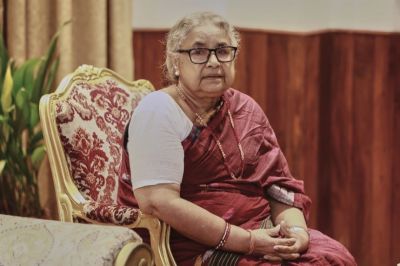 Susila Karki, former Chief Justice, appointed as interim Prime Minister of Nepal. Photo by Yonhap News
In response, President Ram Chandra Paudel appointed Susila Karki, former Chief Justice, as interim Prime Minister to restore order. Nepal operates under a parliamentary cabinet system, where the prime minister holds de facto power. Prime Minister Karki is the first female head of government in Nepal's history and gained widespread public support for her decisive rulings during her tenure as Chief Justice in 2016. Protesters had favored her as interim leader immediately after Prime Minister Oli's resignation.
Upon taking office, Prime Minister Karki declared, "I will fulfill my duties as prime minister for the people and the nation." She is expected to lead the interim government for the next six months and form a new cabinet. Additionally, the presidential office announced the dissolution of the House of Representatives and scheduled a general election for March 5 next year. This measure follows Prime Minister Karki's recommendation and was agreed upon by major political parties and protest groups.
Constitutional scholar Bipin Adhikari emphasized that the interim prime minister's first priority should be investigating the violence and holding those responsible accountable, while also controlling corruption, strengthening public security, and restoring law and order.
© The Asia Business Daily(www.asiae.co.kr). All rights reserved.












