Only About 100 Chinese Crested Terns Remain Worldwide
New Nest Discovered on Uninhabited Island Near Yuksando, Yeonggwang County, Jeollanam-do
The "mysterious migratory bird," the Chinese Crested Tern, with only about 100 individuals remaining on Earth, has been confirmed to have established a new nest in Korea.
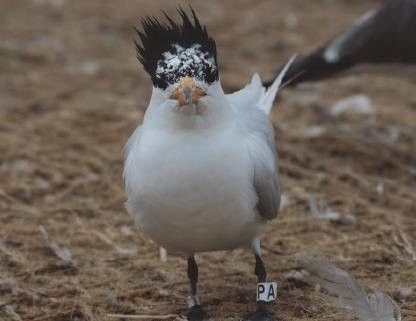
On September 13, Yonhap News reported that a new breeding site for the Chinese Crested Tern was belatedly discovered on an island near Yuksando in May of last year. Until now, only five breeding sites had been identified: Yuksando in Yeonggwang County, Jeollanam-do, South Korea; Jiushan Island and Wuzishan Island in China; and Matsu Island and Penghu Island in Taiwan. Between six and eight birds had visited Yuksando each year.
However, since 2016, the pair known as "K00" and "K11," which used to visit Yuksando even after the breeding season, had not been seen. Researchers from the National Institute of Ecology under the Ministry of Environment, the Korea Institute of Ornithology at Kyung Hee University, and the Seabird Research Institute tracked islands near Yuksando and eventually found the pair on a nearby uninhabited island. At the time of discovery, the pair was incubating eggs among a flock of black-tailed gulls, but they failed to breed successfully. This year, the pair returned to Yuksando, successfully built a nest, and hatched their eggs.
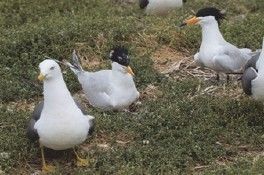 A pair of horned gulls incubating eggs among a flock of black-tailed gulls on an uninhabited island near Yuksando, Yeonggwang County, Jeollanam-do. National Institute of Ecology
The discovery of a new breeding site for the Chinese Crested Tern is welcome news for the academic community, but it has become an unexpected variable for the renewable energy industry. In particular, Doosan Geosolution, a subsidiary of Doosan Enerbility, which had planned to build a 160 MW offshore wind power complex near the uninhabited island at a cost of 980 billion won, now faces a difficult situation.
Doosan Geosolution determined that it was not appropriate to proceed with the project as originally planned and withdrew the final version of its environmental impact assessment, which had been submitted in November last year. Submitting the final environmental impact assessment is the stage just before construction begins, and under the original plan, groundbreaking was scheduled for this year. Instead, the company is reportedly considering alternatives that would not affect the breeding of the Chinese Crested Tern, such as reducing the size of the power complex or changing the construction site.
Experts have suggested that by monitoring the breeding and migratory routes of the Chinese Crested Tern and sharing this information with power developers, it is possible to pursue both renewable energy projects and ecosystem conservation.
Meanwhile, the Chinese Crested Tern is classified as "Critically Endangered" by the International Union for Conservation of Nature (IUCN). "Critically Endangered" is the third highest risk category out of nine in the IUCN Red List, following "Extinct" and "Extinct in the Wild," and refers to species that are at extremely high risk of extinction in the near future. In Korea, the species was designated as a Class 1 endangered wild animal in 2022. It was presumed extinct since 1937, but in 2000, four pairs were discovered on an island in southern China, confirming its survival. Since then, restoration efforts have continued, and it is now estimated that about 100 individuals remain worldwide.
In June, the National Honam Biological Resource Center and the National Institute of Ecology announced that they had secured approximately 1.17 billion base pairs of the Chinese Crested Tern genome at the chromosome level. Securing genetic information is a crucial step in understanding the species' ecology and establishing conservation strategies. The research team plans to use this genetic information to develop systematic conservation and restoration strategies.
© The Asia Business Daily(www.asiae.co.kr). All rights reserved.












