Extraordinary Meeting Held for the First Time in Three Years, Lasts Over Seven Hours
Discussion on Five Key Judicial Reform Agendas, Including Increasing Supreme Court Justices
"Doing Our Best to Restore Trust in the Judiciary, Striving for Prompt and Fair Trials"
Chief judges from courts nationwide have issued an official statement regarding 'judicial reform,' asserting that "judicial independence must be guaranteed" and emphasizing that "the participation of the judiciary is essential in discussions about institutional reforms." They also expressed concerns over the 'Special Court for Insurrection' being promoted by the ruling party, stating that "a cautious approach is necessary."
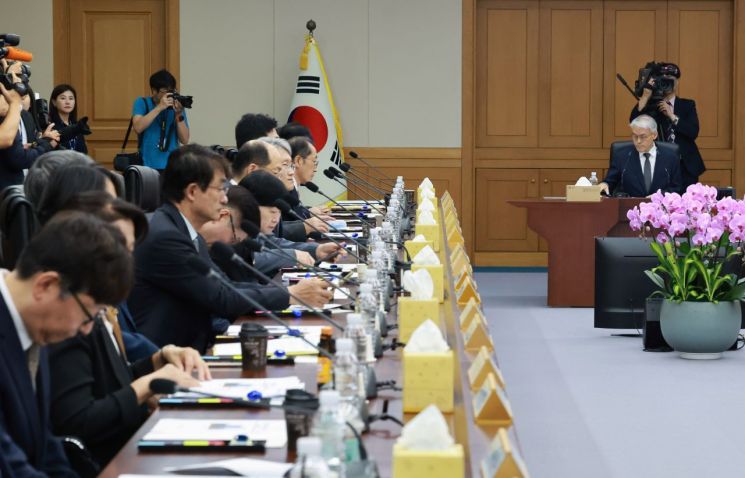
Chun Daeyeob, Chief Justice of the National Court Administration (Supreme Court Justice), and chief judges from courts across the country held an extraordinary meeting of the National Chief Judges’ Conference in the main conference room of the Supreme Court building in Seocho-dong, starting at 2 p.m. on this day. They announced their official position, stating, "Judicial system reform is a major responsibility of the judiciary for the people and a task of the times, so it must be pursued with full consideration of its impact on the public and society as a whole." The meeting concluded at approximately 9:24 p.m. after about seven and a half hours.
After the meeting, the chief judges released a press statement, saying, "The composition of the Supreme Court and the judicial personnel system are core elements of judicial independence," and "Judicial independence must be guaranteed in order to protect the fundamental rights of the people and to realize the rule of law; therefore, the participation of the judiciary in discussions on improvements is essential."
They further emphasized, "Since the judiciary can only exist through the trust of the people, we must do our utmost to restore that trust," and added, "The judiciary will actively participate in reform discussions, maintain an open attitude in communicating with the National Assembly, the government, and the public, and, under any circumstances, strive to deliver prompt and fair trials for the people."
This meeting was a follow-up to Chief Justice Chun’s request on the 1st of this month for chief judges nationwide to gather opinions from their affiliated judges regarding the Democratic Party’s judicial reform proposal.
The topics discussed included the following initiatives being promoted by the Democratic Party’s Special Committee on Judicial Reform, aiming for passage at the plenary session before Chuseok: ▲ Increasing the number of Supreme Court justices ▲ Improving the method for nominating Supreme Court justices ▲ Reforming the judicial evaluation system ▲ Expanding the scope of public access to lower court rulings ▲ Introducing a pre-examination system for search and seizure warrants, among others.
Regarding the increase in the number of Supreme Court justices, the majority of judges expressed concerns that "the process is proceeding without sufficient deliberation" and that "there are worries about weakening the fact-finding function," stating that a significant increase in a short period requires cautious review. Some suggested that a small-scale increase of about four justices would be appropriate, or that sufficient human and material support for fact-finding should be provided either as a prerequisite or in parallel.
On the issue of improving the nomination process for Supreme Court justices by diversifying the composition of the Supreme Court Justice Nomination Committee, there was consensus that a cautious review is needed due to concerns. Depending on the committee’s composition and membership, there is a possibility of infringing on judicial independence, while some argued that the current committee’s proper operation can secure diversity in the Supreme Court’s composition.
Regarding discussions on improving the judicial evaluation system, most judges reportedly expressed concerns about potential infringement on judicial independence or unconstitutionality of the proposed bills. The chief judges agreed that "while upholding the principle of judicial independence against undue external interference, it is necessary, as judicial administrators, to responsibly seek ways to appropriately reflect the voices of the people."
On the expansion of public access to lower court rulings and the introduction of a pre-examination system for search and seizure warrants, they agreed with the need for reform but also stated that further review is required to prepare measures to address potential side effects.
Although it was not an official agenda item, there were reportedly numerous opinions raised that "a cautious approach is necessary" regarding the establishment of a Special Court for Insurrection.
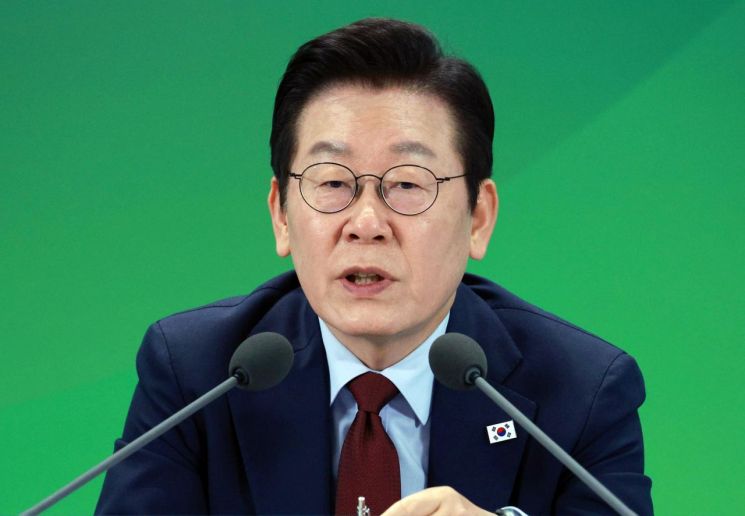
Regarding the 'Special Court for Insurrection' being promoted by the Democratic Party, the legal community has raised concerns that it could infringe on judicial independence and may be unconstitutional. However, President Lee Jaemyung, in a press conference marking his 100th day in office the previous day, expressed support for the ruling party, stating, "Some say it is unconstitutional, but what exactly is unconstitutional about it?" and "The will of the people’s sovereignty is most important."
© The Asia Business Daily(www.asiae.co.kr). All rights reserved.