Medical Tourists: 610,000 in 2023 to 1.17 Million in 2024
President Lee: "Plastic Surgery Industry Offers High Added Value"
A Diverse Range of Related Stocks: Beauty, Dental, and Diagnostic Devices
The number of medical tourists visiting South Korea has been increasing exponentially each year, surpassing 1 million last year. The range of treatments is also diversifying, from plastic surgery and dermatology to dental care. On September 12, Lightwood Partners emphasized in its report, "From K-Beauty to K-Medical," that investors should pay attention to stocks related to medical tourism.
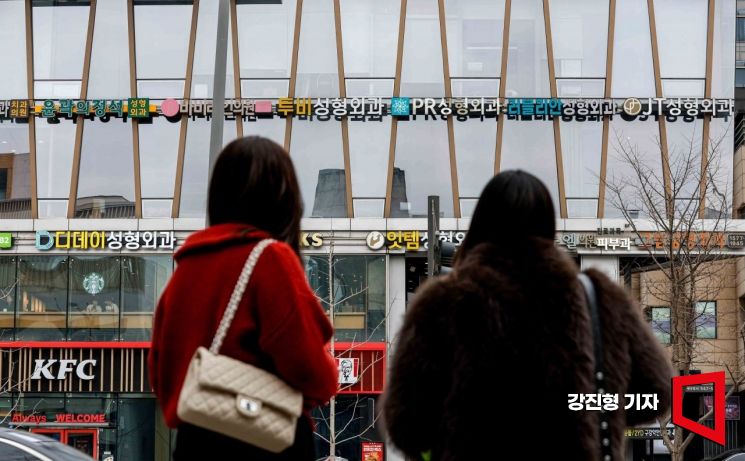 An entire building in Nonhyeon-dong, Gangnam-gu, Seoul is occupied by plastic surgery clinics. Photo by Kang Jinhyung
Medical Tourists Surge Alongside the Korean Wave
According to data released by the Ministry of Health and Welfare, the number of medical tourists increased rapidly from 117,000 in 2020, to 146,000 in 2021, 248,000 in 2022, 606,000 in 2023, and 1.17 million in 2024. As of last year, dermatology accounted for 56.6% and plastic surgery for 11.4%, together making up about 68% of the total. Compared to ordinary tourists, medical tourists tend to stay longer and spend more, as they combine shopping and sightseeing with their medical treatments.
President Lee Jaemyung also commented during a cabinet meeting held on September 10, "Foreign plastic surgery tourists stay for two weeks to a month," adding, "While attention is focused on movies and dramas within K-Culture, industries such as food and plastic surgery actually offer much higher added value." This is interpreted as a signal that medical tourism should be developed not just as a means to attract tourists, but as a national industry.
Within the industry, there are rising expectations that the value-added tax refund program will be maintained. Introduced in 2016, the special value-added tax refund program for foreign cosmetic and plastic surgery treatments allows foreigners to receive a 10% VAT refund when undergoing such procedures in Korea. Industry experts note that this refund program has contributed significantly, given that Korea's medical costs are not cheaper than those of competing countries like Japan, Thailand, and China. However, controversy arose when the Ministry of Economy and Finance announced plans to end the program at the end of this year. Many in the industry now believe that, following the President's remarks, the VAT refund is likely to be maintained.
A Wide Range of Beneficiaries in Medical Tourism
Kim Hanjin, an analyst at Lightwood Partners, stated, "Companies that can expect direct benefits include those in medical devices, products related to plastic surgery and dermatological procedures, hospital service providers, and cosmetics and beauty device companies." He added, "Marketing and service strategies tailored to the characteristics of patients by nationality are important, and the expansion of medical tourism is likely to directly improve the performance of related listed companies."
APR is expanding its Medicube cosmetics brand and AGE-R beauty devices globally, giving it a strong position in the home beauty device market. Classys, which specializes in lifting and laser medical devices, has a high proportion of global exports and stands to benefit directly from the increase in demand for plastic surgery tourism. Wontech, a specialist in dermatology and beauty medical devices, is highly responsive to the increase in foreign patients. Pharmaresearch owns the PDRN-based skin regeneration product "Rejuran," which is widely used in plastic surgery and skincare treatments.
Hugel, a leading company in the botulinum toxin sector, has a global distribution network and is expected to see improved performance as demand for plastic surgery procedures rises. In the dental field, Osstem Implant (unlisted) and Dentium are representative companies. Dental prosthetics and implants are in high demand among overseas patients, making them likely beneficiaries of the overall increase in medical tourism. SD Biosensor, which supplies in vitro diagnostic devices to health screening centers, is also expected to benefit indirectly from the growth in medical tourism.
© The Asia Business Daily(www.asiae.co.kr). All rights reserved.












