Strategy Seminar on Technology Development and Demonstration Infrastructure
"Expectations for Joint Growth of Future Mobility Parts Companies"
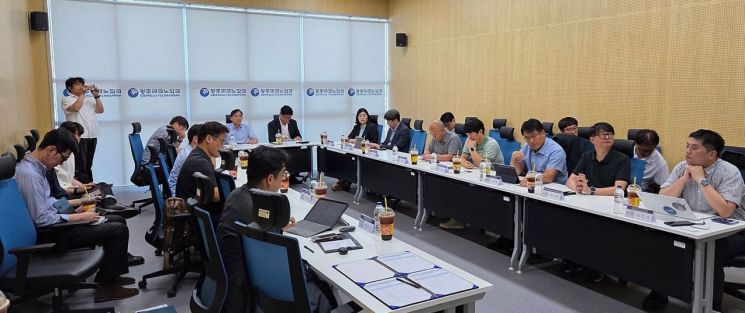 Gwangju City held a seminar on the 11th at the UAM Demonstration Promotion Center in the Buk-gu Advanced National Industrial Complex titled "Seminar for Fostering the Future Air Mobility Industry," discussing cooperation plans with local businesses, academia, and research institutions. Photo by Gwangju City
On September 11 at 2:00 p.m., Gwangju City held a seminar titled "Fostering the Advanced Air Mobility (AAM) Industry" at the UAM Demonstration Promotion Center in the Buk-gu Advanced National Industrial Complex, where it discussed cooperation strategies with local companies, academia, and research institutions.
The seminar, organized by Gwangju Technopark Foundation, was attended by more than 30 participants, including representatives from local governments, industry, academia, and research organizations. They explored activation strategies to foster the Advanced Air Mobility (AAM) industry in Gwangju.
Under the theme "Gwangju's Choices and Strategies for Fostering the AAM Industry," the seminar proposed policy measures to link the rapidly emerging AAM industry as a next-generation transportation system with the region’s manufacturing sector, and to help mobility parts companies secure new growth opportunities.
Kim Min-ki, Director of the UAM National Strategic Technology Project Group, introduced the Ministry of Land, Infrastructure and Transport and the Korea Meteorological Administration's K-UAM (Urban Air Mobility) core technology development strategies and major tasks. He emphasized the need for developing core technologies through industry-academia-research collaboration, as well as establishing infrastructure for commercialization by 2028.
Kang Yonghak, Principal Researcher at the Korea Conformity Laboratories (KCL), explained Gwangju City’s plan to establish a "Support Center for Vertical Takeoff and Landing Aircraft Flight Safety Demonstration Testing" as a new project for 2026. He presented support measures for testing and evaluating avionics equipment and autonomous flight software, which are currently unavailable in Korea, and stressed the importance of central government support and Gwangju City's strong commitment to driving the project forward.
During the discussion, participants explored various policy and technological measures to connect the government’s K-UAM (Urban Air Mobility) initiative with Gwangju City’s project to establish a support center for vertical takeoff and landing aircraft flight safety demonstration testing, aiming to facilitate the early establishment and activation of the regional AAM industry.
Going forward, the city plans to gradually expand test and evaluation infrastructure that companies can utilize, based on its strengths in artificial intelligence (AI) and mobility. Gwangju aims to foster a future aviation industry ecosystem and become a domestic and global hub for cooperation in the new mobility industry.
Lee Donghyun, Director of the Future Automotive Industry Division, stated, "The advanced air mobility industry is an important challenge for Gwangju as it strives to become a leading city in future mobility. We will continue to strengthen Gwangju’s competitiveness by working with experts to advance policies and technologies."
© The Asia Business Daily(www.asiae.co.kr). All rights reserved.