White House: "Joint Response by Homeland Security and Commerce Departments"
Indicates Measures in Wake of Georgia Incident
The administration of U.S. President Donald Trump appears to be moving to improve immigration and visa policies for foreign companies investing in the United States, following the detention of 300 Korean nationals. The need for policy change has emerged in the wake of the U.S. immigration authorities' crackdown at the Hyundai Motor-LG Energy Solution joint (HL-GA) battery factory in Georgia and the mass detention of Korean workers.
At a briefing on the 9th (local time), White House spokesperson Karoline Leavitt responded to questions regarding measures to prevent a recurrence of this situation by stating, "The Department of Homeland Security and the Department of Commerce are responding jointly." The Department of Homeland Security oversees immigration and border policies in the United States, including this recent crackdown. The Department of Commerce is responsible for overseeing foreign investment in the U.S. The fact that these two departments-one in charge of strict immigration restrictions and the other handling trade, tariffs, and investment negotiations-are working together suggests that the Trump administration recognizes that these two policy directions have revealed institutional contradictions in light of the recent incident.
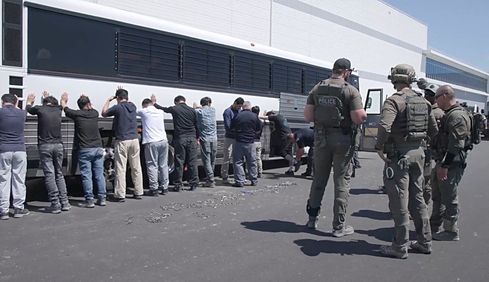 U.S. immigration enforcement authorities released videos and photos on their official website showing the crackdown on illegal residency and employment at the joint battery factory construction site of Hyundai Motor Group and LG Energy Solution in Georgia on the 4th (local time). Photo by Yonhap News Agency
In fact, President Trump not only addressed the issue in response to reporters' questions on the 7th, but also posted about it again on his social media platform, Truth Social. This indicates the seriousness with which he views the matter. Notably, he stated, "We encourage you to legally bring in very smart people with excellent technical talent to produce world-class products. And we will make it possible for you to do so quickly and legally." This particular remark stands out.
Due to the Trump administration's increasingly strict visa restrictions, companies investing in the United States have been facing difficulties in securing professional and technical personnel, which has indirectly led to the use of 'workarounds' such as those seen in this case.
The shortage of skilled workers in advanced industries in the United States has long been an issue. Moreover, from the perspective of companies investing in the U.S., there is a need to minimize the time required to construct factories and begin production. As demonstrated by the HL-GA factory, this often necessitates bringing in Korean workers who are already accustomed to working together and can communicate effectively.
The Washington Post also pointed out on this day, "According to immigration lawyers and economists, there is no visa program in the United States specifically designed to allow foreign companies to bring in hundreds of skilled workers for weeks or months to construct factories."
Going forward, the Department of Commerce is expected to request that the Department of Homeland Security consider these realities by allowing exceptions for professional and technical workers in certain fields, such as issuing E-2 or E-3 visas, or by increasing the country-specific quotas for H-1B visas for foreign professionals. These are demands that Korean companies investing in the U.S. have consistently made.
Arius Derr, Director of Communications at the Korea Economic Institute of America (KEI), argued that the U.S. Congress should establish a new professional visa category for Korean nationals. He also advised that the U.S. administration should operate existing visa policies more flexibly, for example by expanding the range of activities permitted for holders of B-1 business visas, which were widely used at the HL-GA site.
Spokesperson Leavitt stated, "He (President Trump) understands that these companies want to bring highly skilled and trained workers with them to the United States," adding, "This is especially true when they are producing highly specialized products like semiconductors, or batteries as in Georgia."
However, even if this incident serves as a turning point-an "opportunity in disguise"-for Korean companies struggling to obtain U.S. visas, it is still uncertain whether the Trump administration, which is highly sensitive to illegal immigration and residency, will fully open the doors. Even if visa issuance for urgently needed professional and technical positions is expanded through interdepartmental coordination, the Trump administration's fundamental "America First" principle-which ultimately requires increasing local U.S. hiring-remains unchanged. As a result, the administration may seek to ease or expand visa issuance only on the condition that companies hire a certain number of American workers, or require mandatory technical training and knowledge transfer programs to cultivate domestic professional talent.
President Trump has previously emphasized, "The way to cultivate (high-level) talent is to bring in people who are skilled in the field, have them stay for a certain period, and receive their help," adding, "We need to establish a system where experts train our people so that Americans can eventually do the work themselves."
Meanwhile, there are concerns that this mass detention of Korean nationals could significantly dampen foreign investment in the U.S. and freeze manufacturing jobs in the country. The Washington Post noted, "This incident clearly shows how U.S. immigration principles hinder the recruitment of workers needed to build modern manufacturing facilities that could employ tens of thousands of American workers." The article continued, "While President Trump claimed that detaining 300 Koreans was in support of Georgia workers, experts point out that he risks eliminating thousands of American manufacturing jobs."
© The Asia Business Daily(www.asiae.co.kr). All rights reserved.
![User Who Sold Erroneously Deposited Bitcoins to Repay Debt and Fund Entertainment... What Did the Supreme Court Decide in 2021? [Legal Issue Check]](https://cwcontent.asiae.co.kr/asiaresize/183/2026020910431234020_1770601391.png)















