President Lee: "Raise Interest Rates for High-Credit Borrowers to Support Low-Credit Borrowers"
"Interest rates are not a 'standard of discrimination' dividing low-credit and high-credit individuals"
Lee Junseok, Representative of the Reform New Party, strongly criticized President Lee Jaemyung for mentioning the need to lower loan interest rates for low-credit borrowers, urging him to stop populist measures that undermine the foundation of the financial system. He emphasized that interest rates are not a tool for discriminating between low-credit and high-credit individuals, but rather "the price of risk," warning that ignoring this could lead to another financial disaster or a credit card crisis.
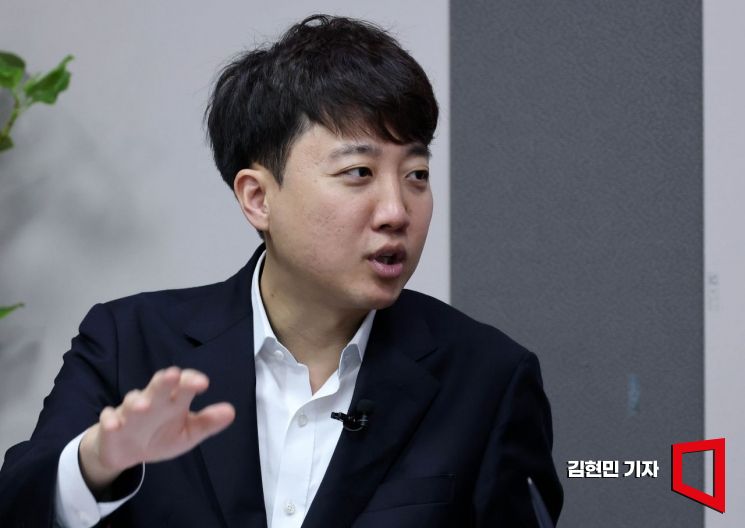
On September 10, Lee Junseok stated on his social media, "President Lee Jaemyung made remarks yesterday that directly contradict market principles. He suggested lowering loan interest rates for low-credit borrowers and raising them for high-credit borrowers," adding, "This is a dangerous idea that denies the very structure by which interest rates are determined in the market."
Lee further explained, "Interest rates are not a 'standard of discrimination' dividing low-credit and high-credit individuals, or the assetless and the wealthy. Interest rates are 'the price of risk.' The reason high-credit individuals receive lower interest rates is not a privilege, but because their risk is lower," and added, "Conversely, the reason low-credit individuals face higher interest rates is due to a higher risk of default, not because of social discrimination."
He also stated that supporting low-credit borrowers should not result in reverse discrimination against those who have diligently managed their credit. Lee Junseok said, "Why should a high-credit individual who has borrowed 1 million won and repaid it consistently be treated less favorably than a low-credit individual who borrowed 10 billion won and committed fraud?" He criticized, "President Lee Jaemyung's remarks are dangerous populism that shakes the foundation of finance under the guise of helping the vulnerable. The moment market principles are disregarded, a crisis will erupt, and ultimately, the most vulnerable will suffer the most."
President Lee: "Let’s raise interest rates for high-credit borrowers by 0.1% to support low-credit borrowers"
During a cabinet meeting on September 9, President Lee Jaemyung referred to the 15% annual interest rate for the lowest credit borrowers as "too cruel," and called for institutional reforms such as raising loan interest rates for high-credit borrowers.
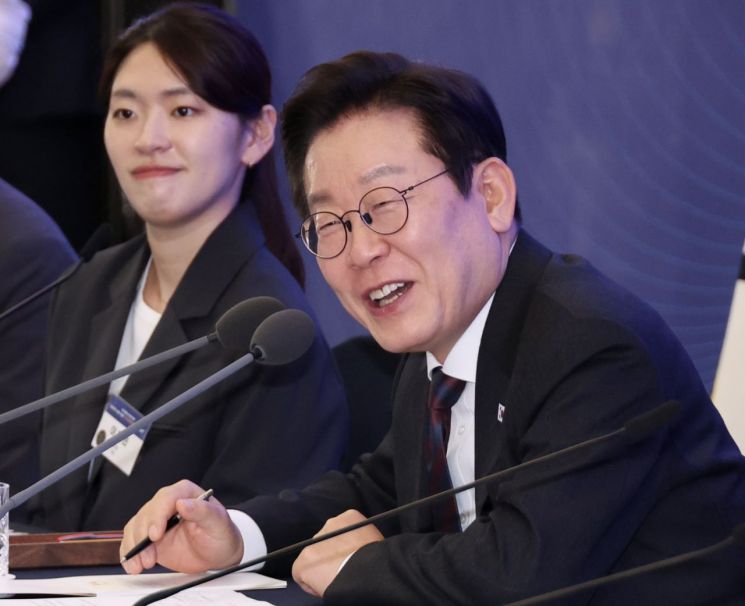 President Lee Jae-myung is discussing with attendees at the National Growth Fund Report Conference held on the 10th at Front1 in Mapo-gu, Seoul. Photo by Yonhap News
On this day, after hearing a report on support measures for low-income borrowers from Deputy Prime Minister and Minister of Economy and Finance Koo Yooncheol, President Lee Jaemyung asked, "What is the interest rate for guaranteed loans for the lowest credit borrowers?" Upon receiving the answer "15.9%," he responded, "Loans for those in difficulty are more expensive. It's too cruel. High-credit individuals can borrow large amounts at low interest rates for long terms, but low-credit individuals can only borrow small amounts at high rates for short terms, which must be unbearable." He added, "It seems the cruelest sector is the financial sector."
He continued, "These are matters the public sector should take responsibility for. Financial institutions earn 30 to 40 trillion won annually in profit from the spread between deposit and loan interest rates. How much help is it to charge double-digit interest rates?" He further stated, "Banks lend money very cheaply to high-credit individuals who don't actually need it, fueling real estate speculation. Instead of telling those who are less well-off, 'You lack ability, so pay higher interest,' we could consider sharing the burden collectively."
President Lee argued that even increasing the burden by just 0.1% for top-tier customers could help support those who have difficulty accessing financial institutions. He said, "The financial system is a business that banks monopolize 100% by utilizing the currency issuance authority of the large community known as South Korea. I hope we can fundamentally reconsider this."
© The Asia Business Daily(www.asiae.co.kr). All rights reserved.
![Clutching a Stolen Dior Bag, Saying "I Hate Being Poor but Real"... The Grotesque Con of a "Human Knockoff" [Slate]](https://cwcontent.asiae.co.kr/asiaresize/183/2026021902243444107_1771435474.jpg)

















