Apple Unveils Its Thinnest Ever 'iPhone Air'
Smartphone Thickness Battle Begins
Ultra-Slim Phone Showdown with Samsung's 'Edge' Series
Competition Down to 0.1mm: Enhanced Heat Control and Durability
Must Perform Smoothly Even with High-Load Tasks Like Generative AI
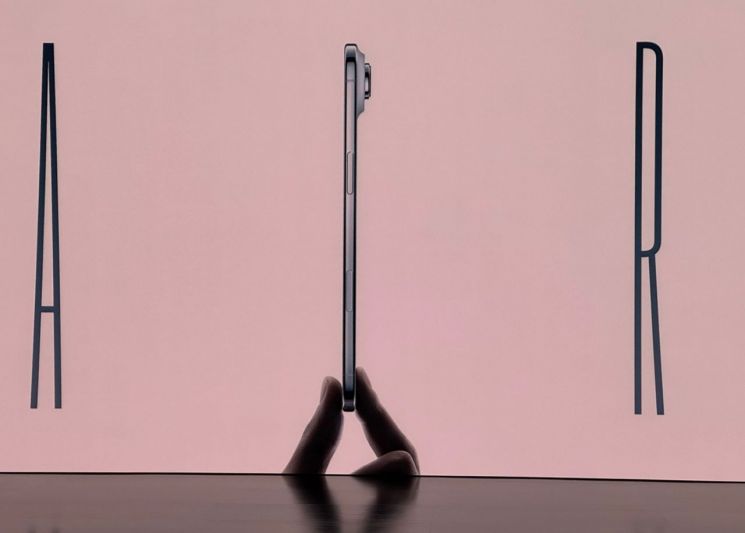 Apple unveiled the thinnest iPhone 'Air' ever at the annual new product launch event held on the 9th (local time) at the Steve Jobs Theater in Apple Park, Cupertino, California, USA. Photo by Yonhap News
On September 9 (local time), Apple unveiled the iPhone Air, its thinnest model ever and a new product lineup. Following Samsung Electronics' launch of the ultra-thin Galaxy S25 Edge, Apple's entry into the market has kicked off a full-fledged competition in ultra-slim smartphones, highlighting portability and refined design.
On this day, Apple held its annual new product launch event at the Steve Jobs Theater in Apple Park, Cupertino, California, where it introduced new products including the iPhone 17 lineup and also showcased the iPhone Air. The iPhone Air measures 5.6mm in thickness and weighs 165g. This is over 2mm thinner than the previous iPhone 16 Plus model, which was 7.8mm thick. The competing slim model, Samsung Electronics' Galaxy S25 Edge, is 5.8mm thick and weighs 163g. When Samsung introduced the Galaxy S25 Edge in May, it described it as the thinnest ultra-slim AI phone in the history of the S series, but the iPhone Air is 0.2mm thinner.
Apple stated, "We wanted to create an iPhone that looks like it came from the future," adding, "We aimed to make it so powerful, thin, and light that you barely feel it in your hand." To achieve both thinness and durability, Apple used grade 5 titanium, which is also used in spacecraft, and wrapped the front and back frames with a ceramic shield to prevent scratches and cracks.
Ultra-slim phones face the challenge of not only having a thin design but also minimizing heat generation during prolonged use and smoothly handling high-load tasks such as generative AI. It is also crucial to enhance durability and optimize the design of internal components to improve functionality and efficiency.
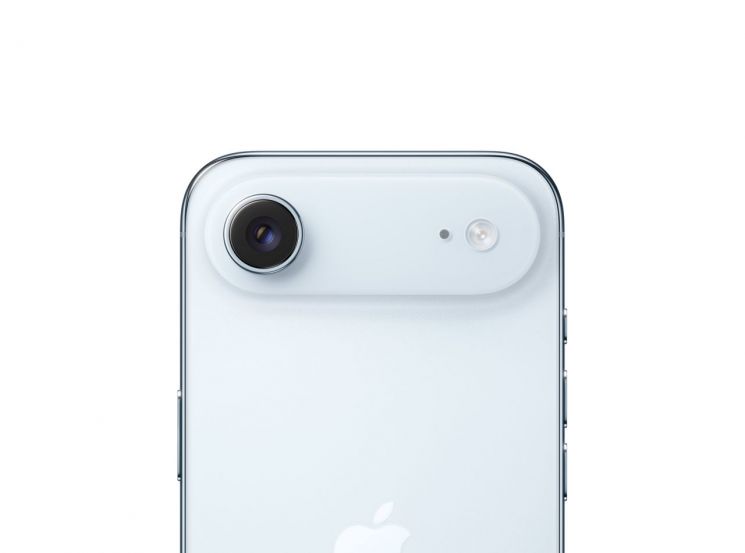
The iPhone Air has secured space for a high-capacity, high-density battery that allows up to 27 hours of video playback. It is equipped with Apple’s self-developed Apple Silicon A19 Pro chip, as well as the N1 wireless communication chip and the C1X cellular modem, delivering professional-grade performance. However, to achieve the slim design, only one rear camera lens (48MP Fusion Main) is installed.
Both Samsung and Apple are using a heat control device called a vapor chamber to maintain a thin design while managing heat in their ultra-slim phones. The vapor chamber contains coolant and distributes heat evenly across a wide area to prevent the device from overheating.
With Apple launching a thin smartphone, the competition over thickness is expected to intensify. In China, the focus on slimness is being applied to foldable phones rather than bar-type models. The Magic V5 by Honor and the Find N5 by Oppo are considered slim and lightweight foldable phones. This trend is seen as a result of consumer demand prioritizing performance and functionality over technical limitations and design.
An industry insider commented, "Ultimately, manufacturers of ultra-slim phones are responding to consumer needs. If phones become excessively thin, issues with grip, durability, and overheating may arise. As manufacturers have to reconfigure and optimize internal components in new ways, the competition in ultra-slim phones will become even fiercer."
On this day, Apple also introduced the iPhone 17 Pro, which enables professional-level photography, and the standard iPhone 17, which for the first time features a 120Hz refresh rate. Additionally, the company unveiled the Watch Series 11, which provides sleep scores, and the AirPods Pro 3, which offers real-time interpretation and translation. The new AirPods also include hearing test and hearing aid functions.
As was the case last year, Korea has been included among the first countries to receive the iPhone release. Starting from the 19th, customers will be able to purchase the new devices at both online and offline stores. However, Apple has been evaluated as not having showcased any striking innovations, reaffirming its status as a latecomer in the advanced AI technology race. On this day, Apple’s stock closed at $234.35, down 1.48% from the previous day.
© The Asia Business Daily(www.asiae.co.kr). All rights reserved.













