‘Implementation Plan for 15 Leading Projects of the Super-Innovative Economy’
Concrete Outcomes Targeted by 2030
The Next Five Years: The Final Golden Time
The government will establish 20 public-private joint task forces to achieve concrete results by 2030. In order to realize a potential growth rate of 3%, it will fully implement 15 leading projects for a super-innovative economy in the fields of national strategic advanced materials and components, climate, energy, future response, and K-Boom-Up. Viewing the next five years as the final "golden time," the government will launch package investments in core technologies such as next-generation power semiconductors, liquefied natural gas (LNG), and graphene application technology. The aim is to double the market share of silicon carbide (SiC) power semiconductors from the current 10% to 20% by 2030, and to increase K-Food exports to 15 billion dollars within five years.
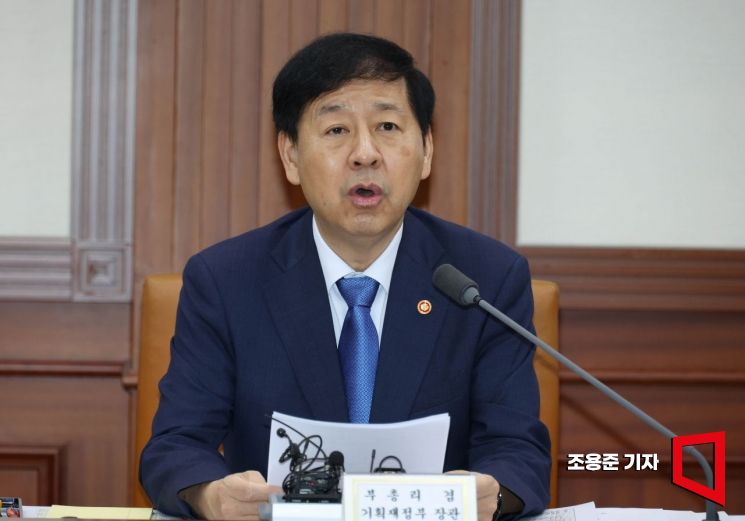 Koo Yoonchul, Deputy Prime Minister for Economic Affairs and Minister of Economy and Finance, is attending and speaking at the Economic Ministers' Meeting and the Ministers' Meeting on Strengthening Industrial Competitiveness held at the Government Seoul Office in Jongno-gu, Seoul on September 3, 2025. Photo by Jo Yongjun
The Ministry of Economy and Finance announced on September 10 at the Government Seoul Office that it held the "Growth Strategy Task Force and Ministers' Meeting on Strengthening Industrial Competitiveness" to discuss the "Implementation Plan for the 15 Leading Projects of the Super-Innovative Economy." The government stated, "In an era where only first place can survive, it is essential to secure global market leadership through the development of world-class technology and industrial advancement."
The government plans to form 20 project-specific task forces within this month. Each task force will consist of around 20 members, including companies, the lead ministry, related agencies, and the Ministry of Economy and Finance. The New Growth Strategy Planning Task Force under the Ministry will be reorganized into the "Super-Innovative Economy Task Force." The Ministry will designate a Super-Innovative Economy Support Officer to assist in resolving issues related to finance, taxation, funding, and regulation. Each project task force will hold its first regular meeting within this month to discuss operational plans. Detailed implementation plans, such as roadmaps, will be completed between October and November. During the meeting, plans for five projects were also discussed.
The projects include: ▲National Strategic Advanced Materials and Components (SiC power semiconductors, LNG cargo holds, superconductors, graphene, special carbon steel); ▲Climate, Energy, and Future Response (next-generation solar power and power grids, offshore wind power and HVDC, green hydrogen and SMR, smart agriculture and smart fisheries, ultra-high-resolution satellites); ▲K-Boom-Up (K-Bio and pharmaceuticals, K-Content, K-Beauty, K-Food). The government aims to produce tangible results within five years through comprehensive support packages covering workforce, financing, overseas expansion, site support, and regulatory improvement.
Doubling SiC Semiconductor Market Share by 2030
First, the government will invest 90.2 billion won in national funding by 2028 to support core technology development in order to double the market share of SiC power semiconductors from the current 10% to 20% by 2030. Additionally, 25 billion won in national funding will be allocated by 2029 to foster master's and doctoral talent specializing in power semiconductors, centered around eight universities including Seoul National University and Sungkyunkwan University. The government plans to support the entire process of developing core technologies, from wafer materials and commercial devices to modules for electric vehicles and green energy, as well as nurturing talent.
SiC power semiconductors are used as key materials for next-generation power semiconductors, as they offer low power loss and lightweight properties even in high-temperature and high-voltage environments. Their ability to improve energy efficiency enables reductions in electricity costs and greenhouse gas emissions, making them suitable for electric vehicles and data centers. However, since a small number of countries, such as the United States and Germany, account for about 90% of the SiC semiconductor market, the government believes that increasing market share is essential to secure competitiveness.
Reducing Overseas Dependence on LNG Cargo Holds (Storage Tanks)... Full Commitment to Localization
The government will also promote the localization of LNG cargo hold (storage tank) technology, a key technology for LNG ships. Funding will be allocated to develop automated equipment for cargo hold panels (1.7 billion won next year), advance materials and components (2 billion won), and establish pilot production bases for core equipment (2.2 billion won next year), thereby strengthening domestic capabilities. Cargo hold technology is highly expandable to next-generation ships such as those using liquefied hydrogen and ammonia, making it a core technology for future market leadership. Although Korea holds the world's top share (55%) in LNG carrier orders, it remains highly dependent on foreign cargo hold technology. The government aims to support the localization of cargo hold technology and raise Korea's share of LNG carriers to 70% by 2030, thereby solidifying its overwhelming first-place position.
The government will also support the development and commercialization of graphene application technology. Graphene is a new material with outstanding strength and conductivity, and the market is expected to grow from 990 million dollars in 2024 to 8.3 billion dollars in 2033. The government aims to enter the energy storage device market by 2030 and the sensor market by 2036.
K-Food Exports: From 10 Billion to 15 Billion Dollars
The government aims to increase K-Food exports to 15 billion dollars by 2030 (from the current 10 billion dollars) and will provide 510 billion won in policy funds to exporting companies. Next year, 72 billion won will be invested in agricultural and food export vouchers to provide tailored support for companies developing K-Food products and clearing samples through customs overseas. Financial support will also be provided for expanding infrastructure such as joint logistics centers and cold chains in major export countries (10.7 billion won next year), as well as for overseas marketing linked with Korean Wave content (11.9 billion won next year).
Riding the popularity of Korean Wave content, products like dumplings, ramen, and kimchi have already achieved success in the global market. K-Food exports have set record highs for nine consecutive years. The government believes that strategic support, including marketing, logistics, and institutional assistance, is necessary to grow K-Food into a global food brand and discover next-generation steady-seller items.
© The Asia Business Daily(www.asiae.co.kr). All rights reserved.












