"We Can't Meet Factory Deadlines by Hiring Only Americans"
In response to the detention of more than 300 Korean workers by immigration authorities at the Hyundai Motor Group joint battery factory construction site in Georgia, calls have emerged to increase the issuance of visas for skilled professionals.
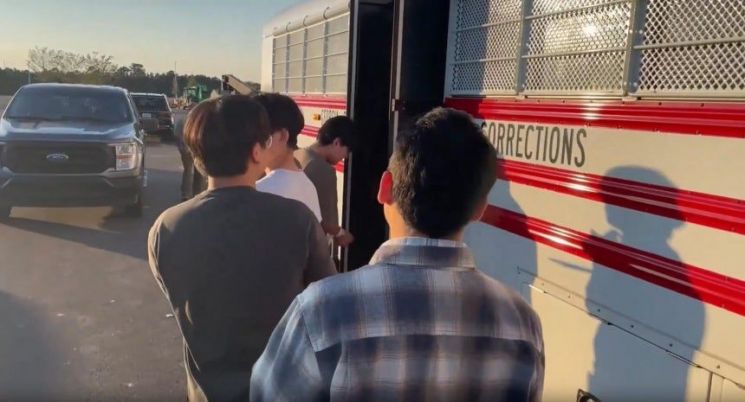 The U.S. Immigration and Customs Enforcement (ICE) released a video showing a surprise raid and detention of about 300 Korean employees at the joint battery factory construction site of Hyundai Motor Group and LG Energy Solution in Georgia. ICE website
On September 9, Yonhap News, citing The Wall Street Journal (WSJ), reported that Asian companies investing in the United States are struggling because they are unable to secure enough visas for the personnel needed to operate their U.S. factories.
The report included expert opinions that the Trump administration's policy of deporting undocumented immigrants is at odds with efforts to attract manufacturing investment in the U.S. It also noted that this detention incident occurred shortly after South Korea announced a plan to invest $350 billion (approximately 486 trillion won) in the United States.
It further relayed the views of immigration experts who said that the U.S. must address its professional visa issues if it wants to attract manufacturing investment.
The Semiconductor Industry Association (SIA) also warned that unless the workforce supply chain is expanded, about 67,000 skilled jobs needed in the semiconductor sector may remain unfilled by 2030.
WSJ reported that while foreign companies investing in the U.S. are trying to hire and train American workers, they lamented that relying solely on U.S. employees would make it impossible to meet tight factory operation deadlines.
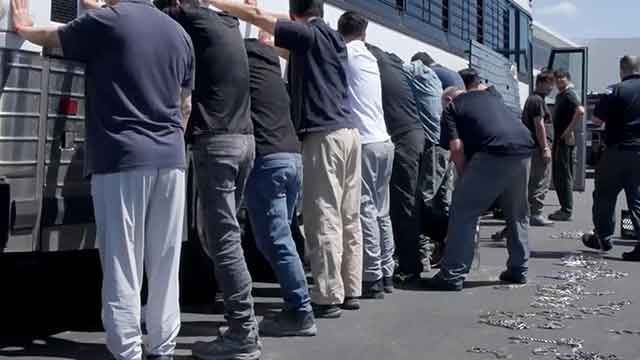 The immigration raid scene at the Hyundai Motor Group-LG Energy Solution joint battery plant located in Georgia, USA, on the 4th (local time), released by the U.S. Immigration and Customs Enforcement (ICE). EPA Yonhap News Agency. Photo by ICE.
Previously, the shortage of skilled technical workers in the United States was cited as one of the main causes of this incident. This shortage is a result of the continued offshoring of manufacturing facilities from the U.S., which has led to a long-term decline in related employment.
The detained Korean employees were holding B-1 visas, commonly referred to as "business trip visas," which are typically used for short-term training and supervision purposes. Many of them worked as supervisors responsible for training workers at the site.
There is also the H-1B visa for foreign professionals in technical and engineering fields, but the annual cap for this visa has recently been set at under 100,000, making it difficult to obtain.
Additionally, there is the E-3 visa, which allows holders to work in the U.S. for up to two years with unlimited renewals. Currently, countries such as Australia and Singapore have agreements with the U.S. that allow their professionals to receive this visa, but South Korea was unable to secure this provision in the Korea-U.S. Free Trade Agreement (FTA).
WSJ stated, "(The Georgia construction site) is an unexpected place where two of Trump's core policies-crackdowns on illegal immigration and the rebuilding of U.S. manufacturing-have collided," adding, "Without these foreign workers, business operations cannot progress, so the visa issue must be resolved for the sake of the U.S. economy."
Wendy Cutler, Vice President of the Asia Society Policy Institute (ASPI), emphasized that since the U.S. prioritizes investment, "a long-term solution is urgently needed" in this area.
Kristi Noem, Secretary of the Department of Homeland Security, which oversees U.S. undocumented immigrant enforcement policy, stated that the more than 300 Koreans arrested at the Hyundai Motor-LG Energy Solution joint battery plant (HL-GA) construction site in Georgia were "detained for violating deportation orders and will soon be deported."
© The Asia Business Daily(www.asiae.co.kr). All rights reserved.













