Return Flight from the U.S. Could Depart as Early as the 10th
The return schedule for over 300 Korean nationals who were arrested by U.S. immigration authorities while working at the Hyundai Motor Group-LG Energy Solution joint battery factory in Georgia has not been finalized as of the morning of September 9. Depending on the outcome of ministerial talks between South Korea and the United States, a return flight could depart as early as the 10th local time, but there is also a possibility that it could be delayed by a day or two. While the government has stated it will make every effort to ensure their swift return, the nature of the detainees' departure and potential disadvantages, such as future denial of re-entry to the United States, are expected to be critical issues in the final negotiations.
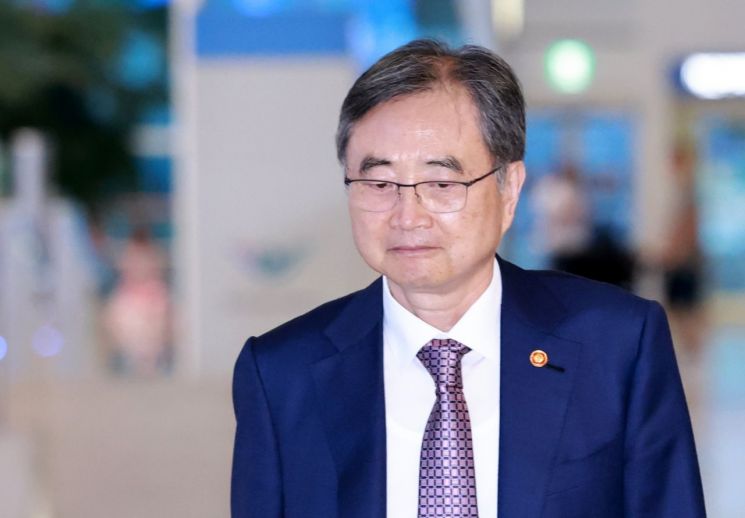 Foreign Minister Cho Hyun is departing for the United States through Incheon International Airport Terminal 2 on the 8th. Photo by Yonhap News
Foreign Minister Cho Hyun, who urgently departed for the United States the previous day to resolve the detention crisis involving Korean nationals, is scheduled to arrive in Washington around midnight on the 8th local time after transiting through Salt Lake City. He is expected to meet with U.S. Secretary of State Marco Rubio on the morning of the 9th to coordinate efforts. There is also a possibility that he will meet with officials from the Department of Homeland Security and other relevant agencies.
There are two main issues at the core of this situation. First, the nature of the detainees' departure from the United States must be clearly defined. The government is negotiating to have all those wishing to return do so under the status of "voluntary departure." As U.S. Secretary of Homeland Security Kristi Noem, who oversees immigration policy, reportedly stated, "We are following the law," and "They will be deported," this matter must ultimately be resolved through ministerial-level discussions between the two countries.
The second issue is resolving the disadvantages for the detainees, such as denial of re-entry to the United States. Even if the detainees are released and safely return home, the construction of the local battery factory is not yet complete, meaning they will eventually need to return to the United States for work. If re-entry is denied due to this incident, it would inevitably disrupt business operations. Even if they return under voluntary departure rather than deportation, it still constitutes an admission of illegal stay, and some point out that a separate pardon process, such as a presidential executive order, would be necessary.
Additionally, there have been calls in the National Assembly for the government to lodge a strong protest with the United States regarding the heavy-handed detention of Korean workers on business trips for U.S. investments, who were restrained with handcuffs and chains. Before departing the previous day, Minister Cho attended a full session of the National Assembly's Foreign Affairs and Unification Committee and stated, "I will make clear statements of protest to the U.S. side during my visit."
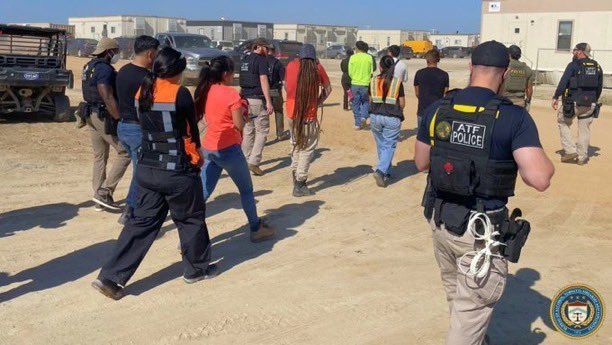 The U.S. Immigration and Customs Enforcement (ICE) and Homeland Security Investigations (HSI) are conducting a large-scale crackdown on illegal immigrants at the construction site of the Hyundai Motor Group-LG Energy Solution joint battery factory located in Savannah, Georgia, on the 4th (local time). Photo by Ex Capture/ Yonhap News
Fundamentally, an institutional solution to the visa issue is needed. Until now, Korean companies have routinely sent employees to the United States on short-term business visas (B1) or travel visas (ESTA), but this incident has led to calls to expand professional work visas (H-1B) or to establish a new visa category (E-4) for Korean professionals. Minister Cho told reporters before his departure, "We will also discuss with the U.S. side the need to change the system in the long term so that such problems do not arise in the future."
However, this visa issue is something the government has been pursuing for over a decade, so it is difficult to expect improvements in the near future. In particular, the establishment of an E-4 visa requires legislative approval by Congress. A Foreign Ministry official explained, "Since 2012, we have been actively reaching out to the U.S. government and Congress to legislate the 'Partner with Korea Act,' which would create a separate E-4 visa quota for Korean professionals," but also acknowledged, "Visa issues are classified as one of the most sensitive topics in the United States, as they are part of the broader immigration issue." The official added that the long-standing practice of including professional quotas in the Free Trade Agreement (FTA) was abolished in 2003 due to concerns raised by the U.S. Congress, and that since a separate E-3 quota was legislated for Australia in 2005, there have been no additional legislative cases for more than 20 years. The official concluded, "We will continue to work with our embassy, consulates, and relevant agencies in the United States to resolve visa and entry issues for our businesspeople."
© The Asia Business Daily(www.asiae.co.kr). All rights reserved.













