Efforts Continue to Save Every Drop of Water
Second National Fire Mobilization Order Issued for Emergency Water Supply
As the Gangneung region marks the tenth day since the government declared a national disaster due to the worst drought on record, even the use of essential facilities such as toilets has become increasingly inconvenient. With water outages now in effect throughout the area, Gangneung residents are sharing makeshift solutions, such as collecting family members' urine in chamber pots and plastic bottles. In addition, Gangneung City is making efforts to save every drop of water, including using plastic covers during meals.
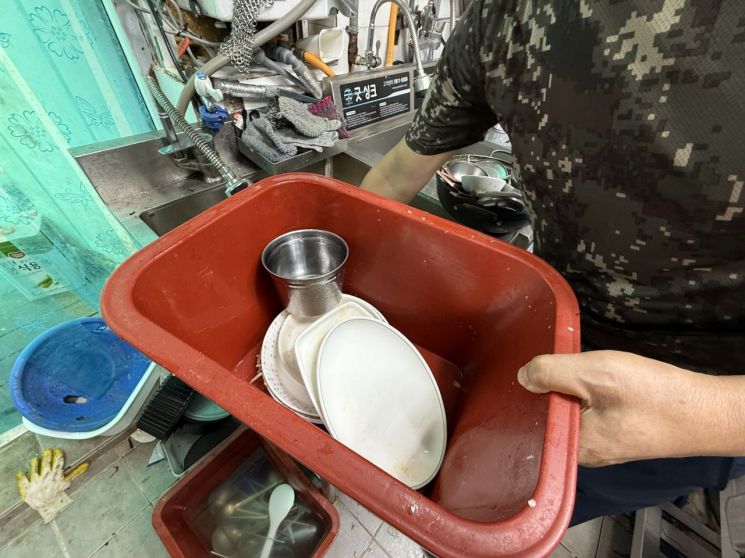 On the 7th, marking the 9th day since the declaration of a "disaster situation" due to an unprecedented drought, a merchant in Gangneung City, Gangwon Province, is using a rubber basin to save dishwashing water. Photo by Yonhap News
On the evening of September 7, a post titled "We are using plastic bottles for urine" appeared on a local mothers' online community in Gangneung, Gangwon Province. The author, Ms. A, shared her plan to collect urine in plastic bottles. She wrote, "My husband said he would do it, and now my son wants to follow suit," adding, "It actually seems cleaner that way." She continued, "As a woman, I have no other choice," and said, "I have to pour stored water to flush." Ms. A also added, "I plan to dispose of the bottles in designated waste bags instead of recycling them later."
Other members of the community expressed empathy, saying, "My youngest heard the announcement not to flush after urinating and said it smells, so they want to use a plastic bottle," and "There is no other choice if we want to survive." One member commented, "Our family bought chamber pots for each person," and explained, "It doesn't seem very hygienic, so we each collect it and throw it away all at once."
Meanwhile, on September 8, Gangneung City announced that it would use disposable plastic tray covers at local social welfare facilities. Sixty-five facilities, including Gangneung Municipal Welfare Center and Gangneung General Social Welfare Center, are participating in the program, which aims to minimize the amount of water used for washing trays and reduce water consumption from the large-scale daily cleaning process. In addition, the city is reducing water usage by using disposable items and simple meals, and the water saved is being prioritized for residents' hygiene and essential water supply needs.
If No Rain Falls in Gangneung, Obong Reservoir's Water Level Will Drop Below 5% in Four Weeks
According to Korea Rural Community Corporation and Gangwon Province, as of 9 a.m. on September 8, the water level at Obong Reservoir was 12.4%, down 0.3 percentage points from the previous day's 12.7%. This is the lowest level ever recorded. After peaking at 36.7% on July 23, the reservoir's water level has decreased for 47 consecutive days.
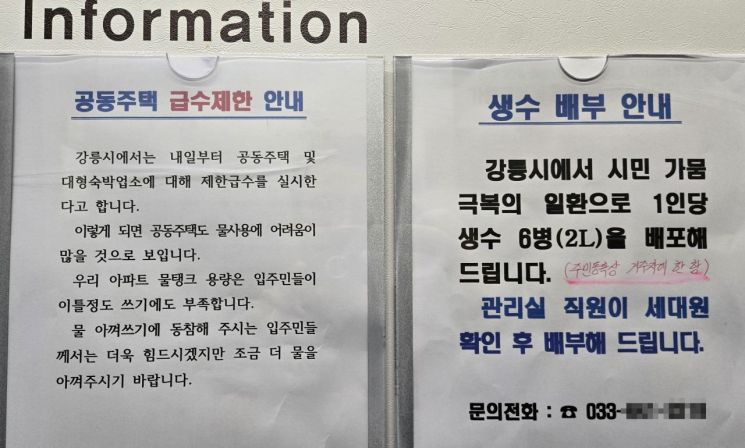 Gangneung City in Gangwon Province, which is experiencing a severe drought, will implement water supply restrictions starting at 9 a.m. on the 6th for 123 large-scale water users, including apartment complexes. A notice informing residents about the water supply restrictions and bottled water distribution is posted in the elevator of an apartment building in Gangneung. Photo by Yonhap News
The province has provisionally analyzed that if the water level at Obong Reservoir, which supplies 87% of Gangneung's drinking water, remains at this level, there will only be enough water to last until September 30. Furthermore, according to the government's "Weekly Drought Status and Outlook for Domestic and Industrial Water," if there is no rainfall, the water level is expected to drop below 5% within four weeks. Obong Reservoir is responsible for supplying 87% of Gangneung's water. The current water level is 99.5 meters, leaving just 7 meters before reaching the dead water line, which is the threshold for normal water supply. "Dead water" refers to water at the very bottom of the reservoir that is severely contaminated and cannot be used, so only water above this line can be supplied.
The National Fire Agency has issued a second national fire mobilization order to support water supply efforts in Gangneung, which continues to suffer from the worst drought damage. Full-scale water supply support activities are set to begin on September 8. Gangneung City has suspended water supply to 123 large-scale users, including 113 apartment complexes with water tanks of over 100 tons and 10 large accommodation facilities. On September 7, 400 military vehicles, two Navy and Coast Guard vessels, five Army helicopters, and 45 pieces of municipal and private equipment were deployed to deliver approximately 30,000 tons of water to Obong Reservoir and Hongje Water Purification Plant. Meanwhile, other regions besides Gangneung are also facing drought. The water level at Gwangdong Dam, the main water source for Samcheok, Jeongseon, and Taebaek, has dropped sharply, prompting a "drought advisory." There are growing concerns that the situation in Gangneung could spread to neighboring areas.
© The Asia Business Daily(www.asiae.co.kr). All rights reserved.













