"AI-Native Developers, Not Junior or Senior"
Jung Gudon CTO Shares Vision for Talent in the AI Era
Emphasizes Mindset and Technical Expertise Over Experience
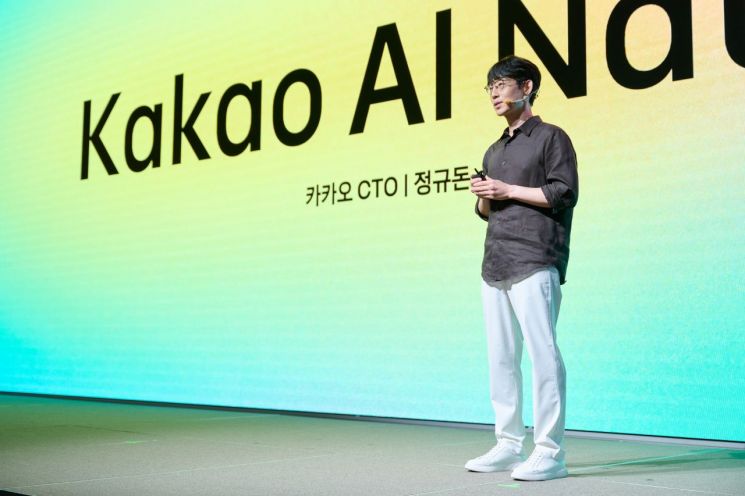
As Kakao prepares for its first-ever group-wide public recruitment since its founding, the company has declared that "distinguishing between junior and senior developers is meaningless" and emphasized that "the talent of the new era is an AI-native developer." Effectively, Kakao is presenting its vision for the ideal talent in the age of artificial intelligence (AI) in conjunction with its public recruitment drive.
According to the information and communications technology (ICT) industry on September 7, Chief Technology Officer Jung Gudon recently published a post titled "To Developers Living in the AI Era" on the Kakao Tech Blog, stressing that "the outdated, seniority-based frame of junior and senior developers no longer matters." He highlighted that in the AI era, "what matters is not experience, but an AI collaboration mindset and expertise in technical domains." Kakao has announced its first integrated public recruitment involving six major group companies since the group's establishment, with applications being accepted from September 8 to 28.
Jung evaluated that AI has brought about a transformation on the scale of upgrading the operating system (OS) of human civilization. He noted that the large language model (LLM) competition has become a full-scale battle requiring national-level infrastructure and resources, making it virtually impossible for individual companies to develop their own models. Instead, he suggested, "A wiser strategy is to utilize AI like an OS to create new applications and services."
Jung also introduced an internal experiment at Kakao called "Vibe Coding." In this approach, developers work with AI to concretize ideas and collaboratively design and write code. In practice, a single developer was able to complete an app prototype in just one week using only AI tools, and productivity improvements of up to 100% were observed even in legacy code environments. Additionally, Kakao piloted an "AI Mileage Program" with a monthly limit of $120, allowing developers to autonomously subscribe to and accumulate usage data with tools such as Cursor, Claude, and WindSurf.
He pointed out that the discussion around productivity also needs to be redefined. Citing developer experiences that "coding speed has more than doubled, but bottlenecks occur during the code review stage," he emphasized that what is needed is not just simple coding efficiency, but innovation across the entire workflow. Accordingly, he suggested that both a bottom-up approach-using AI to resolve bottlenecks in each role-and a new collaboration model led by AI-native talent should be pursued in parallel.
Finally, Jung stated, "In the AI era, roles such as architect, product builder, and agent orchestrator will become more important than that of a simple coder," adding, "Even new hires who know how to use AI as an extension of their own brain can achieve results on par with seniors of ten years' experience." He relayed developers' sentiments that "there is no going back to the days before AI tools," and stressed that "we should greet the AI era with excitement rather than fear."
© The Asia Business Daily(www.asiae.co.kr). All rights reserved.

















