"Special Focus on Changing and Rationalizing Regulations"
Promises of Active Support and Regulatory Easing
Bio Industry Stakeholders Call for Regulatory Rationalization... Raise Need for Investment Ecosystem Improvement
Minister Chung Eunkyung Proposes Plan to Shorten Review Period by Four Months
President Lee Jaemyung has rolled up his sleeves, vowing to foster K-Bio as a national core industry on par with semiconductors. At a gathering of bio industry stakeholders, President Lee stated, "We are considering dramatically shortening the review period to the shortest in the world," and added, "We will pay special attention to changing the regulatory approach and rationalizing or boldly easing regulations to bring about change." He also instructed the accompanying ministers and aides to actively review the suggestions made by bio company CEOs and researchers.
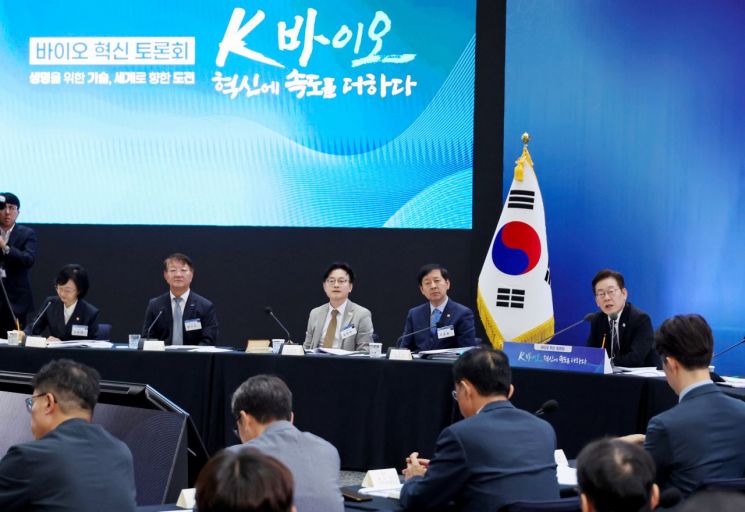
On September 5, President Lee made these commitments at a forum titled "K-Bio, Accelerating Innovation," held at Songdo Convensia in Incheon, attended by over 130 experts from bio companies, investment firms, related associations and organizations, and academia. In his opening remarks, President Lee emphasized, "The bio industry will become a very important sector among Korea's future industries," and reiterated the future industry keywords he had presented during the presidential campaign: 'A (AI), B (Bio), C (Content), D (Defense and Aerospace), E (Energy), F (Manufacturing).'
President Lee particularly promised active support and regulatory easing. He said, "The government must support and firmly back bio industry professionals so they can work autonomously and creatively," adding, "It is important to expedite the certification process during research and development." He continued, "I expect that most of you will mention the need for regulatory relaxation, and I will approach this with an open mind."
Following President Lee's opening remarks, Minister of Health and Welfare Chung Eunkyung presented the "K-Bio Pharmaceutical Industry Leap Forward Strategy," which includes plans to use AI in the review process and significantly increase review personnel, thereby reducing the review period by about four months (from 406 days to 295 days). Minister Chung stated, "In line with the vision of becoming one of the world's top five bio powerhouses over the next five years, we will aim to double exports, develop three blockbuster new drugs, and rank third globally in clinical trials."
At the event, stakeholders from the bio industry offered numerous suggestions. There were strong calls to rationalize regulations in processes such as bio R&D, fundraising and investment, and commercialization. Lee Youngpil, Vice President of Alteogen, pointed out, "Even though we have global-level quality management systems, due to the Pharmaceutical Affairs Act, we are unable to produce under Good Manufacturing Practice (GMP) standards," stressing the need for institutional improvements. Kim Kyunga, CEO of Samsung Bioepis, said, "The adoption rate of biosimilars is lower and the pace of dissemination is slower compared to Europe and the United States. There need to be incentives and systems so that doctors can use them more actively." In response, President Lee remarked, "The biosimilar issue is an unofficial point of contention," adding, "Patients are unaware, but doctors use expensive original drugs. This is a problem that must be solved and could be seen as a form of irrationality."
Choi Yunhee, Research Fellow at the Korea Institute for Industrial Economics and Trade, noted, "While clinical trials for regenerative medicine and gene therapies have increased, market entry remains blocked." Kang Jihoon, CEO of Oncocross, said, "Due to the Personal Information Protection Act and Medical Service Act regulations, it is difficult to utilize data for AI drug development. We need to actively leverage data disclosure."
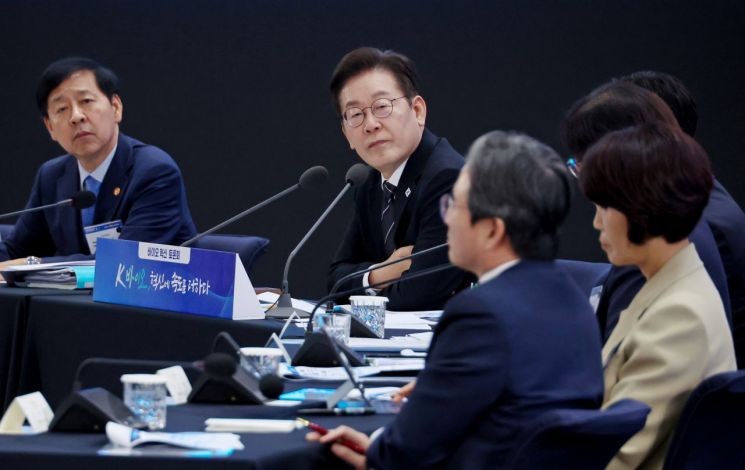
There were also suggestions to structurally innovate the investment ecosystem. Yoon Chaeok, CEO of GenMedicine, stressed, "Companies developing new drugs have no sales revenue. Investment must come from the government or the private sector," adding, "Clinical phases 1, 2, and 3 together require up to 50 billion won in funding. These companies need significant support." Lee Seungjoo, CEO of Orum Therapeutics, pointed out, "In the United States and China, multiple stock exchanges compete, giving companies a variety of options, whereas in Korea, the entire IPO process and oversight are handled by a single entity, which structurally limits market development." In response, Kwon Daeyoung, Vice Chairman of the Financial Services Commission, who attended the forum, said, "I agree with the need for smooth capital procurement."
In his closing remarks, which extended longer than scheduled, President Lee said, "I will remember your comments well. They will be of great help in formulating and implementing internal policies," adding, "Today is not the end. If you have further opinions, please share them actively-even through personal social media (SNS)."
Meanwhile, the fact that the forum was held in Incheon, which was President Lee's former constituency (Gyeyang-eul) during the 22nd National Assembly, also drew attention. President Lee commented, "Incheon is truly a special city. I think I lived here for about three years, and it is a great land that embraces everything anew." He added, "Although the bio industry did not seem to have a special connection with Incheon at first, thanks to your efforts, it is now developing into a hub for the bio industry," expressing his affection for the city.
© The Asia Business Daily(www.asiae.co.kr). All rights reserved.


















