Lee: "Make It the Shortest in the World"
Government Unveils K-Bio Leap Forward Strategy
Plans to Cut New Drug Review Period by Over 100 Days
Industry Calls for Negative Regulation and Flexible Approvals
The government is working to shorten the review period for new drug clinical trials and to streamline the overall clinical process.
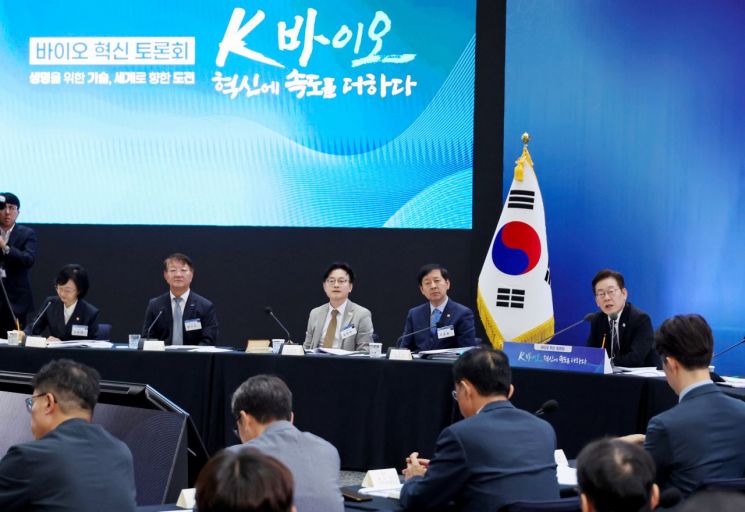 President Jae Myung Lee is speaking at the Bio Innovation Forum held on the 5th at Songdo Convensia in Incheon. From the left at the table are Woo Kyung Oh, Director of the Ministry of Food and Drug Safety; Sang Yeop Lee, Vice Chairman of the National Bio Committee; Jung Kwan Kim, Minister of Trade, Industry and Energy; Yoon Chul Koo, Deputy Prime Minister and Minister of Economy and Finance; and President Jae Myung Lee. Photo by Yonhap News.
On the afternoon of September 5, Minister of Health and Welfare Jeong Eun-kyung unveiled the "K-Bio Leap Forward Strategy" at the Bio Innovation Forum held at Songdo Convensia in Incheon, presided over by President Jae-myung Lee. Minister Jeong presented a plan to reduce the review period for new drug development from 406 days to 295 days by establishing a dedicated clinical trial review team, increasing review personnel, and introducing AI-based review systems. The President also urged, "Make it the shortest in the world, and reduce it dramatically."
The Ministry of Food and Drug Safety stated that it is in discussions with regulatory authorities in the United States and Europe to "simplify phase 3 clinical trial data for biosimilars, as long as safety is not compromised." The ministry also announced that a public-private consultative body will be launched in September to facilitate this initiative.
There were also strong calls for a shift in regulatory approaches. Industry representatives argued that switching to a negative regulatory system would allow for greater innovation in the bio sector. Kim Kyung-sook, CEO of Corestem ChemOn, said, "We need to enhance predictability by lowering pre-approval hurdles and strengthening post-market monitoring through a 'negative rule' system." Jaejin Cho, CEO of Cell in Cells, added, "Conditional approvals should not be limited only to rare and intractable diseases, but should be applied flexibly based on innovation and risk-benefit assessments."
Choi Yunhee, a research fellow at the Korea Institute for Industrial Economics and Trade, suggested, "There is a need to expand local regulatory exemptions and sandboxes in the field of regenerative medicine, and to establish a governance system that can comprehensively manage national clusters." Sangyeop Lee, Vice President for Research at KAIST and Vice Chairman of the National Bio Committee, added, "It is also necessary to discuss industry issues such as legal capital impairment and the capitalization of R&D (research and development) assets in parallel."
© The Asia Business Daily(www.asiae.co.kr). All rights reserved.

















