12 Vessels, Including Purification and Response Ships, Deployed for Intensive Red Tide Control
3.27 Million Red Sea Bream and Other Fish Released to Prevent Mass Mortality
Yeosu City in South Jeolla Province (Mayor Chung Kimyung) announced on September 5 that it is making all-out efforts to prevent damage to farmed marine life after a red tide advisory was issued for the coastal waters of Yeosu on August 29.
Currently, the sea surface temperature along the Yeosu coast is around 25°C, which provides optimal conditions for the proliferation of Cochlodinium, a harmful red tide organism. In addition, the inflow of land-based nutrients has further contributed to the widespread expansion of the red tide bloom.
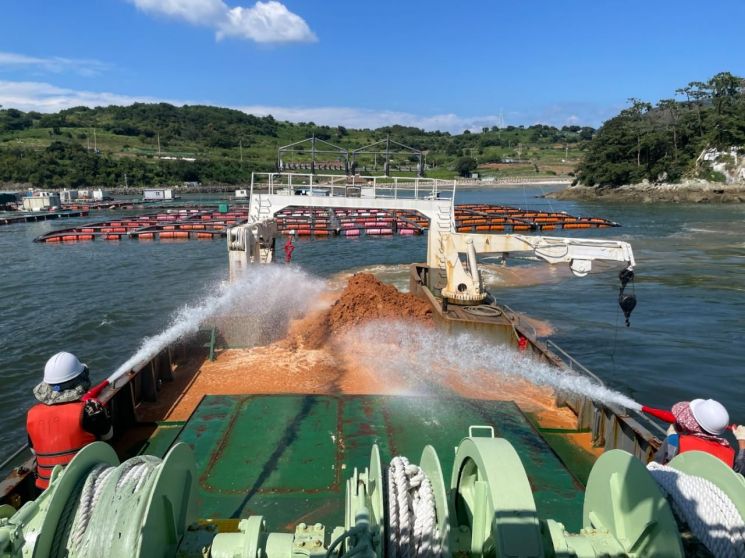
The city monitors the densely clustered fish farms every day, measures the density of Cochlodinium, and establishes a daily red tide control plan to respond accordingly. Three city purification vessels, one provincial purification vessel, one Coast Guard response vessel, and seven chartered barges have been assigned exclusively to fish farms with high red tide density. Approximately 400 tons of loess soil are being spread per day as part of the intensive red tide control efforts.
So far, there has been no damage to farmed marine life caused by the red tide. However, the situation remains tense, as a sudden change in ocean currents could result in mass mortality due to the harmful red tide organisms at any time.
In addition, Yeosu City is releasing approximately 3.27 million fish-including red sea bream, black porgy, rockfish, and sea bass-after disease inspection, for 56 fish farms that applied for emergency release by September 7. This emergency release is a preemptive measure to address concerns about mass mortality of farmed fish, as the red tide has persisted for several days.
A city official stated, "We ask fish farmers to make sure to check the text messages sent by the city to prevent red tide damage," and urged, "Please strictly follow the control guidelines, including stopping feed supply, implementing water flow control, operating liquid oxygen and oxygen generators, and prohibiting nighttime water intake at land-based fish farms."
© The Asia Business Daily(www.asiae.co.kr). All rights reserved.