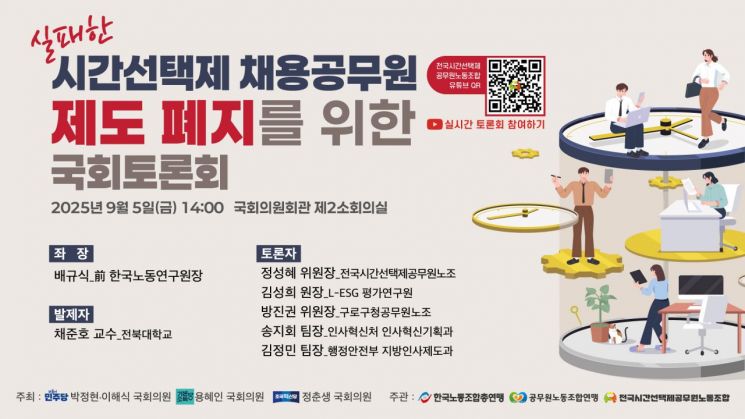
The National Part-Time Public Officials Labor Union (Chairperson Jung Sung-hye, Part-Time Officials Union), under the Federation of Public Officials’ Trade Unions of the Federation of Korean Trade Unions, will hold a press conference in front of the main gate of the National Assembly at 11:30 a.m. on September 5, calling for the complete abolition of the part-time recruitment system for public officials. Later, at 2:00 p.m., a National Assembly debate titled "Abolishing the Failed Part-Time Recruitment System for Public Officials" will be held in Meeting Room 2 of the National Assembly Members' Office Building.
The part-time public official system was introduced based on the National Public Officials Act and the Local Public Officials Act. There are three types: public officials who switch from full-time to reduced working hours; those recruited as part-time employees from the point of appointment; and fixed-term public officials who work only for a certain period. According to the union, the most problematic type is those recruited as part-time employees.
This policy, promoted as part of the Park Geun-hye administration's "Measures to Revitalize Part-Time Jobs" in 2013, recruited more than 6,500 people since 2014. However, as of the end of 2024, only 3,568 remain in service, with a turnover rate reaching 40%. According to the union’s survey of HR departments in local governments and central administrative agencies nationwide, 77.7% and 60.4%, respectively, supported abolishing the system. The main reasons cited were "workforce gaps" and "difficulty in assigning positions."
On the ground, dissatisfaction is high. According to a union survey conducted in July, 63.2% of respondents reported "dissatisfaction with their work." Additionally, 91.4% said there was no distinction in work between them and regular public officials, and 80.6% stated they worked overtime. More than half reported working over 21 hours of overtime per month, effectively performing the same labor as full-time employees. Nevertheless, their pay and promotion periods were proportionally limited based on hours worked. Seventy percent of respondents considered resigning, and 92.1% wanted the system abolished.
It was also pointed out that, unlike those who switch from full-time, only those recruited as part-time employees face concentrated disadvantages. These include discrimination in promotion calculations, parental leave periods, and position assignments. In a follow-up union survey, 100% of respondents agreed with "a blanket conversion to full-time positions."
This debate is co-hosted by Park Jeong-hyun and Lee Hae-sik of the Democratic Party of Korea, Yong Hye-in, leader of the Basic Income Party, and Jeong Chun-saeng of the Korea Reformation Party, and organized by the Federation of Korean Trade Unions, the Federation of Public Officials’ Trade Unions, and the Part-Time Officials Union. Presentations will be given by Chae Jun-ho, professor at Jeonbuk National University, with Bae Gyu-sik, former president of the Korea Labor Institute, serving as moderator. Discussants include Chairperson Jung Sung-hye, Kim Sung-hee, president of the L-ESG Evaluation Institute, Bang Jin-kwon, chairperson of the Guro District Office Public Officials Union, Song Ji-hoe, team leader at the Personnel Innovation Planning Division of the Ministry of Personnel Management, and Kim Jeong-min, team leader at the Local Personnel System Division of the Ministry of the Interior and Safety.
Chairperson Jung Sung-hye emphasized, "The part-time recruitment system for public officials could not overcome its inherent limitations and instead institutionalized discrimination within the public sector. The remaining 3,500 part-time public officials should be converted to full-time positions, and the system must be abolished."
© The Asia Business Daily(www.asiae.co.kr). All rights reserved.

















