President Lee Meets Leaders of Major Labor Unions for the First Time Since Inauguration
Lee: "We Are Only Legislating What the Courts Have Recognized, but People Still Do Not Believe It"
Stresses Dialogue and Communication
"Let's Work Toget
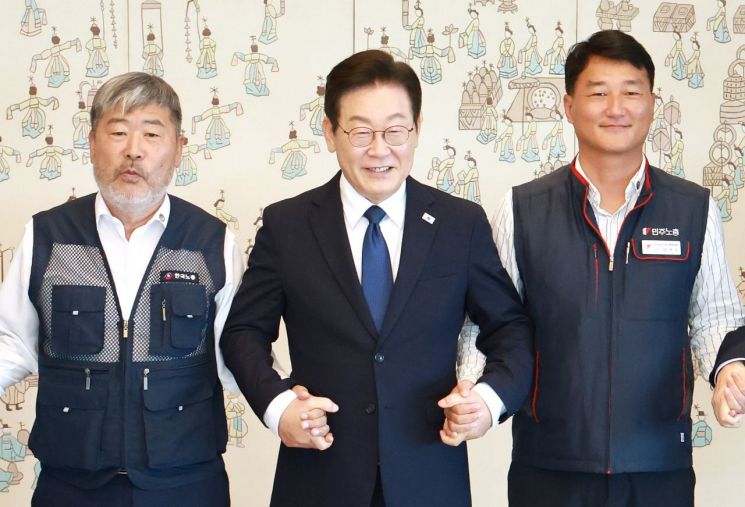 President Lee Jae-myung attended a luncheon meeting with the chairmen of the two major labor unions at the Yongsan Presidential Office building in Seoul on the 4th. He is seen holding hands and taking a commemorative photo with Kim Dong-myung, chairman of the Federation of Korean Trade Unions (left), and Yang Kyung-soo, chairman of the Korean Confederation of Trade Unions. Photo by Yonhap News
On September 4, President Lee Jae-myung addressed concerns from the business community that the Yellow Envelope Act (the amendment to Articles 2 and 3 of the Trade Union and Labor Relations Adjustment Act) would put them at a disadvantage, stating, "That will not happen."
President Lee held a luncheon that day at the Yongsan Presidential Office with Yang Kyung-soo, chairman of the Korean Confederation of Trade Unions, and Kim Dong-myung, chairman of the Federation of Korean Trade Unions. Bibimbap, symbolizing harmony, was served at the luncheon. During the meeting, President Lee said, "There are concerns that the amendment to the trade union law has made things too unfair and unfavorable for employers," emphasizing, "In my view, that will not happen."
President Lee added, "We are only legislating what the courts have already recognized, so I am explaining that there is nothing disadvantageous about it, but people do not seem to believe it." He continued, "Looking at both sides-the business community and the labor community-I feel that our society has a lot of distrust, lacks communication, and is short on dialogue."
President Lee repeatedly urged the chairmen of the two major labor unions to participate in tripartite talks. He said, "Workers and employers really need to have a conversation," and appealed, "We need to resolve misunderstandings, dispel any potential hostility, and have many discussions based on facts to adjust our positions."
Regarding the Economic, Social and Labor Council, a social dialogue body that has yet to elect a chairman, President Lee remarked, "Whether you meet and argue or not, whether you reach a conclusion or not, at least you should meet. I wonder why they are not meeting at all."
The two union leaders also voiced agreement on the need for dialogue. Chairman Kim said, "I propose that the president personally bring together the main economic actors to deliberate for a set period and declare a grand social compromise within that framework." Chairman Yang added, "To address the climate crisis and labor inequality, I propose comprehensive labor-government negotiations."
Kang Yoo-jung, spokesperson for the presidential office, said in a later briefing, "(President Lee) emphasized several times that it is possible to have both an advanced labor society and a business-friendly country, and that it is important for labor and management to meet and talk." Kang continued, "(President Lee) welcomed the Korean Confederation of Trade Unions' important decision to participate in a social body led by the National Assembly," adding, "In particular, President Lee said that the first step in resolving conflict and building trust is to sit down together and talk, and invited participation in the presidential Economic, Social and Labor Council."
President Lee also asked the two union leaders for the labor community's opinions on ways to drastically reduce industrial accident fatalities. Spokesperson Kang said, "By exchanging views on major issues, they confirmed a sincere will for communication and cooperation," and added, "Regarding ways to reduce industrial accident deaths, the two union leaders said it is necessary for frontline workers to have real authority to act as agents of prevention."
Spokesperson Kang further stated, "(President Lee) emphasized the need to enhance technological adaptability and application in the face of advanced technologies such as artificial intelligence (AI), as well as the role of public education." She added, "After carefully listening to the opinions of the two union leaders, President Lee reaffirmed the importance of dialogue and communication to build trust and pledged to promote regular social dialogue."
There was also discussion about the 4.5-day workweek and extending the retirement age. Spokesperson Kang explained, "The chairman of the Federation of Korean Trade Unions conveyed his views on the 4.5-day workweek, and there was discussion about institutions such as Yonsei University Medical Center, which are piloting this system."
© The Asia Business Daily(www.asiae.co.kr). All rights reserved.