APEC Venture Investors Emphasize Cross-Border Cooperation
Summit Highlights Need for Expanded Exchange and Standardization
Secondary Market Growth Seen as Key Solution Amid Liquidity Challenges
Venture capital institutions within the Asia-Pacific Economic Cooperation (APEC) have agreed that the Asian venture investment market can only grow by crossing borders. Amid high interest rates, delayed exits, and geopolitical risks, cooperation between countries is seen as the key to survival and growth.
Rebecca Shum, Chair of the Hong Kong Venture Capital Association (HKVCA), stated at the '2025 Global Venture Investment Summit' held on the 4th at the Jeju International Convention Center (ICC), "For the APEC venture investment market to thrive together, we must go beyond our comfort zones and broaden our perspectives." She added, "I firmly believe that technology knows no borders. I rarely see Korean venture capitalists going to China, and this lack of exchange needs to be addressed."
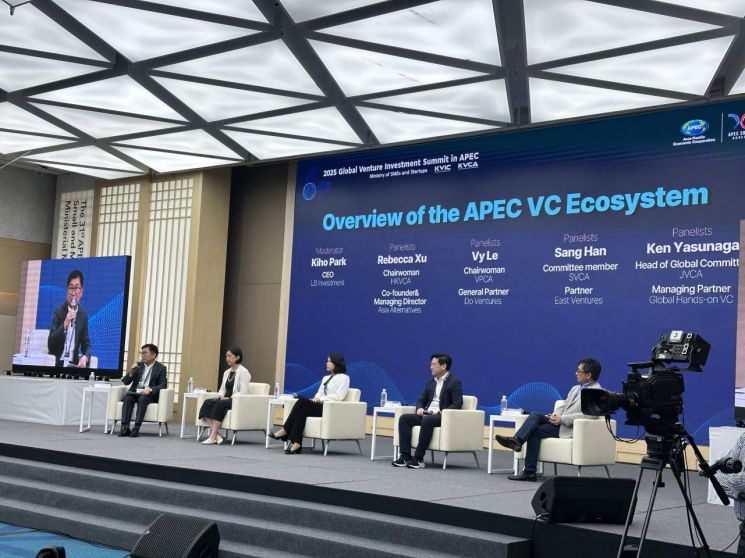 At the Global Venture Investment Summit held on the 4th at the Jeju International Convention Center (ICC), attendees are discussing the Asia-Pacific Economic Cooperation (APEC) venture capital ecosystem. Photo by Lee Sungmin
The summit, held as a side event to the Asia-Pacific Economic Cooperation (APEC) Small and Medium Enterprises Ministerial Meeting scheduled for the 5th, aimed to expand global venture capital networking. A total of 147 institutions participated, including 77 overseas organizations from 17 countries and over 60 domestic investment institutions, making it the largest single venture investment event ever held in Korea.
Chair Shum commented, "The crisis China has faced over the past five years was not due to finance or real estate, but rather a lack of trust." She explained, "As consumers, entrepreneurs, and investors all lost confidence, asset undervaluation persisted." She continued, "Since last September, the government has shifted its focus toward growth and boosting consumption, and we are seeing positive signs. Although investing in China now requires a higher risk premium than before, the country still has ample potential to produce global leaders."
Le Hoang Uyen Vi, Chair of the Vietnam Private Capital Association (VPCA), said, "The scale of private capital investment in Vietnam is only $2.3 billion, far below our GDP." She explained, "While there is capital available at the early stages, there is a significant gap at the Series B and C stages. Government-designated strategic technologies and startup funds alone are not enough; ultimately, international cooperation and the involvement of players at each stage are necessary."
Ken Yasunaga, Chair of the Global Committee of the Japan Venture Capital Association (JVCA), said, "Forty percent of graduates from Japan's top universities are choosing to launch startups." He added, "The number of foreign entrepreneurs is increasing, university and large corporate spin-offs are spreading, and the government has established a $500 million fund to directly support research and development." He emphasized, "Korea and Japan have similar industrial structures, so collaboration in supply chains and customer sharing can yield rapid results."
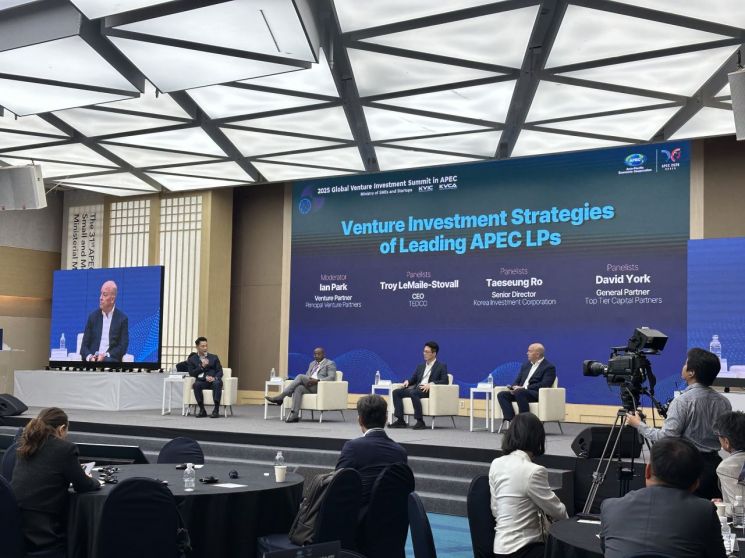 At the Global Venture Investment Summit held on the 4th at the Jeju International Convention Center (ICC), attendees are discussing venture investment strategies from the perspective of limited partners (LPs). Photo by Lee Sungmin
During the limited partner (LP) session, liquidity issues were discussed. Troy LeMaile-Stovall, CEO of TEDCO, said, "Both investors and investee companies are facing liquidity challenges. When exits are delayed, follow-on funding rounds get tied up, causing bottlenecks at the early stages and potentially slowing the pace of innovation." David York, founder of Top Tier Capital, noted, "As interest rates rise, LP funds are flowing into large houses, leaving less room for mid-sized managers. The expansion of the secondary market is the only real valve to relieve this pressure."
However, they analyzed that as interest rates begin to decline, new opportunities may emerge. York said, "In the past six months, there have been 12 acquisitions in the healthcare and enterprise software sectors. There are also attractive companies waiting to go public, and with signs of a shift toward lower interest rates, the atmosphere is reminiscent of the mid-1990s." He added, "The Asian market is especially attractive due to the growing middle class. Valuations are reasonable, and there are opportunities to be seized even amid geopolitical challenges."
© The Asia Business Daily(www.asiae.co.kr). All rights reserved.













