Minister of the Interior and Safety Lacks Investigative Authority
"Democratic Oversight" Virtually Impossible
Skepticism Within Police Ranks
Can They Truly Claim "No Investigative Interference"?
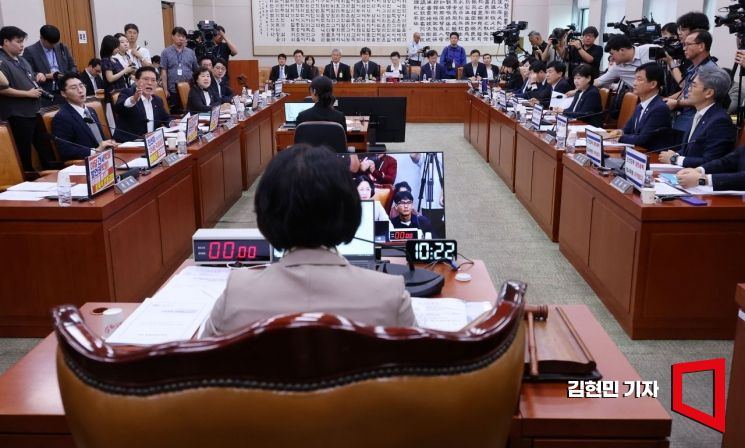 On the 4th, at the Public Hearing on Prosecutorial Reform held by the National Assembly's Legislation and Judiciary Committee, People Power Party lawmakers Joon Tae Park and Seok Jun Song requested a procedural statement from Chairwoman Mi Ae Chu.
The balance is tipping toward placing the Serious Crimes Investigation Agency (SCIA), which is set to take over the prosecution's investigative functions, under the Ministry of the Interior and Safety. If the SCIA is established as a subordinate agency of the Ministry of the Interior and Safety, all investigative bodies in South Korea would be concentrated under a single ministry, creating an abnormal structure. With the Ministry of the Interior and Safety already overseeing the police and the National Investigation Headquarters, the addition of the SCIA would effectively transform it into a massive "dinosaur investigative organization."
On September 5, concerns have been raised both within and outside the legal community that if the SCIA is placed under the Ministry of the Interior and Safety, "democratic oversight" would become virtually impossible. Establishing the SCIA under this ministry would merely add another investigative body that operates without effective oversight, just like the police and the National Investigation Headquarters.
The SCIA is being created to take over the investigation of serious crimes currently handled directly by the prosecution, with the broader goal of separating investigative and prosecutorial powers. Given that the SCIA will function as a quasi-judicial body, the prevailing opinion in the legal community is that it should be placed under the Ministry of Justice.
The problem is that if the SCIA is placed under the Ministry of the Interior and Safety, it will become yet another powerful agency operating without oversight, just like the police and the National Investigation Headquarters, which are not subject to the direction or supervision of the Minister of the Interior and Safety. The prosecutorial reform bill proposed by the Democratic Party of Korea stipulates that the Minister of the Interior and Safety cannot direct or supervise the SCIA in any specific cases, meaning there is no mechanism to control the head of the SCIA, who oversees the agency.
Initially, the Cho Kuk Innovation Party, which introduced a prosecutorial reform bill before the Democratic Party, designed its proposal so that the Minister of Justice would generally direct and supervise SCIA investigators and could also direct and supervise the SCIA chief in specific cases, mirroring the current structure of the Prosecutors' Office Act and enabling oversight of serious crime investigations. Under current law, the Minister of Justice can direct the Prosecutor General in specific cases.
There are also concerns that the Ministry of the Interior and Safety could become a gigantic investigative authority wielding excessive power. If the SCIA, with its serious crime investigative authority, is added to the police and the National Investigation Headquarters under the ministry, the power of the Ministry of the Interior and Safety could become excessively bloated. The ministry is responsible for overseeing local governments and managing elections, so if it gains control over all investigative powers, there is a risk that it could intervene in local government and elections through investigations.
This also means that the Ministry of the Interior and Safety, which holds personnel authority over investigators, would be structurally positioned to easily send so-called "investigative messages" through personnel decisions. The appointment and assignment of prosecutors are stipulated by the Prosecutors' Office Act, which states that the "President appoints them upon the recommendation of the Minister of Justice." In contrast, the Police Act specifies that "police officers at the rank of superintendent and below are appointed by the Commissioner General of the National Police Agency." It is highly likely that SCIA investigators under the Ministry of the Interior and Safety would be appointed through a structure similar to that of the police and the National Investigation Headquarters. Ultimately, the exercise of personnel authority could alter or redirect the course of investigations.
One senior police official stated, "The reason 'officer' is attached to judicial police titles is because they have the authority and responsibility to make independent decisions based on their own judgment," adding, "However, I question whether anyone can confidently say that, in the current investigative process of the police and the National Investigation Headquarters, the opinions of superiors with influence over personnel decisions are not involved at all."
There are also skeptical responses within the police regarding placing the SCIA under the Ministry of the Interior and Safety. They argue that if multiple investigative agencies are concentrated within a single ministry, it would lead to competition, and the targets and scope of investigations would become unclear, increasing the likelihood of internal conflict. Additionally, concerns have been raised that if the SCIA is placed under the ministry, there are no plans for issues such as recruitment and allocation of personnel or personnel exchanges between the police, the National Investigation Headquarters, and the SCIA, which could further exacerbate confusion.
© The Asia Business Daily(www.asiae.co.kr). All rights reserved.












