Export Companies Request Government to Lower Tariffs on Steel Products
The Tax Policy Bureau of the Ministry of Economy and Finance announced on September 4 that it held a joint meeting with the Korea Customs Service at Pyeongtaek Customs for export companies.
This event was organized to listen to the difficulties faced by major export companies, such as those in the automobile and steel industries, amid rapidly changing external conditions including the imposition of reciprocal tariffs by the United States and the restructuring of global supply chains.
The meeting was attended by major export companies in the automobile and steel sectors such as Hyundai Motor Company, Daehan Solution, Seojin Automotive, Hyundai Steel, High Steel Co., Ltd., DI Dongil, and Poongsan Co., Ltd., as well as public institutions including Korea Trade-Investment Promotion Agency (KOTRA), Korea Trade Insurance Corporation, and Korea Origin Information Agency.
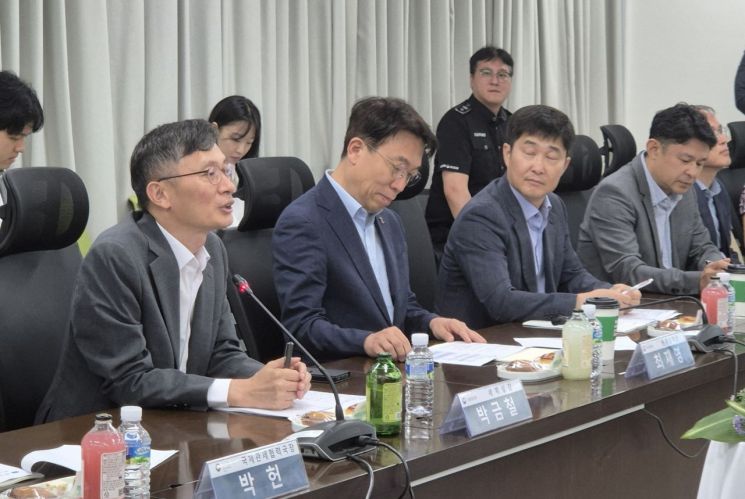 Park Geumcheol, Director of the Tax Policy Bureau at the Ministry of Economy and Finance, is presiding over the "Pyeongtaek Export Companies On-site Meeting" held at Pyeongtaek Customs in Pyeongtaek, Gyeonggi Province, on the morning of the 4th. (Photo by Ministry of Economy and Finance)
On this day, the companies proposed reducing tariffs on steel products, clarifying the application criteria for steel product tariffs, and disclosing detailed HS codes. They also requested expanded financial and insurance support for the automobile and steel industries, as well as the simplification of customs procedures.
The government plans to review these proposals so that they can be reflected in future government policies and customs administration. In addition, it intends to further expand communication with the export sector and increase support for Korean companies in response to changes in external trade conditions.
Meanwhile, the United States previously imposed a 25% tariff on steel, aluminum, and 259 derivative products in March. On June 4, it raised the tariff rate to up to 50%, and subsequently added home appliances such as dryers, washing machines, and freezers to the list of derivative products. Last month, an additional 407 types of derivative products were added, including wind turbines and related parts, heavy equipment such as bulldozers, railway vehicles, furniture, and agricultural machinery.
© The Asia Business Daily(www.asiae.co.kr). All rights reserved.

















