Participated in Installation of Large Cover Over No. 1 Reactor Building
Tokyo Electric Power Company: "Unclear Causal Relationship Between Work and Death"
A worker who was working at the Fukushima Daiichi Nuclear Power Plant in Japan has died, prompting authorities to launch an investigation. The No. 1 reactor at the plant, where the deceased worker was assigned, is one of the reactors that experienced an explosion during the Great East Japan Earthquake in 2011. On September 3, Yonhap News, citing Japanese media outlets such as Kyodo News and Tokyo Shimbun, reported that a man in his 40s, employed by a partner company and participating in the installation of a large cover for the removal of spent nuclear fuel at the No. 1 reactor of the Fukushima Daiichi Nuclear Power Plant, died on the job.
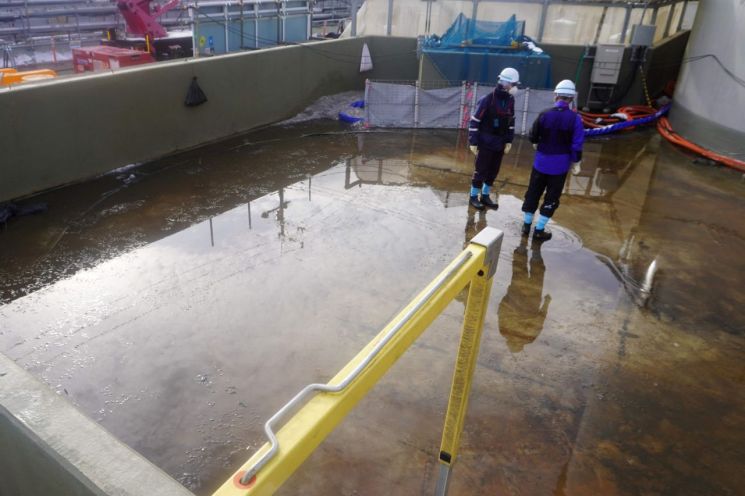 A worker who worked at the Fukushima Daiichi Nuclear Power Plant in Japan has died, prompting authorities to launch an investigation. Photo by AFP Yonhap News
The deceased man participated in the installation of a large cover over the No. 1 reactor building for about an hour starting from 6:10 a.m. that day. After removing his protective suit, he spent about two hours resting in the on-site waiting area. While walking to the seismic isolation important building (the nuclear power plant control facility) to leave work, he collapsed. According to Tokyo Electric Power Company, he had taken a two-hour break and attended a meeting in the waiting area, but had not reported any particular health issues.
The man was transferred to the emergency medical room within the plant site, but was already unconscious, and was later pronounced dead at the hospital to which he was taken. Regarding his death, Tokyo Electric Power Company stated, "The causal relationship between the work and the death is unclear." The man was employed by a subcontractor of the joint venture responsible for the large cover installation. He had only worked at the Fukushima Daiichi Nuclear Power Plant for about three months. Tokyo Electric Power Company and authorities are currently investigating the cause of his death.
Meanwhile, on August 25, Tokyo Electric Power Company completed the 14th ocean discharge of contaminated water (referred to as "treated water" by the Japanese government) from the Fukushima Daiichi Nuclear Power Plant. This is the third of seven planned discharges for the 2025 fiscal year (April 2025 to March 2026). Tokyo Electric Power Company began the discharge on August 7, releasing approximately 7,900 tons of contaminated water into the Pacific Ocean. The discharge of contaminated water from the Fukushima plant began in August 2023, and the cumulative total discharged so far is about 110,000 tons.
Japan Moves to Resume Nuclear Power Utilization 14 Years After the Fukushima Accident
Meanwhile, the Japanese government recently announced plans to increase nuclear power generation to address the surge in electricity demand driven by the expansion of artificial intelligence (AI) adoption and to enhance energy security, sparking controversy. The government aims to raise the share of nuclear power, which currently accounts for less than 10% of total energy sources, to around 20% by 2040.
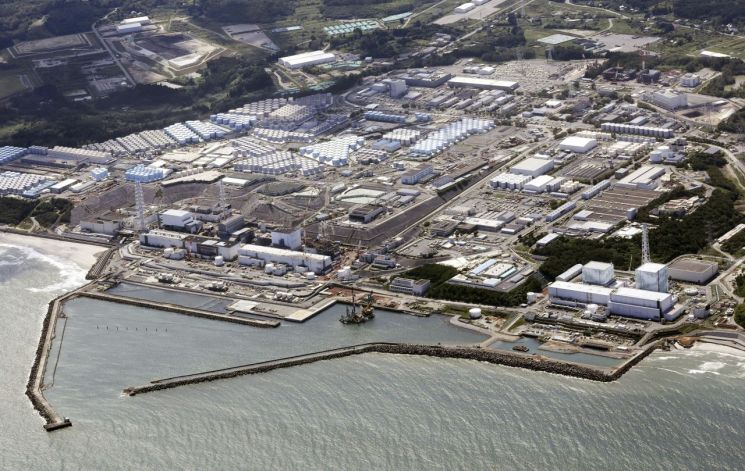 Japan has restarted 14 of the 54 nuclear reactors that were shut down following the Fukushima accident, and the current share of nuclear power generation has recovered to 8.5%. Experts expect this phase of reactor restarts to continue until 2030. Photo by AP Yonhap News
The Japanese government has made a major shift in its energy policy direction. In the 7th Basic Energy Plan, approved by the Cabinet in February this year, the government specified the maximum use of decarbonized power sources, including nuclear power. It removed the phrase "reduce dependence on nuclear power as much as possible," which had been maintained since the Great East Japan Earthquake, and changed its stance to promote the replacement of decommissioned reactors with next-generation nuclear power plants at sites where decommissioning has been decided.
Currently, Japan is restarting 14 of the 54 nuclear power plants that were shut down after the Fukushima accident, and the share of nuclear power generation has recovered to 8.5%. Experts expect this phase of reactivation to continue until 2030. However, in some regions, the restart of nuclear power plants is being delayed due to opposition from Fukushima residents and broader social concerns.
© The Asia Business Daily(www.asiae.co.kr). All rights reserved.
![Clutching a Stolen Dior Bag, Saying "I Hate Being Poor but Real"... The Grotesque Con of a "Human Knockoff" [Slate]](https://cwcontent.asiae.co.kr/asiaresize/183/2026021902243444107_1771435474.jpg)

















