A semiconductor that can be implanted in the human body has been developed in South Korea. This achievement was made possible through the blending and vulcanization process of medical-grade rubber and organic semiconductor nanofibers.
The National Research Foundation of Korea announced on September 3 that a research team led by Professor Jin-Young Oh at Kyung Hee University and another team led by Professor Seok-Ho Bang at Sungkyunkwan University have developed a bio-friendly stretchable semiconductor and implantable organic field-effect transistor (a fundamental semiconductor device in electronic equipment that controls current by adjusting charge density with an electric field) by fusing medical-grade rubber with organic polymer semiconductor nanofibers through a vulcanization process.
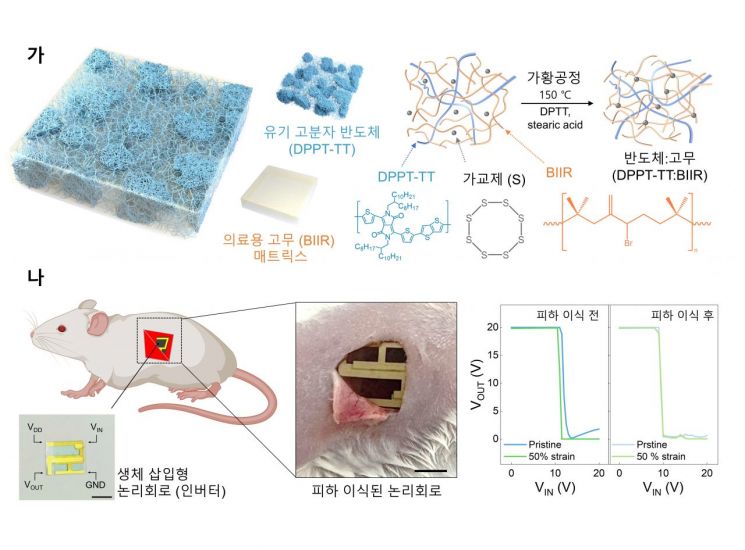 Schematic diagram of stretchable semiconductor and logic circuit for bio-implantable flexible electronic devices. Provided by Professor Jin-Young Oh, Kyung Hee University
Medical-grade rubber refers to a polymer elastomer certified for biocompatibility and safety according to international standards (such as ISO10993), while semiconductor nanofibers are nano-scale fiber structures formed by the self-assembly and phase separation of polymer semiconductors. The vulcanization process is a chemical process that crosslinks polymer chains with sulfur atoms, enhancing mechanical properties and chemical stability.
The transistor developed by the joint research team demonstrated stable operation under 50% tensile strain and in environments immersed in body fluids. In subcutaneous implantation experiments in mice, tissue compatibility was confirmed without significant changes in major inflammation markers.
Conventional implantable electronic devices have been manufactured using rigid silicon semiconductors and inorganic electronic materials, which caused inflammation and fibrosis due to mechanical mismatch with skin and muscle tissues. Moreover, industrial stretchable electronic materials have not been sufficiently proven safe for long-term implantation in the body, posing a limitation to commercialization.
In contrast, the semiconductor developed by the joint research team uses medical-grade elastomers to meet international biocompatibility standards. It also minimizes mechanical mismatch with body tissues and incorporates silver-gold (Ag-Au) dual-metal electrodes, enabling stable operation in body fluid environments without corrosion, thereby overcoming the issues of existing implantable electronic devices.
Notably, the team fabricated transistors based on this semiconductor and implemented logic circuits and active matrix arrays-key components of electronic devices-demonstrating that they maintain stability even in body fluid environments at 37 degrees Celsius.
A logic circuit is a core circuit that performs logical operations using transistors and is responsible for computation and control in digital electronic devices. An active matrix array is a two-dimensional array structure in which transistors are arranged at each device (pixel) unit, enabling individual operation and signal control.
In in vitro cell experiments, the joint research team also confirmed that there were no negative effects on the viability, mobility, or gene expression of human dermal fibroblasts (cells that play a key role in the structure of cell tissue and wound healing in the skin dermis), nor on the inflammatory response of macrophages (cells involved in removing pathogens and foreign substances, as well as regulating inflammation and tissue recovery).
Professor Jin-Young Oh of Kyung Hee University stated, "This research is a decisive turning point that will accelerate the commercialization of implantable electronic devices by simultaneously achieving both stretchability and biostability of semiconductor devices. It also holds great potential to address the issues of diagnostic and therapeutic bio-implantable electronic devices currently used in medical settings, paving the way for the next-generation electronic device form factor beyond smartphones."
This research was supported by the Excellent Young Researcher Program, University-Centered Research Institute Support Program, and Leading Research Center Program (ERC), all promoted by the Ministry of Science and ICT and the National Research Foundation of Korea. The research results were published on September 2 in the international journal "Nature Electronics."
© The Asia Business Daily(www.asiae.co.kr). All rights reserved.