Major Companies' CHO Meeting
Son Kyungshik of Korea Employers Federation: "Dialogue and Consensus Needed"
Minister of Labor: "Minimizing Uncertainty"
Corporate labor executives have voiced strong concerns that the recently passed amendments to Articles 2 and 3 of the Trade Union and Labor Relations Adjustment Act (commonly known as the "Yellow Envelope Law") threaten the principal-subcontractor ecosystem. Kim Younghun, Minister of Employment and Labor, stated that by March next year, before the law takes effect, the ministry will develop detailed guidelines and manuals to minimize uncertainty.
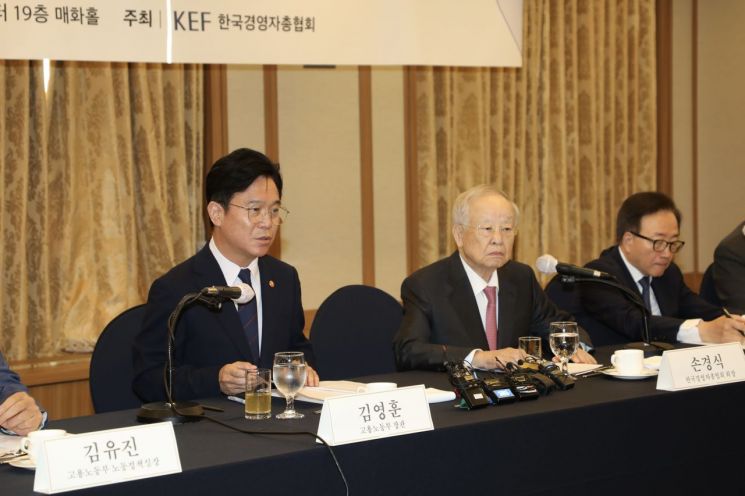 On the 3rd, Son Kyungshik, chairman of the Korea Employers Federation (right), and Kim Younghun, Minister of Employment and Labor (left), attended the "Major Companies' Chief Human Resources Officers (CHO) Meeting" held at the Korea Press Center in Seoul. Korea Employers Federation
At the "Major Companies' Human Resources and Labor Executive Officers (CHO) Meeting" held at the Korea Press Center in Taepyeong-ro, Seoul, on the 3rd, CHOs from major companies expressed their concerns about issues arising on the industrial frontlines following the legal amendments and called for an active and rational role from the Ministry of Employment and Labor. They pointed out that, given the multi-layered structure of the principal-subcontractor ecosystem, it is unclear how far employer status will be recognized and whether negotiations will be required with unions from subsidiaries or affiliates. They emphasized that the expansion of employer status could significantly destabilize labor-management relations at worksites. Furthermore, they expressed concern that if negotiation demands extend to business and management decisions such as corporate spin-offs, mergers, relocations, or overseas investments, it could inevitably undermine corporate competitiveness.
Minister Kim asked for support in ensuring the smooth implementation of the Yellow Envelope Law, pledging to minimize uncertainty. He said, "We plan to diagnose the principal-subcontractor relationships of major companies by region and industry, simulate standard negotiation models, and develop additional measures to promote mutual growth." He added, "We want to identify exemplary cases of labor-management relations. I urge the business community to participate in creating a principal-subcontractor win-win model."
However, Minister Kim drew a clear line regarding concerns that the Yellow Envelope Law would trigger indiscriminate strikes, stating, "There is no government that condones illegal acts," and "I want to make it clear that there is absolutely no intention to grant immunity for illegal strikes." He also argued that, considering the unionization rate in Korea, concerns over indiscriminate strikes are excessive, stating, "What is more concerning than work loss due to strikes is the loss of labor and productivity decline caused by industrial accidents."
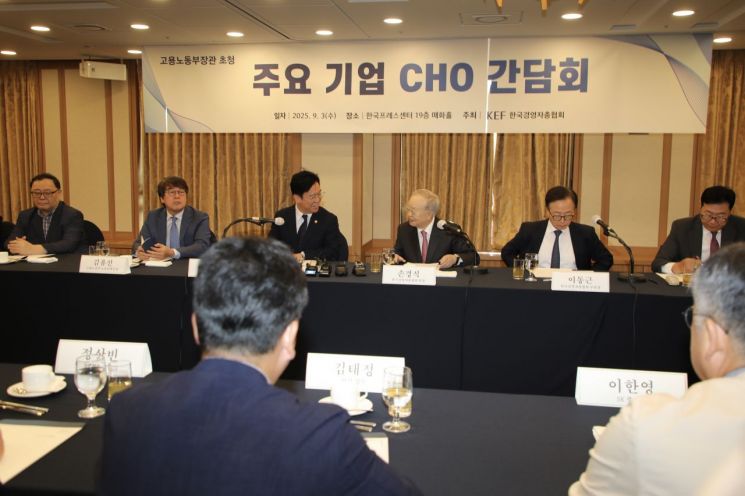 On the 3rd, Son Kyungshik, chairman of the Korea Employers Federation (third from the right), and Kim Younghoon, Minister of Employment and Labor (fourth from the right), attended the "Key Corporate Human Resources and Labor Executive Officers (CHO) Meeting" held at the Korea Press Center in Seoul. Korea Employers Federation
Son Kyungshik, chairman of the Korea Employers Federation, stated, "There are ongoing concerns that the amendment to the Trade Union Act will threaten the principal-subcontractor industrial ecosystem and increase instability in labor-management relations across industries." He emphasized, "Rather than rushing to amend the law, we should carefully examine its impact on the labor market and corporate competitiveness, and pursue policies based on sufficient dialogue and agreement between labor and management."
© The Asia Business Daily(www.asiae.co.kr). All rights reserved.

![Clutching a Stolen Dior Bag, Saying "I Hate Being Poor but Real"... The Grotesque Con of a "Human Knockoff" [Slate]](https://cwcontent.asiae.co.kr/asiaresize/183/2026021902243444107_1771435474.jpg)
















