More Than 60% from China and Vietnam
Over 90% of Students Are from Asia
Scholarship Programs and Tailored Support Initiatives in Operation
The number of international students residing in South Korea has surpassed 250,000, marking an all-time high. By country of origin, students from Asian countries accounted for an overwhelming 91.8%. Universities are actively operating both online and offline study abroad fairs and admissions briefings, focusing their efforts on attracting outstanding international students.
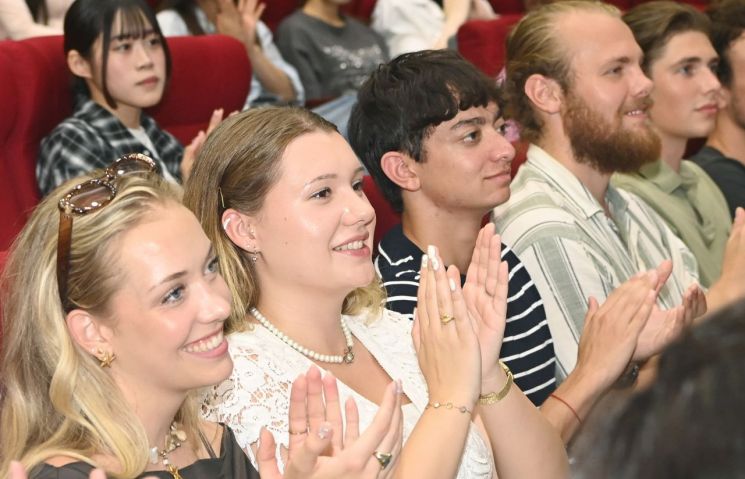 On the 29th of last month, international students at Pukyong National University participated in the freshman orientation. Provided by Pukyong National University
◆Total Number of International Students Up 21.3%
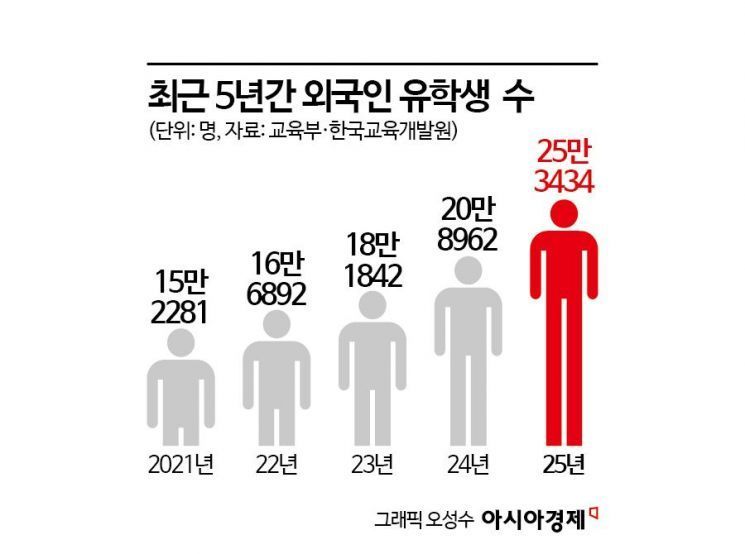
According to the "2025 Basic Education Statistics Survey" released by the Ministry of Education and the Korean Educational Development Institute on September 5, the total number of international students, including both degree and non-degree programs, reached 253,434, an increase of 21.3% from the previous year. This is the highest figure since statistics began to be compiled. International students accounted for 5.9% of the total student enrollment in higher education institutions, which stands at 3,016,724.
The vast majority of international students were from Asian countries. By nationality, China had the highest number with 76,541 students (30.2%), followed by Vietnam with 75,144 (29.7%), Uzbekistan with 15,786 (6.2%), Mongolia with 15,270 (6.0%), and Nepal with 12,784 (5.0%). Since last year, students from Asian countries have made up more than 90% of all international students.
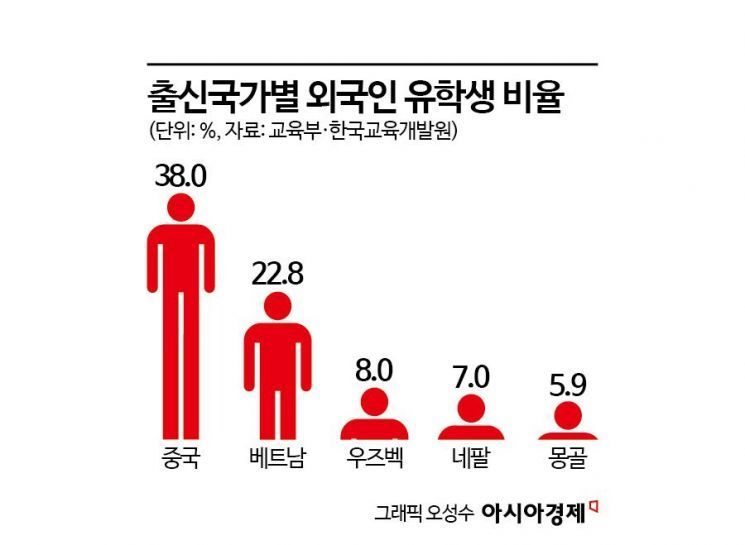
Among all international students, 179,190 were enrolled in degree programs, accounting for 70.7% of the total. This represents an increase of 33,412 students (22.9%) compared to the previous year. By country, China accounted for 68,045 students (38.0%), Vietnam 40,865 (22.8%), Uzbekistan 14,318 (8.0%), Nepal 12,626 (7.0%), and Mongolia 10,570 (5.9%). The number of Vietnamese students in degree programs increased by 32.4% year-on-year, showing a greater growth rate than Chinese students, whose numbers rose by 8.7%.
The number of international students in non-degree programs was 74,244 (29.3%), an increase of 11,060 (17.5%) from the previous year. Vietnam accounted for 34,279 students (46.2%), nearly half, followed by China with 8,496 (11.4%), Mongolia with 4,700 (6.3%), Myanmar with 3,699 (5.0%), and Japan with 2,546 (3.4%). The number of Vietnamese students in non-degree programs surged by 36.4% compared to the previous year, with many entering the country for short-term language training or as exchange students.
◆Laying the Foundation for Nurturing Global Talent
As the number of international students increases, competition to attract them is intensifying. Pukyong National University introduced the Pukyong Invitation Scholarship Program in 2013. This program was established to provide outstanding students from underdeveloped or developing countries with access to high-quality higher education in South Korea, while also expanding the recruitment of international students. To date, a total of 59 students from Kazakhstan, Myanmar, and Uzbekistan have been recommended as Pukyong Invitation Scholars, with 1 to 9 students selected each year. In the second semester of this year, a newly selected student from Kazakhstan will enroll. These students receive full tuition and health insurance for four years of undergraduate study. Pukyong Invitation Scholars are recognized for playing a key role in attracting international students by recommending Pukyong National University to other foreign students based on their own study abroad experiences, serving as "pro-Pukyong" ambassadors.
Kangwon National University operates more than 15 online and offline study abroad fairs and admissions briefings annually and actively utilizes government-funded scholarship programs. The university also supports international students' stable adaptation and academic achievement through a range of multi-layered programs, including academic counseling, mentoring, tutoring, psychological counseling, career development, support for Korean language speaking and TOPIK (Test of Proficiency in Korean) exam fees, and pilot implementation of AI-based captioning and translation services. President Jung Jaeyeon of Kangwon National University stated, "We will not stop at simply increasing the number of international students, but will establish a comprehensive support system encompassing academics, daily life, and employment to further strengthen our competitiveness as a global campus. We will continue to provide full support so that all international students can grow into global talent based on the knowledge and experience gained at Kangwon National University."
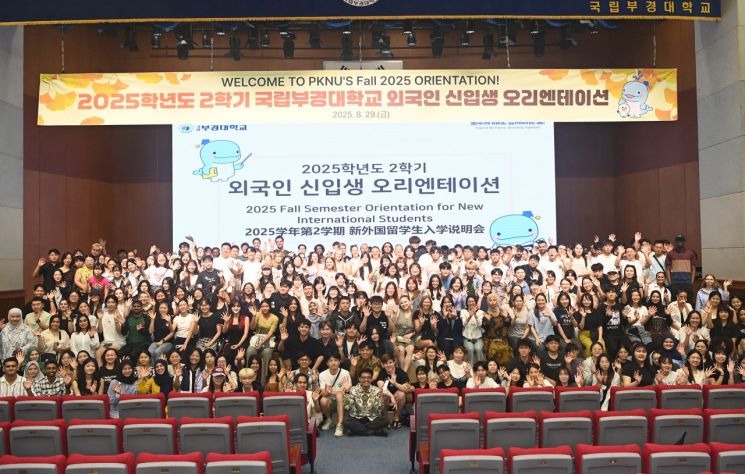 On the 29th of last month, international students at Pukyong National University took a group commemorative photo. Photo by Pukyong National University
Chonbuk National University plans to expand its global network through the activities of its Internationalization Competency Activity Group each year, with the goal of attracting 5,000 international students. In practice, during the summer vacation, the group carried out various educational volunteer and exchange activities at Fuyang Xinhua Foreign Language School, Shaanxi Vocational and Technical College of Finance and Economics, Hanyang Vocational and Technical College, and Shaanxi Energy Vocational and Technical School in Xi'an and Nanjing, China, as well as at SMK Mahaputra High School, Pasundan 2 High School, IWU University, and UNPAS University in Bandung, Indonesia. Next year, the Namwon Glocal Campus, to be established in Namwon, will open undergraduate programs exclusively for international students, such as the Department of Glocal Commerce, Department of K-Entertainment, and Department of Korean Language, with the aim of attracting 1,000 international students.
Keimyung University signed a memorandum of understanding (MOU) with the National Institute for International Education to cooperate on the internationalization of higher education. The agreement aims to expand exchanges and cooperation based on mutual trust between the two institutions and to nurture talent with international competitiveness. The two sides agreed to: ▲nurture global talent and improve policies for the internationalization of higher education; ▲explore ways to strengthen universities' global capabilities; and ▲cooperate in attracting and supporting international students. The National Institute for International Education, an executive agency under the Ministry of Education, is a leading international education exchange institution dedicated to nurturing global talent. It carries out various international education cooperation projects, including the operation of the TOPIK (Test of Proficiency in Korean), attracting and supporting international students, and supporting public foreign language education. In particular, through international cooperation in higher education, it is enhancing the internationalization status of Korean education. President Shin Ilhee of Keimyung University stated, "We will work closely with the National Institute for International Education to promote the internationalization of higher education and strive to nurture both domestic and international talent who will excel on the global stage."
© The Asia Business Daily(www.asiae.co.kr). All rights reserved.

![Clutching a Stolen Dior Bag, Saying "I Hate Being Poor but Real"... The Grotesque Con of a "Human Knockoff" [Slate]](https://cwcontent.asiae.co.kr/asiaresize/183/2026021902243444107_1771435474.jpg)
















