Large-Scale Gas Cooperation Agreement
Russia and China Sign Deal to Expand Natural Gas Supply and Build New Pipeline via Mongolia
Russian President Vladimir Putin and Chinese President Xi Jinping demonstrated their solidarity on the 2nd (local time) by reaching an agreement to expand natural gas supplies during a summit meeting.
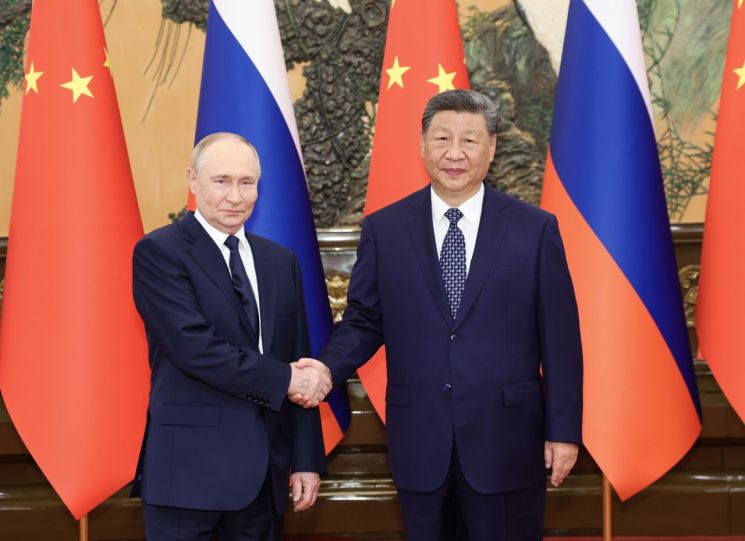 Russian President Vladimir Putin (left) and Chinese President Xi Jinping. Photo by Xinhua News Agency
At the summit, the two countries signed more than 20 documents related to cooperation. In particular, they pledged large-scale collaboration in the gas sector. They agreed to significantly increase the volume of natural gas supplied from Russia to China and to construct a new gas pipeline from Russia to China via Mongolia.
Alexey Miller, CEO of Russian state-owned gas company Gazprom, told Russian media outlets such as TASS that a document was signed to increase annual gas supplies to China via the existing Power of Siberia pipeline from 38 billion cubic meters to 44 billion cubic meters, and to boost annual gas transmission through the Far East pipeline, which will be operational in 2027, from 10 billion cubic meters to 12 billion cubic meters.
He also explained that a legally binding memorandum was signed regarding the construction of the Power of Siberia 2 pipeline, which will deliver gas to China via Mongolia. Through this pipeline, Russia will be able to supply 50 billion cubic meters of gas annually via Mongolia for 30 years. While the gas supply price will be announced separately at a later date, he stated, "It will be lower than the price currently charged to Europe." He emphasized that the Power of Siberia 2 construction project will be the largest and most capital-intensive undertaking.
The expansion of gas cooperation with China presents Russia with an opportunity to secure a new source of income, having lost the European market due to Western sanctions imposed in response to its "special military operation" in Ukraine. For China, already Russia's largest energy customer, this means receiving energy supplies that are both cheaper and more stable.
It is believed that President Putin and President Xi also discussed the Ukraine issue, which has drawn the attention of President Trump. In particular, they may have exchanged specific views regarding Russia's demand that, in addition to the United States and European countries, both Russia and China should participate as guarantor states for Ukraine's security.
Yuri Ushakov, Kremlin aide, said in a Russian television interview that President Putin briefed President Xi on the results of his meeting and phone call with President Trump in Alaska. He reported that the deployment of Chinese peacekeeping forces to Ukraine was not discussed at all during the summit. When asked whether President Putin planned to inform President Trump about the outcome of his visit to China, Ushakov responded, "Russia-U.S. relations are currently developing mainly through discussions on the Ukraine conflict. It is still too early to talk about progress in other areas." He added, "Consultations are planned between the Russian and U.S. foreign ministries. There are many unresolved issues," indicating that discussions on improving bilateral relations will continue.
© The Asia Business Daily(www.asiae.co.kr). All rights reserved.
![Clutching a Stolen Dior Bag, Saying "I Hate Being Poor but Real"... The Grotesque Con of a "Human Knockoff" [Slate]](https://cwcontent.asiae.co.kr/asiaresize/183/2026021902243444107_1771435474.jpg)










