Discovery of Wild Ginseng Roots in Jirisan
Appraised at 150 Million Won, Family Group Spanning Four Generations Found
A total of 38 rare wild ginseng roots were discovered in the foothills of Jirisan Mountain in Hamyang County, South Gyeongsang Province. The appraised value has been set at 150 million won.
According to the Korea Traditional Simmani Association on September 2, a wild herb gatherer in his 50s, identified as Mr. A, recently discovered 38 wild ginseng roots in the foothills of Jirisan Mountain. The find included a mother ginseng root bearing red berries and its descendants, which had grown wild for more than four generations.
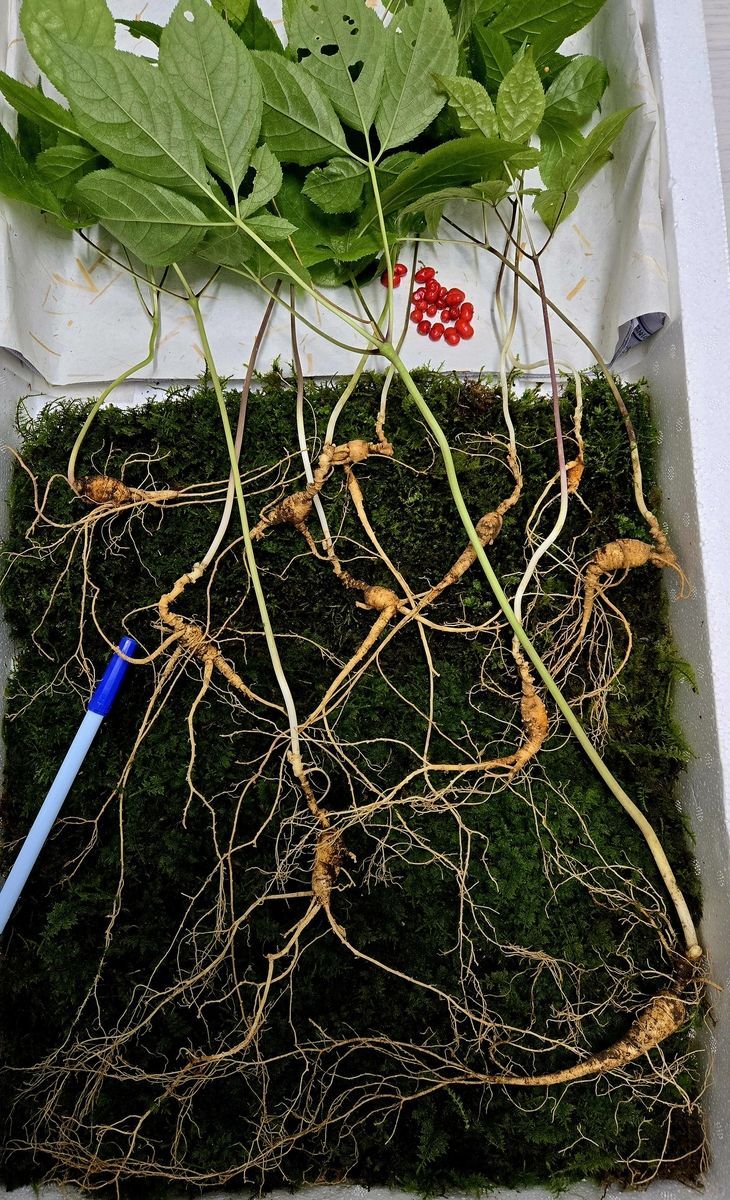 A rare wild ginseng discovered in Jirisan Mountain. Provided by the Korea Traditional Simmani Association. Yonhap News Agency
Wild ginseng refers to ginseng that grows naturally in deep mountains, sprouting from seeds without any human intervention. According to the association's appraisal, the recently discovered ginseng roots formed a family group spanning more than four generations. The oldest root was estimated to be 50 years old. The total weight of the roots is 282 grams, which is enough for four adults to consume.
An association official stated, "In a situation where most of the domestic ginseng market is dominated by ginseng imported from China, this discovery is the result of simmani tirelessly climbing high mountains."
This is the second time this year that wild ginseng has been discovered in the Jirisan Mountain area. In May, a wild herb gatherer in his 60s, also identified as Mr. A, harvested 30 wild ginseng roots from the foothills of Jirisan Mountain. The oldest root in that batch was estimated to be 70 years old.
Wild ginseng, as its name suggests, refers to ginseng that grows wild in deep mountains. Ginseng that is artificially cultivated is called cultivated ginseng, and when cultivated ginseng is steamed and dried, it becomes red ginseng. Wild ginseng is widely believed to be far more effective than cultivated ginseng or red ginseng because it grows in pristine natural environments.
Compared to cultivated ginseng, wild ginseng grows more slowly and remains smaller in size, making it extremely expensive in the market. During the Joseon Dynasty, it was considered the finest tribute for the royal court and was a precious tonic reserved only for royalty and the highest officials.
According to the Donguibogam, wild ginseng is slightly warm in nature and tastes sweet. It is also said to calm the mind and spirit, protect the internal organs, and treat people with weak energy. These effects are attributed to the powerful bioactive compound called saponin. In traditional Korean medicine, wild ginseng is not recommended for people with excessive internal heat.
© The Asia Business Daily(www.asiae.co.kr). All rights reserved.
![User Who Sold Erroneously Deposited Bitcoins to Repay Debt and Fund Entertainment... What Did the Supreme Court Decide in 2021? [Legal Issue Check]](https://cwcontent.asiae.co.kr/asiaresize/183/2026020910431234020_1770601391.png)
















