Record-High 7.3 Trillion Won for Water Management
737 Billion Won Loan Program for Electric and Hydrogen Bus Purchases
The Ministry of Environment has drafted next year's budget at 16 trillion won, focusing on projects directly related to people's daily lives, such as responding to the climate crisis, transitioning to decarbonization, expanding water management safety nets, and supporting environmental victims. In particular, the ministry has introduced a new electric vehicle transition support fund and allocated a record-high 7.3 trillion won for water management, aiming to strengthen the social safety net.
On September 2, Vice Minister of Environment Keum Hanseung unveiled the budget plan at the Government Complex Sejong. He stated, "Next year's Ministry of Environment budget is designed to support the transition to a decarbonized green civilization, expand infrastructure to prepare for climate disasters, and promote coexistence between people and the environment."
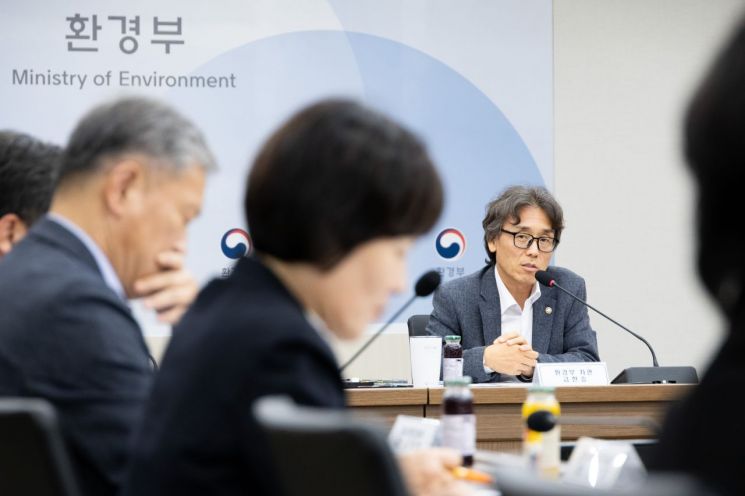
Total Expenditure: 15.9 Trillion Won... Record-High Environmental Technology R&D
According to the 2026 budget and fund operation plan submitted by the Ministry of Environment to the National Assembly, total expenditure is set at 15.916 trillion won, an increase of 1.109 trillion won from this year. Of this, the budget for technology development in the environmental sector has risen by 19.8% to 418 billion won, the largest ever. Most of the increase (53.7 billion won) will be invested in climate response technology development. The government plans to actively expand climate-responsive research and development investment to restore the research ecosystem and secure future growth engines.
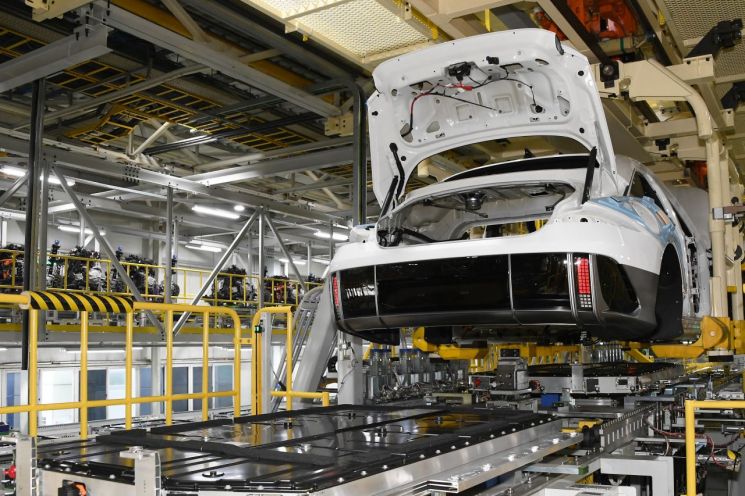
The support system for promoting the supply of zero-emission vehicles has also been significantly strengthened. The unit subsidy for purchasing electric and hydrogen vehicles (3 million won for electric passenger cars), which had been reduced annually, will be maintained at this year's level. At the same time, a new electric vehicle transition support fund has been established with a budget of 177.5 billion won to provide additional support when replacing or scrapping internal combustion engine vehicles with electric vehicles.
To reduce the burden on transport operators, a new loan program for purchasing electric and hydrogen buses (73.7 billion won) has been introduced. An electric and hydrogen vehicle infrastructure fund (74 billion won), combined with private investment, has been created, and a new electric vehicle safety insurance (2 billion won) has been established to prepare for accidents such as electric vehicle fires. The budget for the circular use of used batteries will be increased by 74.6%, from 28.2 billion won this year to 49.3 billion won next year, enhancing the sustainability of the electric vehicle ecosystem.
Expansion of Renewable Energy Projects
A restructuring of expenditures is also underway to reduce support for fossil fuel-based projects and expand renewable energy initiatives. The support for low-NOx boilers, which had been in place until this year, will be abolished, and the funds will be redirected to a new heating electrification project (distribution of air-source heat pumps, 9 billion won).
The biogas project utilizing organic waste such as food waste and sewage sludge will increase by 92.6%, from 16 billion won to 30.9 billion won. In water source areas, a new solar pension pilot project (4.9 billion won) involving local residents will be introduced, allowing residents to share profits generated from solar installations on communal buildings.
Green finance investment to establish a low-carbon industrial ecosystem will also be expanded. The scale of loans will increase significantly from 2.6 trillion won this year to 3.4 trillion won next year, and budgets for green policy finance, green bonds, and guarantee projects will all be increased. In particular, the project structure will be reformed to support large-scale greenhouse gas reduction facility investments by companies, improving effectiveness. Guarantees will also be provided to startups and venture companies with limited access to finance, addressing blind spots in support.
To establish a carbon-neutral lifestyle culture with public participation, support for the distribution of reusable containers will be expanded to 163 local governments nationwide (budget: 15.7 billion won). This is expected to reduce the use of approximately 31.4 million single-use products. The carbon neutrality points budget will also be increased to 18.1 billion won, raising the number of beneficiaries from 1.33 million to about 1.51 million people annually.
Strengthening Climate Disaster Response and Water Management Safety Nets
The Ministry of Environment has expanded the water management budget to a record-high 7.3 trillion won to respond to climate disasters such as extreme rainfall and floods. First, the national river maintenance budget for flood prevention in tributaries and streams has been increased by 25.2% to 86.1 billion won, and an advanced management system will be established, including the installation of AI-based human detection on 1,000 river CCTVs. The AI flood forecasting infrastructure budget (21.5 billion won) has surged by 126.6%. The budget for sewer maintenance to address urban flooding has also been increased by 22.9% to 385.5 billion won. Investments in deep rainwater tunnels and underground drainage channels will also be greatly expanded.
Public safety will also be enhanced. Next year, fall-prevention devices for manholes (110.4 billion won) will be installed in all areas nationwide at risk of sewage overflow (excluding Seoul). Budgets for the maintenance of aging sewage and water supply systems have been increased to 365.2 billion won and 407.7 billion won, respectively, to help prevent accidents such as sinkholes. An Internet of Things (IoT)-based wildfire detection system will be newly installed in national parks, and the wildfire response budget has been expanded more than fourfold, from 9.7 billion won to 42.4 billion won. Management of vulnerable areas such as landslides and rockfalls will also be strengthened.
The budget for pollution source management to respond to green algae outbreaks will be increased by 19.6% to 203.7 billion won, and a new rapid response system for algal bloom alerts (500 million won) will be introduced. Projects to improve intake and pumping stations (38 billion won), monitor perfluorinated compounds in water purification plants (1.1 billion won), and advance wide-area water supply systems with smart technology (4 billion won) will also be newly established to enhance drinking water safety.
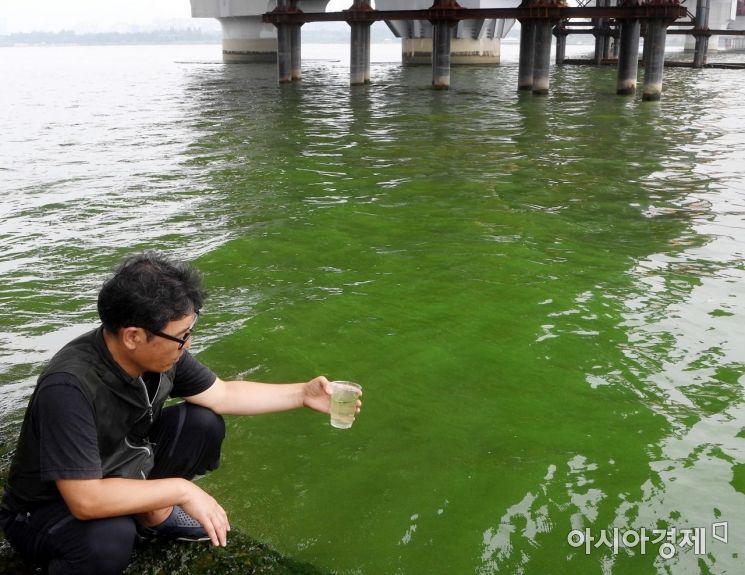 On the 9th, amid the continuing heatwave, a member of an environmental organization checked the green algae occurring in the Han River near Seongsan Bridge in Mapo-gu, Seoul. Photo by Kim Hyunmin kimhyun81@
100 Billion Won in Government Contributions for Humidifier Disinfectant Victims
To support victims of humidifier disinfectants, a new government contribution of 10 billion won has been allocated. This is a follow-up measure after the Supreme Court recognized state responsibility last year and is significant in establishing a stable foundation for victim relief. Other initiatives include support for forest weddings in national parks (3.5 billion won), response to mass outbreaks of insects such as lovebugs (500 million won), and securing ecological corridor connectivity (41.3 billion won). A new project to strengthen aviation safety through research on migratory bird habitats near airports (2.2 billion won) has also been included.
To strengthen region-led environmental policies, the budgets for sewer maintenance (1.1167 trillion won) and sewage treatment plant installation (1.2686 trillion won) have been greatly increased. Both projects will be transferred to a comprehensive local government subsidy system from next year, raising expectations for improved region-led water management. The budget for infrastructure investment in Palgongsan National Park will also increase significantly from 4.9 billion won to 16 billion won, supporting balanced regional development.
This Ministry of Environment budget and fund operation plan will be submitted to the National Assembly today and will be finalized in December after review and approval by the Assembly.
© The Asia Business Daily(www.asiae.co.kr). All rights reserved.