Chinese Companies Respond to Government's Push for Domestic AI Chips
Growing Interest in 'China Semiconductor ETF' Listed in Korea
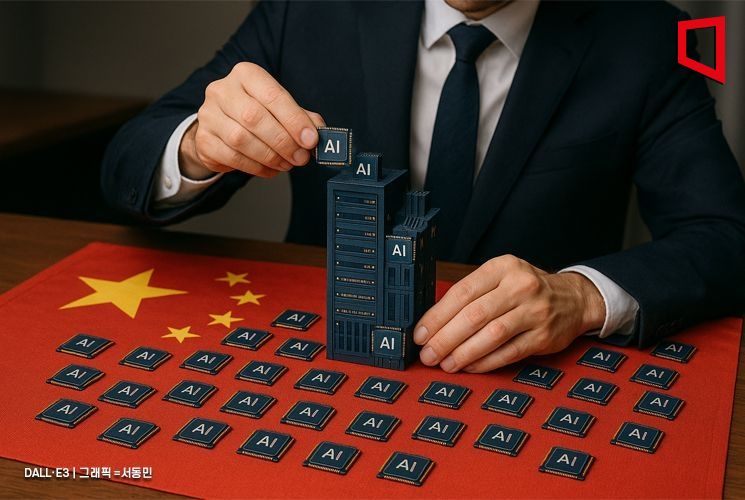
Recently, it was reported that DeepSeek's next-generation artificial intelligence (AI) model R2 is undergoing performance testing on Huawei's AI chip, Ascend, while Alibaba Cloud Service is conducting tests on Chinese-made chips. Chinese companies appear to be responding swiftly to the Chinese government's domestic substitution policy in response to U.S. technology sanctions.
On September 2, Meritz Securities released a report titled "The Path to Domestic Production of Chinese AI Semiconductors," stating, "Currently, many companies in China are striving to develop chips with performance comparable to Nvidia's A100," and added, "Even if the performance is somewhat lower, policy authorities are actively promoting their use, making it highly likely that the pace of domestic substitution in China will accelerate."
Chinese Companies Respond to Government's Push for Domestic AI Chips
At the end of July, Chinese policymakers pointed out the potential backdoor risks in Nvidia's H20 chip and called for Chinese companies to be cautious in purchasing it. While sales were not outright banned, this effectively discouraged Chinese companies from using the H20 chip. At the same time, the Chinese government is encouraging the purchase of domestically produced AI semiconductors. A representative measure is the request for public data centers to source more than half of their computing chips from Chinese suppliers. In particular, Beijing and Shanghai have set a goal to achieve a domestic adoption rate of over 70% for computing and storage chips in data centers by 2027.
Within China, a variety of solutions are emerging to replace Nvidia chips. The most powerful alternative is considered to be Huawei's Ascend. The latest model, Ascend 910C, delivers 2.5 times the performance of Nvidia's A100. Compared to the H100, it achieves about 60-80% of the performance, but is said to be competitive in terms of energy efficiency and cost. Huawei is working to overcome the limitations of single AI chip performance by clustering Ascend chips to achieve results that surpass Nvidia's systems.
The next notable alternative is Cambricon's MLU370/590. Cambricon initially started with inference chips, but has fully entered the cloud AI training market with the MLU370 series. The MLU590 was released as a replacement for Nvidia's A100 and is evaluated to deliver about 80% of the A100's performance. Next year, Cambricon plans to introduce the higher-end MLU690 lineup, targeting the high-performance computing (HPC) market in earnest.
As for Baidu's Kunlun chip, mass production of the second-generation chip began in 2021, and its performance has improved by two to three times compared to the first generation. Although its computing speed and precision are about 40% lower than Nvidia's A100, its utilization is rapidly increasing thanks to China's domestic chip demand policy. Baidu is applying these chips to services such as autonomous driving and cloud search. Like Huawei, Baidu is also improving overall system performance by clustering 30,000 P800 chips based on Kunlun 2.
Growing Interest in 'China Semiconductor ETF' Listed in Korea
Investment bank Bernstein forecasts that the share of domestically produced AI chips in China will rise from 17% in 2023 to 46% this year, and to 55% by 2027. Following mobile phones and electric vehicles, the semiconductor industry-previously the only sector with a significant gap with overseas markets-has now entered a phase where the market share of Chinese companies is visibly increasing.
Last month, in the Chinese stock market, the expectation of accelerated domestic production of AI semiconductors led to a sharp rise in the stock prices of related companies. Cambricon, often called "Mini Nvidia," saw its stock price surge by 110% in August alone, with its market capitalization surpassing 100 trillion won. In addition, the mainland share price of SMIC, China's largest foundry, rose 28% over the month. Choi Seolhwa, an analyst at Meritz Securities, commented, "The rise in stock prices of these leading companies is not just a short-term theme but is accompanied by fundamental changes such as government policy direction, technological localization achievements, and improved performance," and added, "Government policy is acting as a catalyst for demand, and as companies expand their market share in China through technological advancement, we can expect a virtuous cycle of increased corporate profits and higher return on equity (ROE)."
Meritz Securities introduced ETFs listed in Korea that include leading companies in China's AI ecosystem, such as TIGER China Tech TOP10, TIGER China Semiconductor, KODEX China Tech TOP10, and KODEX China AI Tech.
© The Asia Business Daily(www.asiae.co.kr). All rights reserved.

![Clutching a Stolen Dior Bag, Saying "I Hate Being Poor but Real"... The Grotesque Con of a "Human Knockoff" [Slate]](https://cwcontent.asiae.co.kr/asiaresize/183/2026021902243444107_1771435474.jpg)















