Initiation of District Unit Plan Guidelines
500,000 Square Meters of Green Space to Match Project Site
Utilizing Both Public and Private Land, Including Natural Ground
Three-Dimensional Parks on Pilotis, Terraces, and Building Walls
The Seoul Metropolitan Government is beginning the preliminary work to develop the Yongsan International Business District as an "Urban Three-Dimensional Garden City." Known as the largest development project since the founding of Korea, the Yongsan International Business District will feature large-scale commercial and residential facilities, including a landmark building with 100 floors. The city plans to create green spaces equivalent in size to the entire project site.
According to the urban renewal industry on September 2, Seoul Housing & Communities Corporation (SH), an affiliate of the Seoul Metropolitan Government, has recently started establishing guidelines for the creation of a three-dimensional garden city to be included in the district unit plan for the Yongsan International Business District development project.
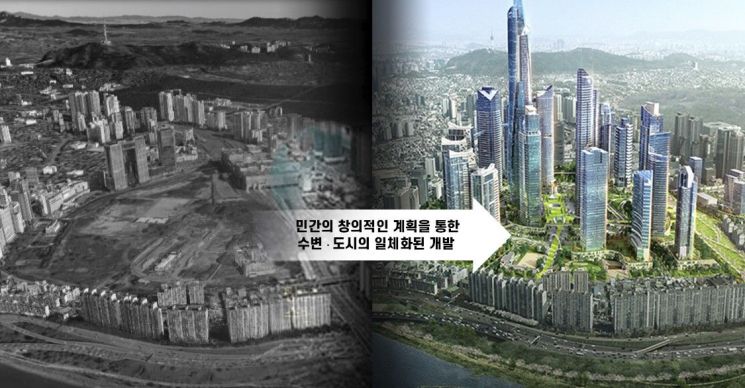 Before and after views of the Yongsan International Business District development, created as an "Urban Three-Dimensional Garden City." Seoul Metropolitan Government
The "Yongsan International Business District Development" is a core project of Mayor Oh Sehoon's "Urban Space Grand Renovation," which aims to elevate Seoul into a "Global Top 5" city. The plan is to invest 14 trillion won to transform approximately 456,000 square meters of land near Yongsan Station, previously used as a railway vehicle maintenance depot, into a three-dimensional city integrating international business, residential, commercial, and cultural functions.
The Seoul Metropolitan Government has planned to create green spaces on a scale equal to 100% of the project site. The goal is to utilize the entire space three-dimensionally, from underground to ground level and even into the air, to realize an "Urban Three-Dimensional Garden City." The upcoming guidelines will discuss the feasibility and scope of spatial utilization for this vision.
Internally, it has been confirmed that the plan includes utilizing not only public land but also private land. In particular, the city will review the development potential of every possible space where green areas can be created. This includes underground, low-rise, mid-rise, and high-rise spaces within the project district, as well as both natural and artificial ground levels.
Of the 500,000 square meters of green space, 20% will be secured by utilizing the area of the district itself, such as ground-level green spaces and railway lines. Another 30% will be created as indoor open spaces using pilotis, as well as open green spaces using public and front open spaces. The remaining 50% will be developed as three-dimensional green areas using building terraces, rooftops, and walls.
The key concept is a "Three-Dimensional Walkable Green City." In addition to flat green spaces such as ground-level parks, various models will be applied, including aerial green spaces (Green Square), circular green spaces (Green Curve), and linear green spaces (Green Corridor). Among these, the aerial green space known as Green Square will be built above the southern tracks of Yongsan Station, covering an area of 80,000 square meters. This will serve as a three-dimensional park directly connecting Hangang Park and Yongsan Station, and will become a symbolic space representing the Yongsan International Business District.
During this process, additional three-dimensional garden models based on these concepts will also be proposed. SH has developed more than 30 three-dimensional garden design models and plans to incorporate them into the urban plan for the business district and other relevant areas.
Given the rapid progress of the project, the Seoul Metropolitan Government expects that construction on some infrastructure, such as roads and parks, could begin by the end of the year. Last month, the Yongsan-gu District Office submitted a revised development plan and implementation plan for the Yongsan International Business District to the Seoul Metropolitan Government. Urban development projects generally proceed in three major stages: designation of the urban development zone and establishment of the development plan, approval of the implementation plan (including land compensation), and groundbreaking. The submission of the implementation plan is the final administrative step before construction begins. The implementation plan includes the total construction cost and detailed guidelines for infrastructure and buildings. The public notice period for residents to review the revised development plan has also ended. If everything proceeds as planned, infrastructure construction will begin at the end of this year, and building construction will commence in 2028.
© The Asia Business Daily(www.asiae.co.kr). All rights reserved.

![Clutching a Stolen Dior Bag, Saying "I Hate Being Poor but Real"... The Grotesque Con of a "Human Knockoff" [Slate]](https://cwcontent.asiae.co.kr/asiaresize/183/2026021902243444107_1771435474.jpg)














