Radio Jamming Incident During Eastern Europe Tour
EU Vows to Strengthen Detection Capabilities
The European Commission announced on September 1 (local time) that the aircraft carrying Ursula von der Leyen, President of the European Commission, experienced interference with its satellite navigation system (GPS), which appears to have been caused by Russian operations.
According to the Associated Press and other sources, Arianna Podesta, Chief Deputy Spokesperson for the European Commission, stated at a press conference that GPS interference occurred over Bulgaria the previous day, but the aircraft landed safely at Plovdiv Airport in Bulgaria. She added, "We received information from the Bulgarian authorities that there are suspicions of blatant radio jamming by Russia," and emphasized, "This incident only underscores the urgency of the President's mission in frontline member states."
The Financial Times reported that the aircraft circled above the airport for an hour before the pilot relied on an analog map to land. However, Dmitry Peskov, spokesperson for the Kremlin, denied allegations of Russian involvement during a briefing that day.
Andrius Kubilius, European Commissioner for Space and Defense, announced plans to deploy additional low-Earth orbit satellites to respond to GPS jamming activities and to strengthen detection capabilities. Earlier this year, 13 Eastern European countries sent a letter to the EU, requesting action to address Russia's GPS jamming, stating that civilian aircraft and ships have been affected.
The President of the European Commission does not have a dedicated aircraft and instead charters civilian planes as needed. Since August 30, President von der Leyen has been touring Eastern European member states bordering Russia and Belarus to promote European rearmament plans, including a loan program for joint arms procurement.
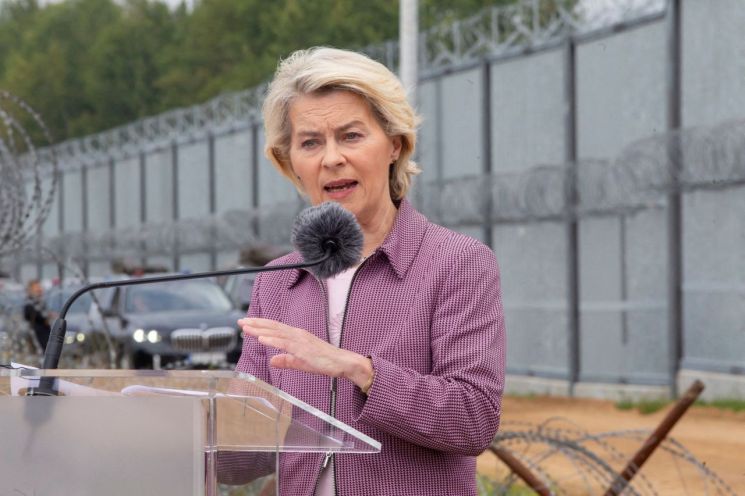
The previous day, she held a press conference in front of the border fence in eastern Poland, criticizing, "President Vladimir Putin of Russia has not changed, and he never will." In contrast, spokesperson Peskov accused Europe of obstructing U.S. President Donald Trump's efforts for peace in Ukraine and of encouraging Ukraine's "absurd" uncompromising stance.
President von der Leyen is coordinating security guarantees for Ukraine among European countries. However, there have been internal and external disagreements, as Russia does not consider Europe a negotiating partner and German government officials have issued unusually critical remarks.
In a media interview the previous day, President von der Leyen stated that European countries are specifically discussing plans to deploy troops to Ukraine. However, on the same day, Friedrich Merz, leader of Germany's Christian Democratic Union, said, "At this point, no one is discussing sending ground troops." German Defense Minister Boris Pistorius also commented, "Aside from the fact that the EU has no authority to deploy troops, we must refrain from confirming or commenting on such discussions in any way," and criticized, "It is fundamentally wrong to bring up such topics before even sitting at the negotiating table."
President von der Leyen, a member of Germany's Christian Democratic Union (CDU), served as Germany's Defense Minister from 2013 to 2019. During a North Atlantic Treaty Organization (NATO) exercise in 2014, it was revealed that the German military painted broomsticks black to disguise them as rifles in an attempt to conceal equipment shortages. As a result, there remains considerable skepticism in Germany regarding her European rearmament plans.
© The Asia Business Daily(www.asiae.co.kr). All rights reserved.
![Clutching a Stolen Dior Bag, Saying "I Hate Being Poor but Real"... The Grotesque Con of a "Human Knockoff" [Slate]](https://cwcontent.asiae.co.kr/asiaresize/183/2026021902243444107_1771435474.jpg)











