Ministry of Trade, August Trade Trends
Exports Maintain Growth for Third Consecutive Month
Semiconductor Exports Hit Record High at $15.1 Billion
Trade Surplus Continues for Seventh Straight Month
Exports in August recorded a growth rate in the 1% range, driven by strong performances in semiconductors and automobiles, marking the third consecutive month of export growth. However, despite the customs agreement reached on July 30, exports to the United States plunged by 12%. It was only thanks to record-high semiconductor exports that overall exports managed to stay positive.
According to the Ministry of Trade, Industry and Energy on September 1, exports in August totaled 58.4 billion dollars, up 1.3% compared to the same month last year.
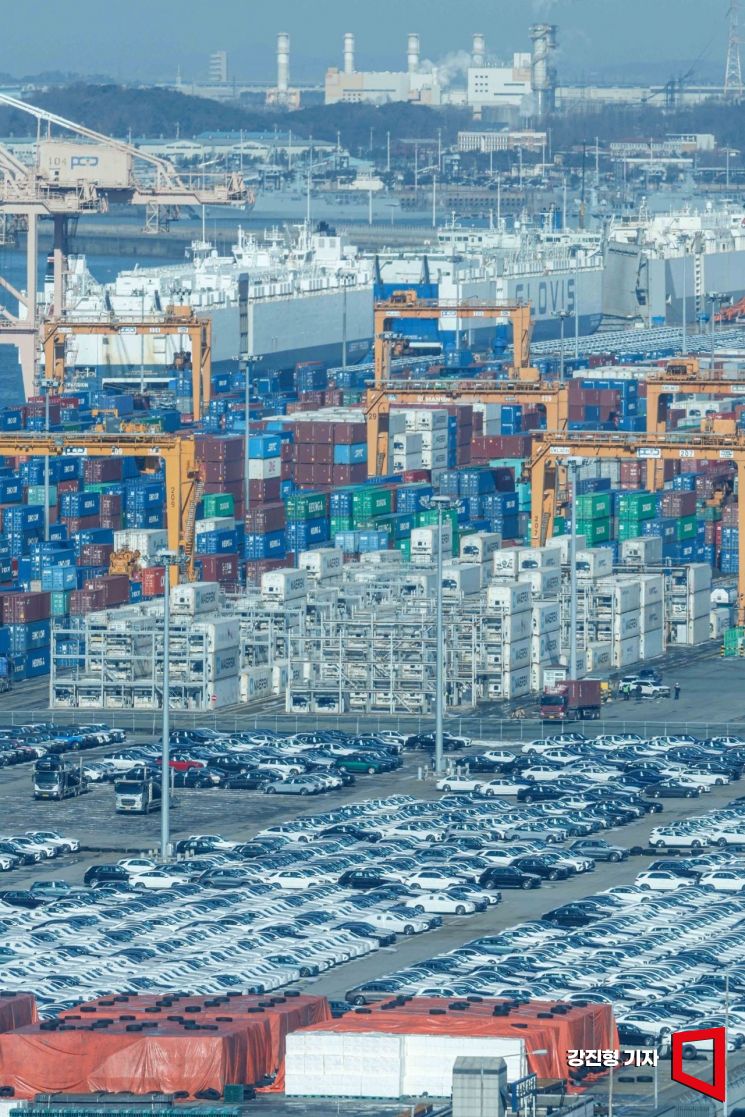
An official from the Ministry explained, "Despite the number of working days in August being 22.5 days, one day less than last year, monthly exports continued to grow. This export performance is the highest ever for the month of August, and monthly export records have been broken for three consecutive months since June."
In August, exports increased in three out of the fifteen major export items. Semiconductor exports rose by 27.1% to 15.1 billion dollars, setting a new all-time high just two months after the previous record. This was due to continued strong demand for server semiconductors and stable memory fixed prices.
Automobile exports, including both electric vehicles and hybrid vehicles, all posted positive growth, while used car exports also expanded. As a result, automobile exports reached a record-high 5.5 billion dollars for August (up 8.6%), continuing a three-month streak of growth.
Ship exports also maintained positive momentum for six consecutive months, rising by 11.8% to 3.14 billion dollars as deliveries continued for vessels ordered at high prices in 2022 and 2023.
Petroleum products (4.17 billion dollars, down 4.7%) and petrochemicals (3.38 billion dollars, down 18.7%) continued to decline due to falling oil prices and global oversupply, which led to lower export prices.
In August, exports increased in three out of the nine major regions. Exports to ASEAN (Association of Southeast Asian Nations) reached a record-high 10.89 billion dollars for August (up 11.9%), driven by strong performances in semiconductors and ships, marking three consecutive months of growth. Exports to the Middle East rose by 1.0% to 1.4 billion dollars, returning to positive growth after one month, while exports to the Commonwealth of Independent States (CIS) increased by 9.2% to 1.12 billion dollars, marking six consecutive months of growth.

Exports to China decreased for most items, but semiconductor exports-the largest export category-increased, resulting in a total of 11.01 billion dollars (down 2.9%), which is roughly flat compared to the same month last year. This marks the second consecutive month that exports to China exceeded 11 billion dollars. Exports to the United States fell by 12.0% to 8.74 billion dollars, as major export items such as automobiles, general machinery, and steel all declined.
Imports in August decreased by 4.0% to 51.89 billion dollars. Energy imports (11.02 billion dollars) dropped by 12.2%, and non-energy imports (40.86 billion dollars) also fell by 1.5%.
Last month, the trade balance recorded a surplus of 6.51 billion dollars, an increase of 2.93 billion dollars, marking the seventh consecutive month of surplus. The cumulative surplus from January to August this year reached 40.97 billion dollars, an increase of 10.8 billion dollars.
Minister of Trade, Industry and Energy Kim Jungkwan stated, "We will develop reliable and practical policies based on the voices of Korean export companies in the field. In particular, to minimize the impact of U.S. tariff measures on small and medium-sized enterprises, we plan to announce and implement support measures in early September focusing on three main pillars: short-term business support and domestic demand creation to ease burdens, support for market diversification to maintain export momentum, and strengthening the fundamental competitiveness of core and promising industries."
© The Asia Business Daily(www.asiae.co.kr). All rights reserved.

![Clutching a Stolen Dior Bag, Saying "I Hate Being Poor but Real"... The Grotesque Con of a "Human Knockoff" [Slate]](https://cwcontent.asiae.co.kr/asiaresize/183/2026021902243444107_1771435474.jpg)















