Discussion at EU Foreign Ministers' Meeting in Preparation for Peace Agreement
314 Trillion Won Deposited in Central Securities Depository in Belgium
European Union (EU) member states have discussed postwar options for the use of frozen Russian assets in preparation for the possible signing of a peace agreement between Russia and Ukraine.
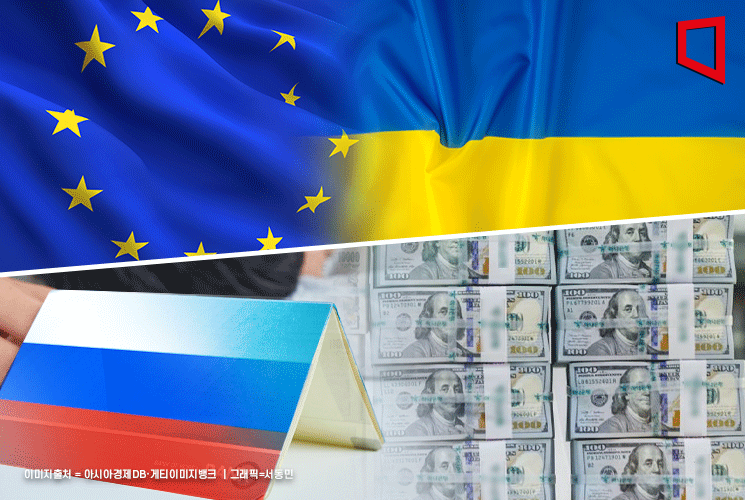
On August 30 (local time), ahead of the EU informal foreign ministers' meeting held in Copenhagen, Denmark, EU High Representative for Foreign Affairs and Security Policy Kaja Kallas told reporters that there would be an in-depth discussion on frozen Russian assets.
She told reporters, "There are pros and cons to using the frozen assets, and there are also sensitive issues, but we need to discuss exactly what the risks are." She added, "If a ceasefire or peace agreement is signed and they (Russia) do not pay reparations, it is unimaginable to return the assets frozen in the EU."
According to the EU, since Russia's full-scale invasion of Ukraine in February 2022, about 210 billion euros (approximately 341 trillion won) of Russian central bank assets have been frozen within the EU. Most of these assets are deposited with Euroclear, a central securities depository (CSD) located in Belgium.
During the administration of former U.S. President Joe Biden, the Group of Seven (G7) nations, including the United States, and the EU agreed not to touch the principal of the frozen Russian assets, but to use the interest income generated from managing these assets as collateral to provide a total of 45 billion euros (approximately 73 trillion won) in military aid to Ukraine. Each country would lend to Ukraine from its own budget and be repaid with the income generated from the frozen Russian assets.
The current focus of discussions regarding the frozen assets has shifted to their postwar use. Some member states, including Poland and the three Baltic states (Estonia, Lithuania, and Latvia), argue that the principal of the frozen assets itself should be confiscated and used to support Ukraine.
On the other hand, France and Germany strongly oppose this due to a lack of legal basis. Belgium, where most of the assets are deposited, is also negative about the idea, making it unlikely that a consensus will be reached in the short term.
Some have suggested a compromise option: not touching the principal, but investing the entire principal in "high-risk products."
The informal foreign ministers' meeting is a customary event hosted by the country holding the six-month rotating presidency (currently Denmark). In addition to issues related to the war in Ukraine, the agenda for the meeting also included the war in Gaza and the humanitarian crisis in Israel.
© The Asia Business Daily(www.asiae.co.kr). All rights reserved.











