Proposals for the Advancement of the AX Textile Autonomous Manufacturing Center and Specialized Base Industry Zones
Yangju City in Gyeonggi Province announced on August 30 that the "2025 Advanced Textile New Material Technology Innovation" seminar, aimed at discussing future growth strategies for Gyeonggi's textile industry, was successfully held on the 27th at the Gyeonggi Textile Comprehensive Support Center Convention Hall.
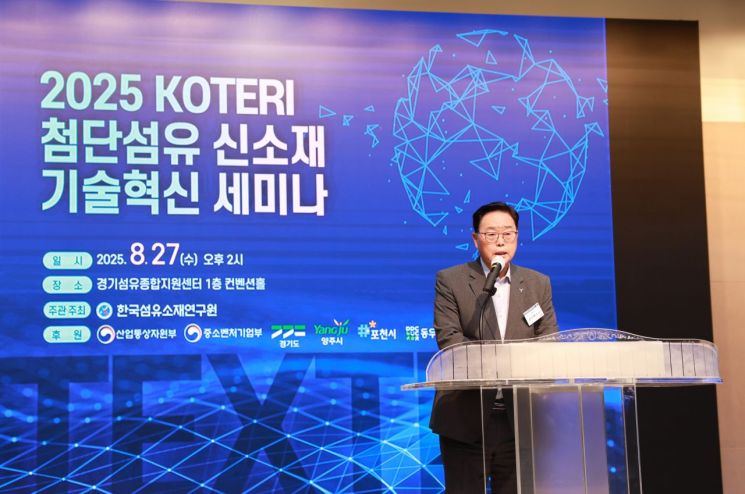 Yang Suhyun, mayor of Yangju, is delivering a greeting at the "2025 Advanced Textile New Material Technology Innovation" seminar held on the 27th at the Gyeonggi Textile Comprehensive Support Center Convention Hall. Provided by Yangju City
This seminar was hosted by the Korea Textile Development Institute and jointly sponsored by the Ministry of Trade, Industry and Energy, the Ministry of SMEs and Startups, Gyeonggi Province, Yangju City, Pocheon City, and Dongducheon City. The event was attended by more than 100 key figures from industry, academia, research, and government, including Yangju Mayor Kang Suhyeon, Director Lee Sangheon from the Ministry of Trade, Industry and Energy, members of the Gyeonggi Provincial Council and Pocheon City Council, and officials involved in textile policy.
Prior to the event, Moon Cheolhwan, Director of the Korea Textile Development Institute, stated in his welcoming remarks, "Due to the nature of textile products, the industry involves many manual processes, making automation and digital transformation slower compared to other industries." He emphasized, "Now is the time to secure new competitiveness by integrating AI-based process innovation and eco-friendly, low-carbon technologies." He added, "The institute will become a reliable partner for companies by resolving technical challenges in the field and developing and spreading advanced technologies."
In his congratulatory address, Yangju Mayor Kang Suhyeon said, "Although the textile industry, a key local industry, is facing difficulties, the designation of the Geomjun General Industrial Complex as a specialized base industry zone this year has marked a new turning point." He continued, "If industry, academia, research, and government join forces in preparation, we can fully expect to be selected for leading projects next year."
He also stated, "AI-based automation of dyeing factories and the establishment of autonomous manufacturing facilities will be effective alternatives for textile companies facing equipment aging and workforce aging issues," and added, "Yangju City will continue to provide active support to strengthen the competitiveness of the textile industry."
The seminar covered a variety of topics, including R&D investment strategies for the textile and fashion industry, smart textile autonomous manufacturing using AI, future-oriented eco-friendly material technologies based on non-wood cellulose, and plans for the designation and development of specialized base industry zones. The participants agreed on the need for expanded policy support for industrial transformation and enhanced public-private cooperation, given that the textile industry still holds a significant share in Gyeonggi Province's overall economy.
Lee Sangheon, Director at the Ministry of Trade, Industry and Energy, stated, "The textile industry is not merely a traditional industry; it has great potential to evolve into a new growth industry by combining with AI, bio, and eco-friendly technologies." He added, "The government will also actively support companies' technological innovation and the creation of an industrial ecosystem."
This seminar is regarded as a meaningful event that established a foundation for cooperation, enabling Gyeonggi Province's textile industry to overcome current challenges and make a new leap forward as a future growth engine through the integration of advanced technologies.
© The Asia Business Daily(www.asiae.co.kr). All rights reserved.

















