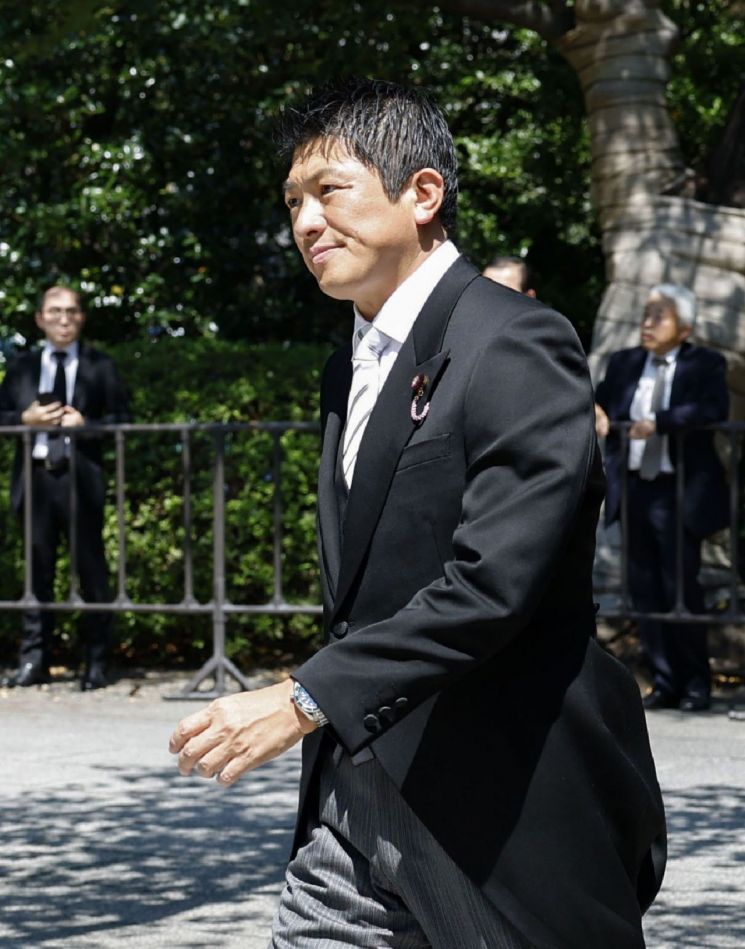
 Sohei Kamiya, leader of the Japanese far-right party Sanseit?, is moving to visit Yasukuni Shrine in Tokyo, Japan, on the 15th, the day marking the end of World War II. Photo by Yonhap News
The Japanese government has decided to fundamentally review its long-term foreign resident policy.
According to the Asahi Shimbun on August 30, Justice Minister Keisuke Suzuki announced at a press conference the previous day that a team will be established within the Immigration Services Agency to promptly review policies regarding the influx of foreigners.
In a report released the previous day, Minister Suzuki explained that up until now, the policy on accepting long-term foreign residents has been more of an "ad hoc remedy" and has lacked a unified direction.
The Japanese government plans to investigate the impact of foreign inflows on finances, social security, wages, education, and public safety. For foreigners other than those with "Specified Skilled Worker" status, who are admitted as part of labor force management, the government is also considering setting a cap on the number of entrants. If signs of friction appear as the number of foreign residents in Japan increases, the government intends to temporarily restrict the influx.
Additionally, the report identified as a challenge the need to create "social integration programs" to ease friction, with roles divided between the central government and local governments.
The Japanese government decided to review its foreign resident policy out of concern that a surge in the foreign population could fuel exclusionary public sentiment and lead to social division, making appropriate management necessary.
It is also analyzed that the decision was influenced by the view that it is time to prepare for an era in which foreigners account for more than 10% of the total population.
Meanwhile, according to population estimates by the Ministry of Internal Affairs and Communications, there are 3,565,000 foreign residents in Japan, accounting for 2.9% of the total population. The National Institute of Population and Social Security Research projected that the proportion of foreigners would reach 10% around 2070, but the government estimates that this could happen sooner.
In last month's House of Councillors (upper house) election, the right-wing party Sanseit?, which campaigned on a "Japanese First" platform and called for stricter regulations on foreigners, made significant gains, increasing its seats from two to fifteen.
© The Asia Business Daily(www.asiae.co.kr). All rights reserved.

















