"Enhancing Negotiating Power with the US"
and "Showing Respect to China," Analysts Say
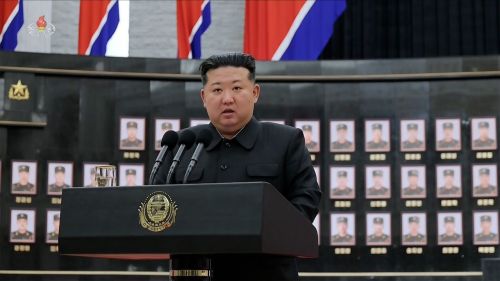 Kim Jong Un, Chairman of the State Affairs Commission of North Korea. Photo by Yonhap News via Korean Central TV
On August 29, Japanese media analyzed that North Korean leader Kim Jongun's planned attendance at China's Victory Day 80th anniversary event on September 3 (local time) is a move with the upcoming North Korea-US talks in mind. It has been 45 years since a North Korean supreme leader attended a multilateral meeting.
The Mainichi Shimbun explained, "It is extremely rare for a North Korean supreme leader to attend an event abroad where leaders from multiple countries gather." In fact, according to Satoru Miyamoto, a professor at Seigakuin University and an expert on North Korea, this will be the first time in 45 years that a North Korean leader has attended a multilateral meeting since Kim Il Sung, Kim Jongun's grandfather, went to the funeral of former Yugoslav President Josip Broz Tito in 1980.
The Chinese government announced the previous day that Kim Jongun and Russian President Vladimir Putin are scheduled to attend the Victory Day 80th anniversary military parade. This will be the first time since the end of the Cold War that the leaders of North Korea, China, and Russia, including Chinese President Xi Jinping, will gather together.
"North Korea's Motivation: Enhancing Negotiating Power with the US and Pursuing Balanced Diplomacy"
Japanese media observed that Kim Jongun's visit to China signifies North Korea's intention to increase its negotiating leverage with US President Donald Trump and to show respect for China.
The Yomiuri Shimbun reported, "Kim Jongun's visit to China is a move with the North Korea-US dialogue, which the Trump administration is eager to pursue, in mind," adding, "There is an intention to demonstrate that China and Russia are backing North Korea in order to strengthen its negotiating power with the United States." The report continued, "(North Korea) needs to show that it is also securing support from China, in addition to Russia, with the North Korea-US dialogue in mind," and explained, "Kim Jongun decided to visit China for the first time in six and a half years to signal an improvement in the North Korea-China relationship, which has long been described as cooled."
The Nihon Keizai Shimbun (Nikkei) also pointed out that Kim Jongun's visit to China appears to be an attempt to counter the US-led world order by strengthening ties with Russia and now seeking to improve relations with China, forming a 'North Korea-China-Russia' bloc. Nikkei noted, "Before any past North Korea-US talks, Kim Jongun always held preliminary negotiations with the Chinese side," and reported that "there is a view that a North Korea-US summit may follow this visit to China."
Shunji Hiraiwa, a professor at Nanzan University, told the Asahi Shimbun, "Kim Jongun's decision to attend a multilateral diplomatic event, where he risks being seen as 'one of them,' is likely an effort to show sincerity to China," adding, "Just as North Korea balanced its foreign relations between China and Russia during the Cold War, there may be an intention to pursue balance in external relations." He also noted that although it is known that China invited Kim Jongun, it is possible that North Korea actually sought the visit to China.
"From China's Perspective: Cautious of Direct North Korea-US Contact"
It is also observed that China has ample motivation to invite Kim Jongun. The suggestion is that China, which has previously kept its distance from the North Korea-China-Russia framework, called Kim Jongun with President Trump in mind.
The Yomiuri Shimbun explained that "China and North Korea are traditionally friendly nations, but exchanges stagnated during the COVID-19 pandemic," and that China's motivation to demonstrate unity among North Korea, China, and Russia stems from its wariness of President Trump's positive stance toward negotiations with North Korea and Russia. The report suggested that President Xi is trying to draw North Korea closer to China out of concern that the United States, North Korea, and Russia might approach each other while leaving China out.
The Yomiuri Shimbun also noted that although the Chinese government claims the event is to "defend the international order," it could instead become a symbol of division within the international community.
However, Nikkei reported that "it is uncertain whether a North Korea-China-Russia summit will actually take place in Beijing," and added, "Although all three countries are trying to counter the United States, each has its own strategies and calculations, so there are also aspects of conflicting interests."
© The Asia Business Daily(www.asiae.co.kr). All rights reserved.
![Clutching a Stolen Dior Bag, Saying "I Hate Being Poor but Real"... The Grotesque Con of a "Human Knockoff" [Slate]](https://cwcontent.asiae.co.kr/asiaresize/183/2026021902243444107_1771435474.jpg)
















