Foundation Project Launched to Localize Space-Grade Components
Mass Production and Test Methods to Reduce Reliance on Imports
Eight Organizations Selected for Key Component and Testing Development
Han Changheon: "Technological Independence Will Expand Korea's Space Industry"
The "Future Space Economy Foundation Project," aimed at achieving technological independence for space components that currently rely entirely on imports and enabling mass production of key parts, has officially begun.
On August 29, the Korea Aerospace Agency and the Korea Aerospace Research Institute held a kickoff meeting for the new Foundation Project, which will be launched in 2025, and began full-scale efforts to localize space-grade components.
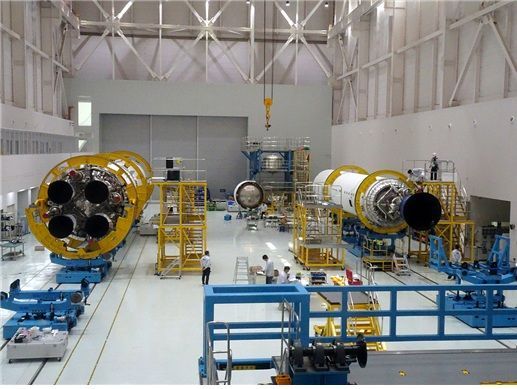 A launch vehicle is completed by assembling numerous components. The photo shows the assembly site of Nuriho-4 stage. Provided by the Korea Aerospace Agency.
The Foundation Project is being promoted with the goal of developing "test methods for space radiation environment" for the "localization and development of self-sufficient space components." A total of 22.5 billion won will be invested in the project over five years, from 2025 to 2029.
The goal of the localization and development of space-grade components is to achieve technological independence for space parts that are currently fully dependent on imports by developing six types of core space-grade components (three types of passive components and three types of active components) up to the mass production and supply stage. The development of test methods for the space radiation environment aims to establish domestic testing methods for environmental testing (proton-based and heavy ion-based space radiation environment tests) required for the use of components and devices in space, utilizing available domestic equipment.
Among the six types of space-grade components to be localized, three (D-sub connectors, multilayer ceramic capacitors (MLCC), and temperature compensated crystal oscillators (TCXO)) will begin development this year. Two projects for developing test methods for the space radiation environment (proton-based and heavy ion-based) will also be launched. Eight organizations have been selected through a public call to participate in these development projects.
Union Precision Co., Ltd. will develop the D-sub connector; Samwha Capacitor Group will work on the multilayer ceramic capacitor (MLCC); and Pas Electronics Co., Ltd. along with MID Co., Ltd. will develop the temperature compensated crystal oscillator (TCXO). For the development of space radiation environment test methods, Korea Atomic Energy Research Institute (KAERI) and Korea Testing Laboratory (KTL) have been selected for the proton-based project, while Korea Institute of Science and Technology (KIST) and QRT Co., Ltd. will handle the heavy ion-based project.
Han Changheon, Director General of the Space and Aerospace Industry Bureau at the Korea Aerospace Agency, stated, "Through the Foundation Project, we will mitigate the risks associated with overseas supply of space-grade components and contribute to the expansion of the domestic space industry market by achieving technological independence for key components."
© The Asia Business Daily(www.asiae.co.kr). All rights reserved.

















